- Animals
- ›Chordates
- ›Vertebrates
- ›Ray-finned Fishes
- ›Spiny-rayed fishes
- ›Perches, Scorpionfishes, Sticklebacks, and Allies
- ›Perches, groupers and allies
- ›Perches, Darters, and allies
- ›Pikeperches, Zingels, and Allies
- ›Sander
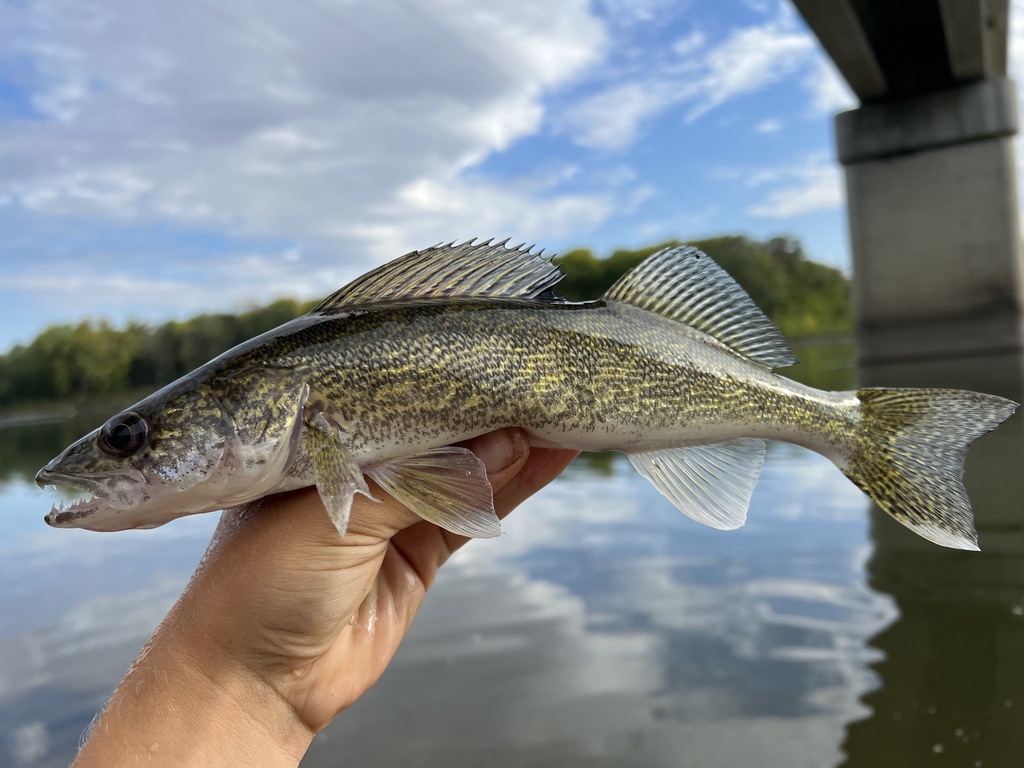
Walleye
Sander vitreus
The walleye (Sander vitreus, synonym Stizostedion vitreum), also called the walleyed pike, yellow pike, yellow pikeperch or yellow pickerel, is a freshwater perciform fish native to most of Canada and to the Northern United States. It is a North American close relative of the European zander, also known as the pikeperch. The walleye is sometimes called the yellow walleye to distinguish it from the blue walleye, which is a color morph that was once found in the southern Ontario and Quebec regions, but is now presumed extinct. However, recent genetic analysis of a preserved (frozen) 'blue walleye' sample suggests that the blue and yellow walleye were simply phenotypes within the same species and do not merit separate taxonomic classification.
In parts of its range in English-speaking Canada, the walleye is known as a pickerel, though the fish is not related to the true pickerels, which are members of the family Esocidae. It is also sometimes called a dory in British English (and its common name in French is the similar doré—meaning golden or gilded), although this name is also used for various other species.
From the article Walleye on Wikipedia (CC BY-SA), quoted section by section
Description
Walleyes are largely olive and gold in color (hence the French common name: doré—golden). The dorsal side of a walleye is olive, grading into a golden hue on the flanks. The olive/gold pattern is broken up by five darker saddles that extend to the upper sides. The color shades to white on the belly. The mouth of a walleye is large and is armed with many sharp teeth. The first dorsal and anal fins are spinous, as is the operculum. Walleyes are distinguished from their close relative the sauger by the white coloration on the lower lobe of the caudal fin, which is absent on the sauger. In addition, the two dorsals and the caudal fin of the sauger are marked with distinctive rows of black dots which are absent from or indistinct on the same fins of walleyes.
Length and weight. Walleyes grow to about 80 cm (31 in) in length, and weigh up to about 9 kg (20 lb). The maximum recorded size for the fish is 107 cm (42 in) in length and 13 kg (29 lb) in weight. The rate depends partly on where in their range they occur, with southern populations often growing faster and larger. In general, females grow larger than males. Walleyes may live for decades; the maximum recorded age is 29 years. In heavily fished populations, however, few walleye older than five or six years of age are encountered. …
What it does
In most of the species' range, male walleyes mature sexually between three and four years of age. Females normally mature about a year later. Adults migrate to tributary streams in late winter or early spring to lay eggs over gravel and rock, although open-water reef or shoal-spawning strains are seen, as well. Some populations are known to spawn on sand or vegetation. Spawning occurs at water temperatures of 6 to 10 °C (43 to 50 °F). A large female can lay up to 500,000 eggs, and no care is given by the parents to the eggs or fry. The eggs are slightly adhesive and fall into spaces between rocks. The incubation period for the embryos is temperature-dependent, but generally lasts from 12 to 30 days. After hatching, the free-swimming embryos spend about a week absorbing a relatively small amount of yolk. Once the yolk has been fully absorbed, the young walleyes begin to feed on invertebrates, such as fly larvæ and zooplankton. After 40 to 60 days, juvenile walleyes become piscivorous. Thenceforth, both juvenile and adult walleyes eat fish almost exclusively, frequently yellow perch or ciscoes, moving onto bars and shoals at night to feed. Walleye also feed heavily on crayfish, minnows, and leeches.
Wikipedia: “Reproduction”
At the table
The walleye is considered to be a quite palatable freshwater fish, and consequently, is fished recreationally and commercially for food. Because of its nocturnal feeding habits, it is most easily caught at night using live minnows or lures that mimic small fish. Most commercial fisheries for walleye are situated in the Canadian waters of the Great Lakes, and fried walleye is considered a staple of Canadian cuisine. In Minnesota, the walleye is often fished in the late afternoon on windy days (known as a "walleye chop") or at night. A walleye sandwich is commonly served in Minnesota's pubs, and deep-fried on a stick at the Minnesota State Fair. Fried walleye is a favored dish in both Canada and Minnesota.
Wikipedia: “As food”
In human culture
The name "walleye" comes from its pearlescent eyes caused by the reflective tapetum lucidum which, in addition to allowing the fish to see well in low-light conditions, gives its eyes an opaque appearance. Their vision affects their behavior. They avoid bright light and feed in low light on fish that cannot see as well as they do. Many anglers look for walleyes at night since this is when major feeding efforts occur. The fish's eyes also allow them to see well in turbid waters (stained or rough, breaking waters), which gives them an advantage over their prey. Thus, walleye anglers commonly look for locations where a good "walleye chop" (i.e., rough water) occurs. Their vision also allows the fish to populate the deeper regions in a lake, and they can often be found in deeper water, particularly during the warmest part of the summer and at night.
Wikipedia: “Etymology”
Where it lives
Recorded sightings
—
geo-referenced records in GBIF, from museums, herbaria and field observers.
Drag the globe to turn it. Dots are where records exist, not a range map; darker means more records.
In the stacks
Searching the stacks…
Every page naming Sander vitreus in the Biodiversity Heritage Library →
This page is assembled live from iNaturalist, GBIF, Wikipedia, the Source Library and the Internet Archive. It is not yet part of the hand-edited codex. iNaturalist taxon 48154.