- Animals
- ›Chordates
- ›Vertebrates
- ›Ray-finned Fishes
- ›Spiny-rayed fishes
- ›Perches, Scorpionfishes, Sticklebacks, and Allies
- ›Perches, groupers and allies
- ›Perches, Darters, and allies
- ›Darters
- ›Percina
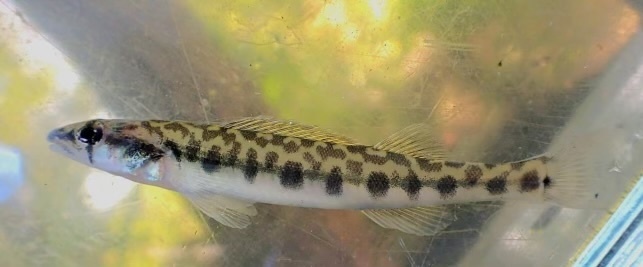
Leopard Darter
Percina pantherina
The leopard darter (Percina pantherina) is a species of freshwater ray-finned fish, a darter from the subfamily Etheostomatinae, part of the family Percidae, which also contains the perches, ruffes and pikeperches. It is native to the United States, where it can be found only in the Little River drainage in Oklahoma and Arkansas. Its typical habitat is medium to large streams with rubble and boulder substrate. It feeds on small invertebrates on the riverbed and spawns mainly in March and April. It is threatened by impoundment, habitat loss and runoff from agricultural activities. It has never been a common species and has been listed as a threatened species in the United States since 1978, and the International Union for Conservation of Nature lists it as a "vulnerable species".
From the article Leopard darter on Wikipedia (CC BY-SA), quoted section by section
Description
Leopard darters rarely exceed three inches (8 cm) in length. They have 11–14 large, dark spots on their sides. These spots contrast against a light background that ranges from pale olive on the back to yellowish-olive on the underside. The back of the fish has numerous saddles and bars.
Range & habitat
Historically, the leopard darter was limited to upland, large stream habitats of the Little River drainage in Oklahoma and Arkansas. Currently, scattered populations are found within its historic range. In Oklahoma, it occurs within the Little River drainage (Mountain Fork, Glover, and Little Rivers) in LeFlore, McCurtain, and Pushmataha Counties. In Arkansas, the leopard darter occurs in the Cossatot, Robinson Fork, and Mountain Fork Rivers in Howard, Polk, and Sevier Counties.
Wikipedia: “Distribution”
What it does
Leopard darters typically live less than two years, but individuals older than three years have been found. Spawning occurs in March and April, but may occur as early as February, on gravel-bottomed riffles. The fertilised eggs are buried in gravel. The average clutch size is about 65 eggs. Young leopard darters begin to appear in May of each year. Food items include aquatic insects and microcrustaceans. Leopard darters are found in medium to large streams. Typically, they are not found in smaller, headwater streams. From May to February, leopard darters prefer small, noisy pools with a rubble and boulder substrate. Spawning occurs on gravel substrates; however, the dominant riffle substrate may be gravel, rubble, boulder, and bedrock.
Wikipedia: “Ecology”
Where it lives
Recorded sightings
—
geo-referenced records in GBIF, from museums, herbaria and field observers.
Drag the globe to turn it. Dots are where records exist, not a range map; darker means more records.
In the stacks
Searching the stacks…
Every page naming Percina pantherina in the Biodiversity Heritage Library →
This page is assembled live from iNaturalist, GBIF, Wikipedia, the Source Library and the Internet Archive. It is not yet part of the hand-edited codex. iNaturalist taxon 109096.