- Animals
- ›Chordates
- ›Vertebrates
- ›Ray-finned Fishes
- ›Spiny-rayed fishes
- ›Perches, Scorpionfishes, Sticklebacks, and Allies
- ›Perches, groupers and allies
- ›Perches, Darters, and allies
- ›Darters
- ›Ammocrypta
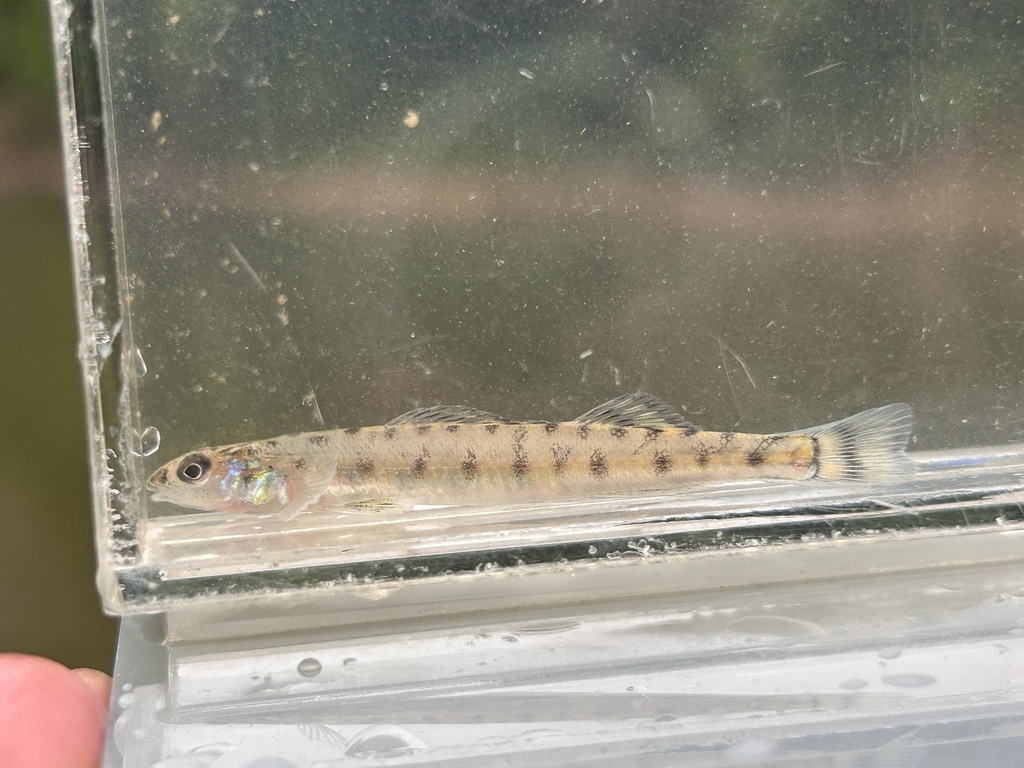
Scaly Sand Darter
Ammocrypta vivax
The scaly sand darter (Ammocrypta vivax) is a species of freshwater ray-finned fish, a darter from the subfamily Etheostomatinae, part of the family Percidae, which also contains the perches, ruffes and pikeperches. It is endemic to the southeastern United States. It is found in the coastal plain area of the Mississippi River basin, typically in medium-sized streams with slow currents over sandy substrates where it feeds on midge larvae and other small invertebrates. The slender body is semi-translucent, yellowish with a dozen or so dark bars. This fish has a wide range and is relatively common, and the International Union for Conservation of Nature lists it as a "least-concern species".
From the article Scaly sand darter on Wikipedia (CC BY-SA), quoted section by section
Description
The scaly sand darter is an elongated, subcylindrical darter. It has a horizontal mouth with a broad, flat head. Compared to other Ammocrypta species, the body is not as translucent as its relatives and appears to have a yellow tent to the body. Nine to 16 vertically oriented, dusky bars occur along the side of the body and irregular dark, dusky spots are found on the back. The lateral scales seemed to be faintly outlined in black. It has numerous dark spots in front of the eyes that extend to the snout. The cheeks and opercles have an iridescent shade of silver to blue. The scaly sand darter typically has a yellow color under the body and head. The spines of the anal and paired fins have scattered black/dark spots near the base. The membranes of the pectoral and pelvic fins are cream to yellow. The base of the caudal fin is usually white to yellow in color. The males can have submarginal bands in the spinous (harder or tougher fins near the base) and soft dorsal fins and also on the caudal fin. Black marginal bands may occur on the soft dorsal and caudal fins (the end of the fin).
Range & habitat
They inhabit moderate-sized streams that have slow water current where they feed on the sand bed midge larvae and entomostracans. Primarily found in Coastal Plain habitats in Gulf Coastal drainages from the Pascagoula River drainage, Mississippi, west through the San Jacinto River, Texas. Their range extending up the Mississippi River basin to southeastern Missouri and western Kentucky.
Wikipedia: “Habitat”
Where it lives
Recorded sightings
—
geo-referenced records in GBIF, from museums, herbaria and field observers.
Drag the globe to turn it. Dots are where records exist, not a range map; darker means more records.
In the stacks
Searching the stacks…
Every page naming Ammocrypta vivax in the Biodiversity Heritage Library →
This page is assembled live from iNaturalist, GBIF, Wikipedia, the Source Library and the Internet Archive. It is not yet part of the hand-edited codex. iNaturalist taxon 93853.