- Animals
- ›Chordates
- ›Vertebrates
- ›Ray-finned Fishes
- ›Spiny-rayed fishes
- ›Freshwater Sunfishes, Grunters, and Allies
- ›Grunters, Stripeys, and Allies
- ›Sea Chubs
- ›Neoscorpis
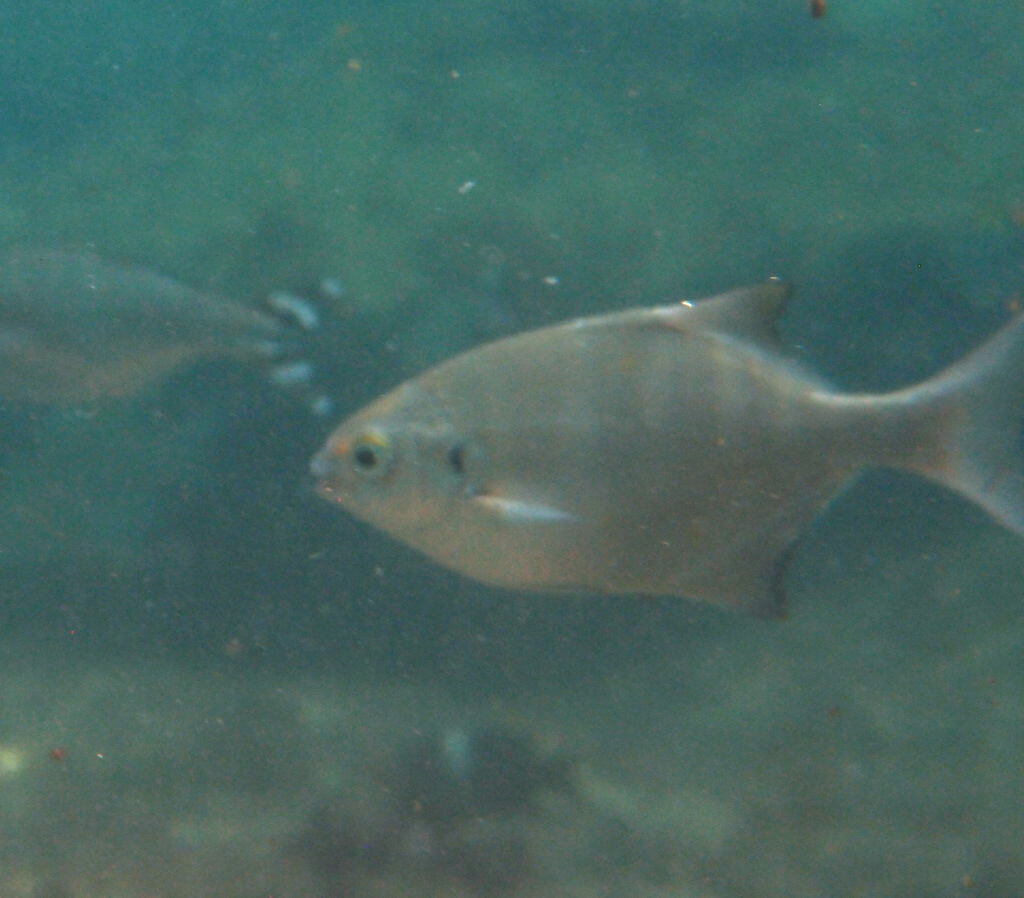
Stone Bream
Neoscorpis lithophilus
The stone bream (Neoscorpis lithophilus) is a species of marine ray-finned fish, a sea chub from the family Kyphosidae, which is native to the Indian Ocean coast of Africa where it can be found along rocky coasts from Mozambique to South Africa. This species grows to a length of 50 centimetres (20 in) SL though most do not exceed 18 centimetres (7.1 in). The greatest recorded weight for this fish is 2.6 kilograms (5.7 lb). This species is commercially important and is also popular as a game fish. This species is the only known member of its genus.
From the article Stone bream on Wikipedia (CC BY-SA), quoted section by section
Description
The stone bream is a fast growing fish. They can live at least 10 years. The max recorded length of the stone-bream is about 50 centimetres although the most common size for this fish is typically 18 centimetres long. An adult stone bream can reach up to 27 cm and can weigh around 2.6 kg. The stone bream is often blue and silver in color. Each stone bream has anywhere from 6-8 dorsal fins and 20-25 dorsal soft rays. They are also equipped with 3 anal spines and around 20-26 anal soft rays. They have very small mouths. Like other species in the Kyphosid family, Neoscorpis lithophilus has two distinct rows of teeth. The front row contains 34 flat and sharp frontal teeth within their jaws. The second row of smaller sharp teeth protrudes from behind the first row of teeth. Their mouth contains around 3460 taste buds.
Wikipedia: “Anatomy & morphology”
Range & habitat
The stone bream can be found mainly in the Western Indian Ocean where it is native in the subtropical regions from 25°S - 35°S, 18°E - 34°E. The stone bream is found along the African coast from Inhaca in Mozambique to False Bay in South Africa, it also occurs along the eastern coast of Madagascar. Stone breams tend to gather in shallow tropical waters as opposed to deep waters. They tend to be desmeral, meaning that they tend to live at the bottom of the sea floor. They feed off of macro-algae found at the bottom of the oceans.
Wikipedia: “Habitat & distribution”
What it does
Stone breams are mainly herbivores, meaning that their diet is composed of marine plants like macro-algae. Their diet consists of red algae and other sea plants. Because of this, they tend to dwell in shallow, rocky waters, feeding off of many different kinds of plants. Stone breams become sexually mature at fork lengths of 260 millimetres (10 in) for males and 290 millimetres (11 in) for females, when they are 3 to 4 years of age. Spawning takes place in midwinter, July to January, but little is known about the subsequent development of the larvae. A tagging study off South Africa found that a relatively low number of tagged fish are recovered which suggests that this species is somewhat nomadic. However, it is thought that, as is typical for reef fishes, this species is more likely to be sedentary.
Wikipedia: “Behavior”
Where it lives
Recorded sightings
—
geo-referenced records in GBIF, from museums, herbaria and field observers.
Drag the globe to turn it. Dots are where records exist, not a range map; darker means more records.
In the stacks
Searching the stacks…
Every page naming Neoscorpis lithophilus in the Biodiversity Heritage Library →
This page is assembled live from iNaturalist, GBIF, Wikipedia, the Source Library and the Internet Archive. It is not yet part of the hand-edited codex. iNaturalist taxon 615599.