- Animals
- ›Chordates
- ›Vertebrates
- ›Ray-finned Fishes
- ›Spiny-rayed fishes
- ›Perches, Scorpionfishes, Sticklebacks, and Allies
- ›Eelpouts and allies
- ›Eelpouts
- ›Typical Eelpouts
- ›Zoarces
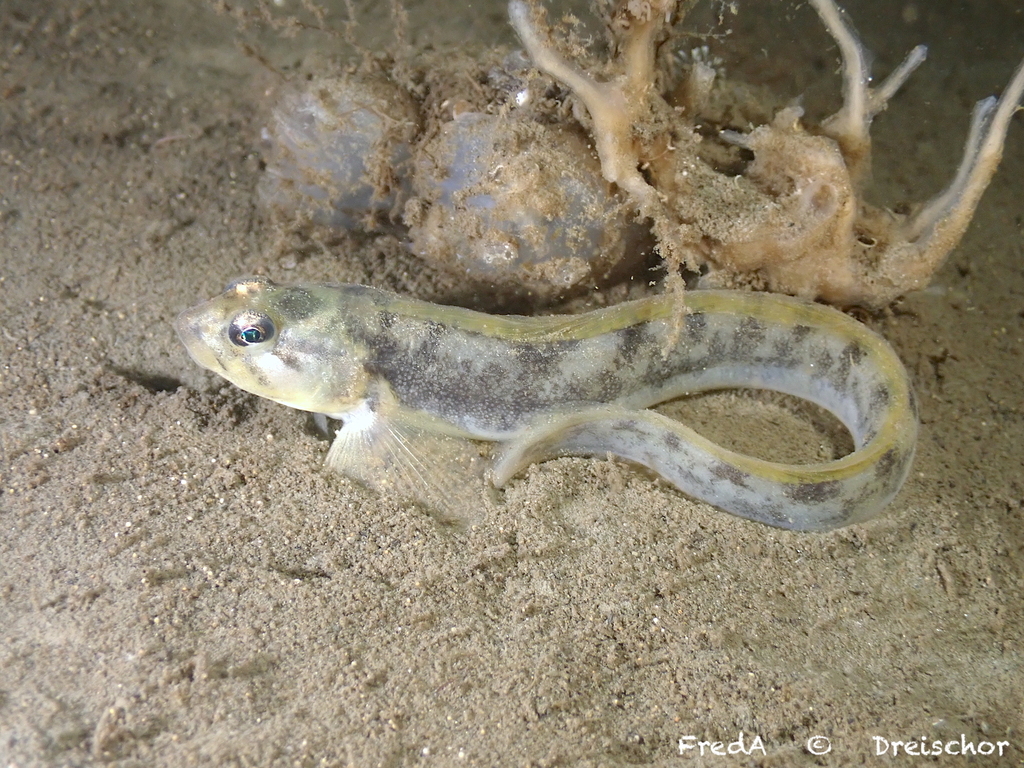
Viviparous Blenny
Zoarces viviparus
The viviparous eelpout (Zoarces viviparus), also known as the viviparous blenny and European eelpout, is a species of marine ray-finned fish belonging to the family Zoarcidae, the eelpouts. It is notable for being ovoviviparous and gives birth to live larvae (hence the description "mother of eels"). It is a common soup ingredient in Mediterranean countries. The bones are of greenish colour, due to a harmless pigment. Their skin is slimy and the colour is variable.
From the article Viviparous eelpout on Wikipedia (CC BY-SA), quoted section by section
Description
The viviparous eelpout has a slim, tapering body and resembles a small burbot (Lota lota), a wide head and mouth and protuberant lips. It has long, ribbon-like dorsal and anal fins which continue on to unite with the arrowhead-shaped caudal fin. This distinguishes this fish from the two similar slim-bodied bottom-dwelling fish of the area, the rock gunnel (Pholis gunnellus) and the snake blenny (Ophidion barbatum). The bones are green. The tiny scales are embedded in the slimy skin. There dorsal fin becomes lower as it nears the caudal fin with these shorter rays being short and spinous. The colour is highly variable, although they are commonly greyish brown on the upper body and yellowish ventrally. They are marked with either a single or double series of blotches along the body and on the dorsal fin. The pectoral fins have yellow or yellowish orange edges. This species reaches a maximum published total length of 52 cm (20 in), although 30 cm (12 in) is more typical, and may weigh up to 510 g (18 oz).
Range & habitat
The viviparous eelpoutis found in the eastern Atlantic Ocean where its range extends from the English Channel north around the British Isles, although it is absent from the Atlantic coasts of Ireland, eastwards onto the Baltic Sea and northwards through the North Sea and along the coast of Norway to the White Sea and the Barents Sea. This species occurs in the intertidal zone where it can live in marine and brackish environments, avoiding drying out when exposed at low tide by sheltering beneath rocks or in fissures in the rock or by staying submerged in rock pools. This demersal fish is normally sedentary, hiding under rocks or among seaweed. It can be found at depths between 0 and 40 m (0 and 131 ft), although it is normally found at depths of 2 to 20 m (6 ft 7 in to 65 ft 7 in).
Wikipedia: “Distribution and habitat”
Where it lives
Recorded sightings
—
geo-referenced records in GBIF, from museums, herbaria and field observers.
Drag the globe to turn it. Dots are where records exist, not a range map; darker means more records.
In the stacks
Searching the stacks…
Every page naming Zoarces viviparus in the Biodiversity Heritage Library →
This page is assembled live from iNaturalist, GBIF, Wikipedia, the Source Library and the Internet Archive. It is not yet part of the hand-edited codex. iNaturalist taxon 483237.