- Animals
- ›Chordates
- ›Vertebrates
- ›Ray-finned Fishes
- ›Spiny-rayed fishes
- ›Gobies, cardinalfishes and allies
- ›Gobies and allies
- ›Mudskippers and Allies
- ›Mudskippers
- ›Boleophthalmus
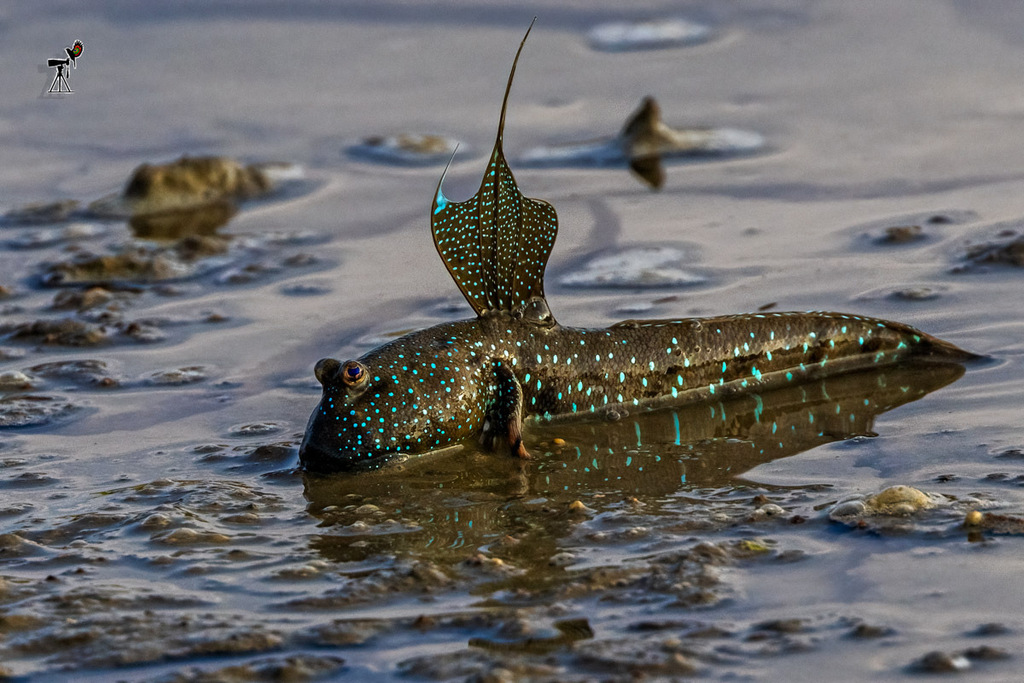
Boddart's Blue-spotted Mudskipper
Boleophthalmus boddarti
Boleophthalmus boddarti, commonly known as Boddart's goggle-eyed goby, is a species of mudskipper native to the Indo-Pacific, and the type species of the genus Boleophthalmus.
In Vietnam, this species is called "Cá Bống Sao", which means "star sky goby".
From the article Boleophthalmus boddarti on Wikipedia (CC BY-SA), quoted section by section
Description
Like other mudskippers, Boleophthalmus boddarti is capable of moving on land, and uses its pectoral and pelvic fins to move about on the surface of tidal flats in its native range at low tide. The fish is boldly patterned, with rows of blue spots along its flanks and cheeks, as well as dark bands running down its body.
Anatomy. B. boddarti has fused pelvic fins, as in its fin rays are interconnected and merged with its skin, which aid in its walking across the mudflats it lives in. Its large pelvic ray fin bone structure provides B. boddarti with a sitting pad for stability in semi-terrestrial substrate and cushion for landing after hopping. The pelvic fins can also flatten into a slightly concave shape when it makes impact to further cushion its landing. Similarly to other mudskippers, B. boddarti has moist skin with capillaries near the surface in dermal bulges that allow it to perform cutaneous respiration, although it has been observed to have less mucus-secreting cells than more terrestrial species of mudskipper such as Periophthalmus variabilis, on account of it living primarily in aquatic areas and thus having greater access to moisture.
Range & habitat
B. boddarti occurs across the Indo-Pacific region, ranging from India in the west to Papua New Guinea in the east, with additional populations found on the coastline of China in the north and Sulaibikhat Bay in the Persian Gulf off the coast of Kuwait. Populations in Malaysia and Sumatra are sympatric with the closely related species Boleophthalmus pectinirostris. In India, the species is sympatric with the similarly-related Boleophthalmus dussumieri.
Wikipedia: “Distribution”
What it does
Boleophthalmus boddarti is primarily herbivorous, and browses on green algae by scraping it off the surface of the ground at low tide using horizontal motions of its head and the teeth of its lower jaw. It also eats benthic crustaceans, polychaete worms, fish eggs and copepods.
Wikipedia: “Diet”
At the table
B. boddarti is edible, and is occasionally caught and eaten, though it isn't targeted by commercial fisheries. The species is sometimes found on sale at markets in the vicinity of its native range. It is commercially important in Vietnam and Thailand.
Wikipedia: “As food”
In human culture
The specific epithet, boddarti, is in reference to Pierre Boddaërt, who collected the holotype for the species.
Wikipedia: “Etymology”
Where it lives
Recorded sightings
—
geo-referenced records in GBIF, from museums, herbaria and field observers.
Drag the globe to turn it. Dots are where records exist, not a range map; darker means more records.
In the stacks
Searching the stacks…
Every page naming Boleophthalmus boddarti in the Biodiversity Heritage Library →
This page is assembled live from iNaturalist, GBIF, Wikipedia, the Source Library and the Internet Archive. It is not yet part of the hand-edited codex. iNaturalist taxon 120494.