- Animals
- ›Chordates
- ›Vertebrates
- ›Ray-finned Fishes
- ›Spiny-rayed fishes
- ›Gobies, cardinalfishes and allies
- ›Gobies and allies
- ›Mudskippers and Allies
- ›Estuarine Gobies
- ›Chaenogobius
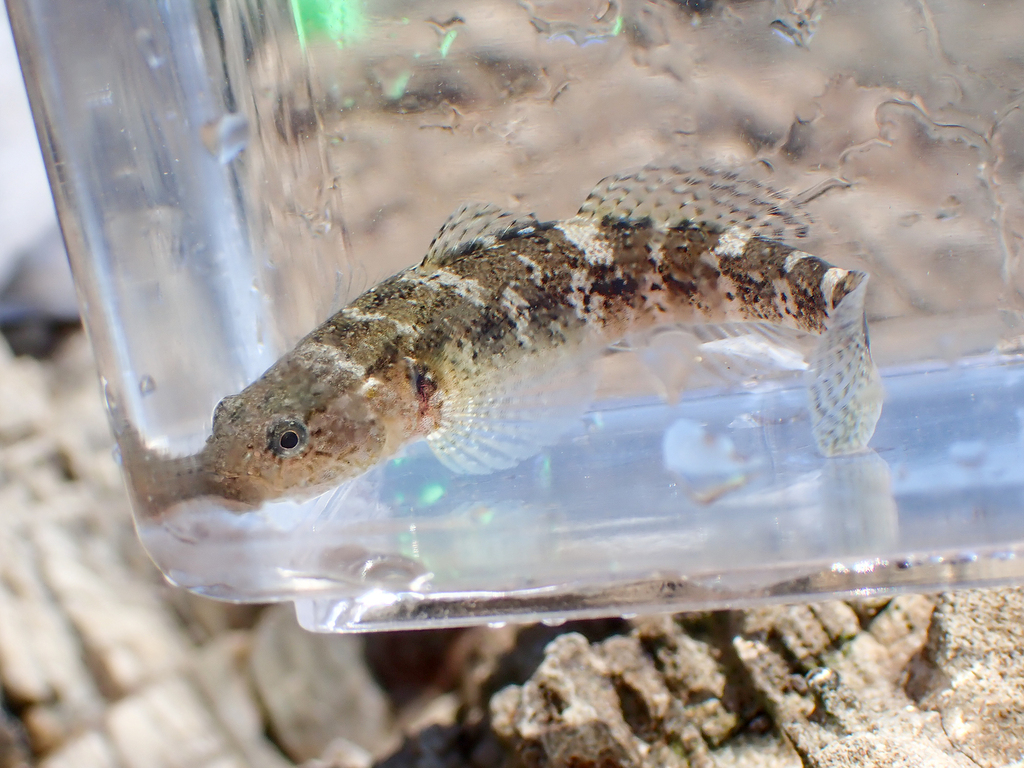
Forktongue Goby
Chaenogobius annularis
Chaenogobius annularis, the fork-tongued goby, is a species of goby from the subfamily Gobionellinae which is found in the brackish waters of temperate eastern Asia. It is the type species of the genus Chaenogobius.
From the article Chaenogobius annularis on Wikipedia (CC BY-SA), quoted section by section
Description
Chaenogobius annularis has a light brown head and body with six, or so, broad vertical bands along the body and with several small, dusky spots and a distinct blotch on the caudal peduncle. The dorsal fins are light brown with darker, sinuous horizontal bands while the caudal and pectoral fins are also light brown but are marked with darker vertical bands. It grows to a maximum total length of 16 centimetres (6.3 in).
Range & habitat
Chaenogobius annularis occurs in temperate eastern Asia including Russia, China and the Korean Peninsula as well as the islands of Japan, the Kuril Islands and Sakhalin.
Wikipedia: “Distribution”
In human culture
The generic name Chaenogobius is a compound of the Greek chaeno meaning "gape" and gobius or goby while the specific name annularis is Latin meaning "ringed", referring to the transverse bands on its body.
== References ==
Wikipedia: “Etymology”
Where it lives
Recorded sightings
—
geo-referenced records in GBIF, from museums, herbaria and field observers.
Drag the globe to turn it. Dots are where records exist, not a range map; darker means more records.
In the stacks
Searching the stacks…
Every page naming Chaenogobius annularis in the Biodiversity Heritage Library →
This page is assembled live from iNaturalist, GBIF, Wikipedia, the Source Library and the Internet Archive. It is not yet part of the hand-edited codex. iNaturalist taxon 97130.