- Animals
- ›Chordates
- ›Vertebrates
- ›Ray-finned Fishes
- ›Spiny-rayed fishes
- ›Gobies, cardinalfishes and allies
- ›Gobies and allies
- ›Mudskippers and Allies
- ›Mudskippers
- ›Periophthalmodon
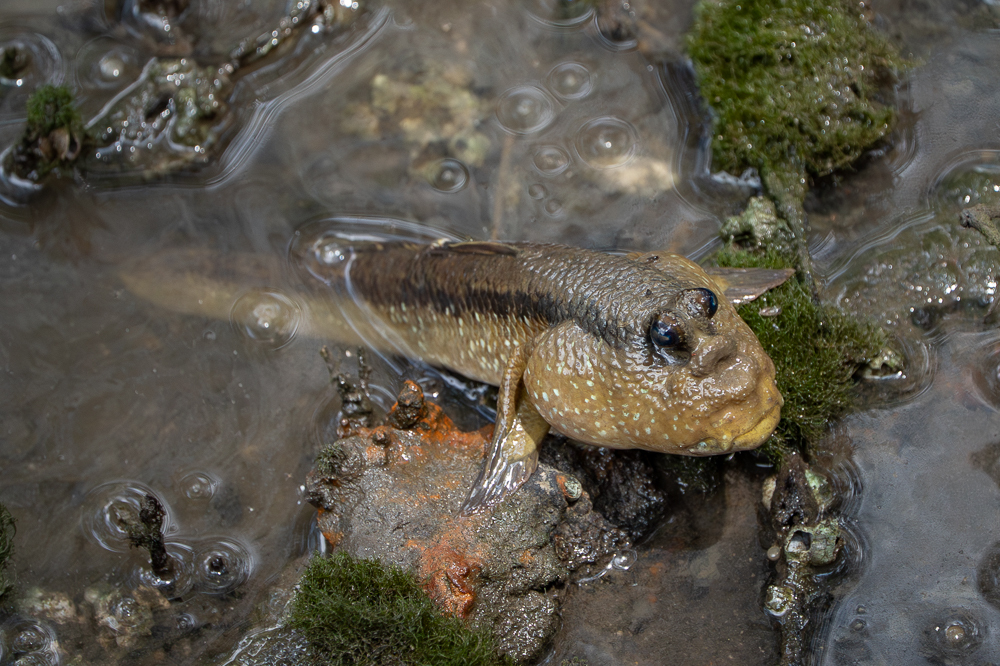
Giant Mudskipper
Periophthalmodon schlosseri
The giant mudskipper (Periophthalmodon schlosseri) is a species of mudskipper native to the tropical shores of the eastern Indian Ocean and the western Pacific Ocean where it occurs in marine, brackish and fresh waters. It is most frequently found along muddy shores in estuaries as well as in the tidal zones of rivers. It lives in burrows that it constructs in higher grounds of the intertidal zone, which are typically filled with both water and air. During warmer seasons, it is typically active outside of its burrow during low tide. It is an obligate air-breather and is capable of drowning without sufficient access to air, so it spends much of its life on land.
As its name suggests, the giant mudskipper is distinguishable by its larger size when compared to other mudskipper species. Males have been recorded to grow up to 27.5 cm (10.8 in) TL, while females have been found to grow up to 28.5 cm (11.2 in) TL. Typically, it is a yellow or greenish-brown color with light blue speckles on its side, but when disturbed or agitated, it will display a bold, black, and uninterrupted horizontal stripe that runs from its eye to its caudal peduncle.
From the article Giant mudskipper on Wikipedia (CC BY-SA), quoted section by section
Range & habitat
The giant mudskipper can be found in intertidal mudflats and mangroves in Eastern India, Thailand, Malaysia, Singapore, Indonesia, and Vietnam. Although giant mudskippers are more commonly found in areas close to mangroves, they can sometimes be found living in mudflats without any nearby mangroves as well.
Wikipedia: “Distribution”
What it does
The giant mudskipper is a generalist carnivore, with a preference for small crabs and fish. The giant mudskipper typically forages for prey that are close to its burrow, though it is not uncommon for them to explore out of the range of their burrows. It is an ambush predator, and upon discovering its prey, it will slowly follow it before ambushing it by leaping. It may also leap at prey while swimming. The giant mudskipper will then attempt to trap their prey using its tail, and once trapped, the giant mudskipper captures the prey within its mouth. Occasionally, they will even capture prey that are larger than their gape width, which they will repeatedly bite until they are subdued. After moving to a safe place to feed, they can also sometimes be seen playing with their food. Male giant mudskippers prefer to feed during low tide when small crabs are available. However, during high tide, when crabs are not as accessible, they will instead feed on alternative food sources, like insects or worms. Female giant mudskippers were found to prefer eating small fish during the spawning season, as they tend to stay closer to the water's edge in comparison to males. When eating its prey, the giant mudskipper will usually fill its mouth with water to aid in swallowing.
Wikipedia: “Diet”
In human culture
The name Periophthalmodon is derived from Periophthalmus, a visually similar genus under the Oxucerdinae subfamily, and the Latin suffix -odon, which means "toothed". The specific name honors the Dutch physician and naturalist Johann Albert Schlosser (1733-1769), who was a friend of Peter Simon Pallas and who received the type from the East Indies and sent it to Pallas.
Wikipedia: “Etymology”
Where it lives
Recorded sightings
—
geo-referenced records in GBIF, from museums, herbaria and field observers.
Drag the globe to turn it. Dots are where records exist, not a range map; darker means more records.
In the stacks
Searching the stacks…
Every page naming Periophthalmodon schlosseri in the Biodiversity Heritage Library →
This page is assembled live from iNaturalist, GBIF, Wikipedia, the Source Library and the Internet Archive. It is not yet part of the hand-edited codex. iNaturalist taxon 361342.