- Animals
- ›Chordates
- ›Vertebrates
- ›Ray-finned Fishes
- ›Spiny-rayed fishes
- ›Gobies, cardinalfishes and allies
- ›Gobies and allies
- ›Gobies
- ›Sea Gobies
- ›Pleurosicya
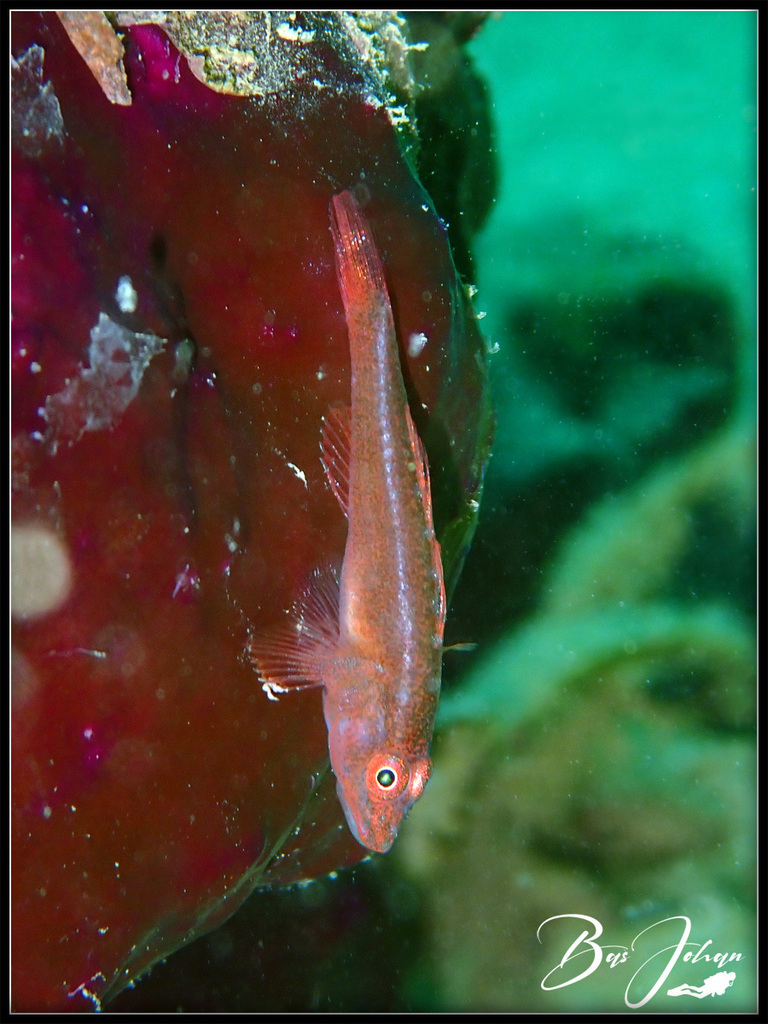
Many-host Ghostgoby
Pleurosicya mossambica
Pleurosicya mossambica, also known as the toothy goby or the Mozambique ghost goby, is a small species of goby native to the tropical Indo-West Pacific region. It was first described by South African ichthyologist J.L.B. Smith in 1959. Like many other gobies, it forms commensal relationships with several other marine invertebrates, including soft corals and sponges.
From the article Pleurosicya mossambica on Wikipedia (CC BY-SA), quoted section by section
Description
Pleurosicya mossambica is a small goby, growing to a maximum recorded length of 3 cm (1 in). It is a pale red in coloration, and the body is partially translucent. It has seven dorsal spines, seven to eight dorsal soft rays, one anal spine, and eight anal soft rays. The eyes are prominent with red and yellow rings, and are positioned at roughly 45 degrees on each side of the head to allow it a greater field of vision. Their pelvic fins have evolved into sucker-like appendages, which allow them to attach themselves to corals in high-current areas.
Range & habitat
Pleurosicya mossambica is native to the greater western Indo-Pacific region. The limits of its range extend as far west as the Red Sea and the eastern African coastline, as far east as Fiji and the Marquesas Islands, as far north as southern Japan, and as far south as southeastern Australia and New Caledonia. It can be found in coastal bays and reef slopes, most commonly near one of its many hosts, at depths between 2 and 30 m (10 and 100 ft).
Wikipedia: “Distribution and habitat”
What it does
Pleurosicya mossambica lives amongst a variety of plant and invertebrate hosts, including soft corals, sponges, Tridacna, broad-blade plants, algae, and bivalves. There is at least one recorded instance of it living among the blue sea cucumber (Actinopyga caerulea) off the coast of Sulawesi, Indonesia.
Diet. The diet of Pleurosicya mossambica primarily consists of zooplankton, as well as mucus and polyps off of corals.
Reproduction. Pleurosicya mossambica is a protogynous species, meaning that they are sequential hermaphrodites with female sexual organs reaching maturity before male sexual organs. It is a benthic spawner, typically depositing its eggs on ascidians or soft corals.
Wikipedia: “Ecology and behavior”
In human culture
Pleurosicya mossambica was first described by South African ichthyologist J. L. B. Smith in 1959. Its generic name, Pleurosicya, is derived from the Greek words pleura, meaning side, and sikya, as in cucumber. Its species name, mossambica, refers to Mozambique, the region in which it was first discovered.
Wikipedia: “Taxonomy and etymology”
Where it lives
Recorded sightings
—
geo-referenced records in GBIF, from museums, herbaria and field observers.
Drag the globe to turn it. Dots are where records exist, not a range map; darker means more records.
In the stacks
Searching the stacks…
Every page naming Pleurosicya mossambica in the Biodiversity Heritage Library →
This page is assembled live from iNaturalist, GBIF, Wikipedia, the Source Library and the Internet Archive. It is not yet part of the hand-edited codex. iNaturalist taxon 196641.