- Animals
- ›Chordates
- ›Vertebrates
- ›Ray-finned Fishes
- ›Spiny-rayed fishes
- ›Butterflyfishes, Angelfishes, and Allies
- ›Bigeyes
- ›Pristigenys
Popeye Catalufa
Pristigenys serrula
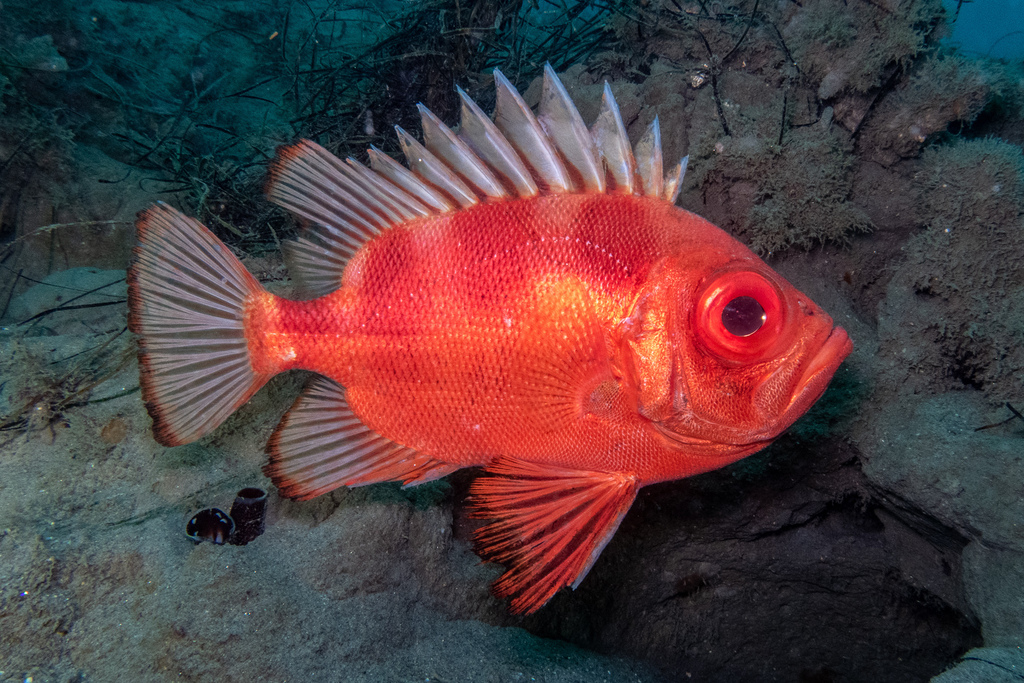
The popeye catalufa (Pristigenys serrula), also known as the bigeye soldierfish, is a species of marine ray-finned fish in the family Priacanthidae, the bigeyes. This fish has an overall dusky orange to red colour with white markings. The dorsal fin appears feathery while rest of fins have black margins. It occurs in the eastern Pacific, where it is found from Oregon to Chile. It occasionally makes its way into the aquarium trade. It grows to a size of 34 centimetres (13 in) in length. This species is nocturnal and shy, preferring deeper waters off islands. It has been recorded associating with squirrelfishes and cardinalfishes but the popeye catalufa goes as deep as 76 metres (249 ft), deeper than its associated species. This species has been recorded from rocky habitats at depths of less than 5 metres (16 ft) to over 100 metres (330 ft). It is a carnivorous species and, when kept in captivity, is known to feed on worms, crustaceans and brittle stars.
From the article Popeye catalufa on Wikipedia (CC BY-SA), quoted section by section
Range & habitat
Pristigenys serrula is found as an unfragmented population all the way from Oregon to Chile, and even the Galápagos Islands and Panama. Oregon sightings are the extremities of the range and most of the population density is along the coast of California and Central America. These fishes extend into temperate regions in association with warm ocean currents although there has not been observations of this family in other typical temperate species. Locations such as New Zealand or the Mediterranean Sea which are typical of the fishes that follow these currents.
Wikipedia: “Geographic range”
What it does
Reproduction of some Pristigengys and Priacanthus species show the eggs being small, spherical, and planktonic from which small larvae hatch with a yolk sac, unpigmented eyes, and undeveloped mouth. These fishes let groups of their eggs out into the open water for scattering and don't show parental care for their eggs. The spawning season for this species has been estimated to occur from between August and December as this is when the larvae are primarily spotted.
Wikipedia: “Reproduction”
At the table
Species of priacanthids feed on a diet of crustaceans, small cephalopods, polychaetes, and small fishes. These fish are most often found to be the predators of some smaller macrofauna, especially crabs. Other creatures they prey on include octopuses, pelagic shrimp, stomatopods, small fish and polychaetes.
Wikipedia: “Food habits”
Where it lives
Recorded sightings
—
geo-referenced records in GBIF, from museums, herbaria and field observers.
Drag the globe to turn it. Dots are where records exist, not a range map; darker means more records.
In the stacks
Searching the stacks…
Every page naming Pristigenys serrula in the Biodiversity Heritage Library →
This page is assembled live from iNaturalist, GBIF, Wikipedia, the Source Library and the Internet Archive. It is not yet part of the hand-edited codex. iNaturalist taxon 110371.