- Animals
- ›Chordates
- ›Vertebrates
- ›Ray-finned Fishes
- ›Spiny-rayed fishes
- ›Butterflyfishes, Angelfishes, and Allies
- ›Bigeyes
- ›Priacanthus
Atlantic Bigeye
Priacanthus arenatus
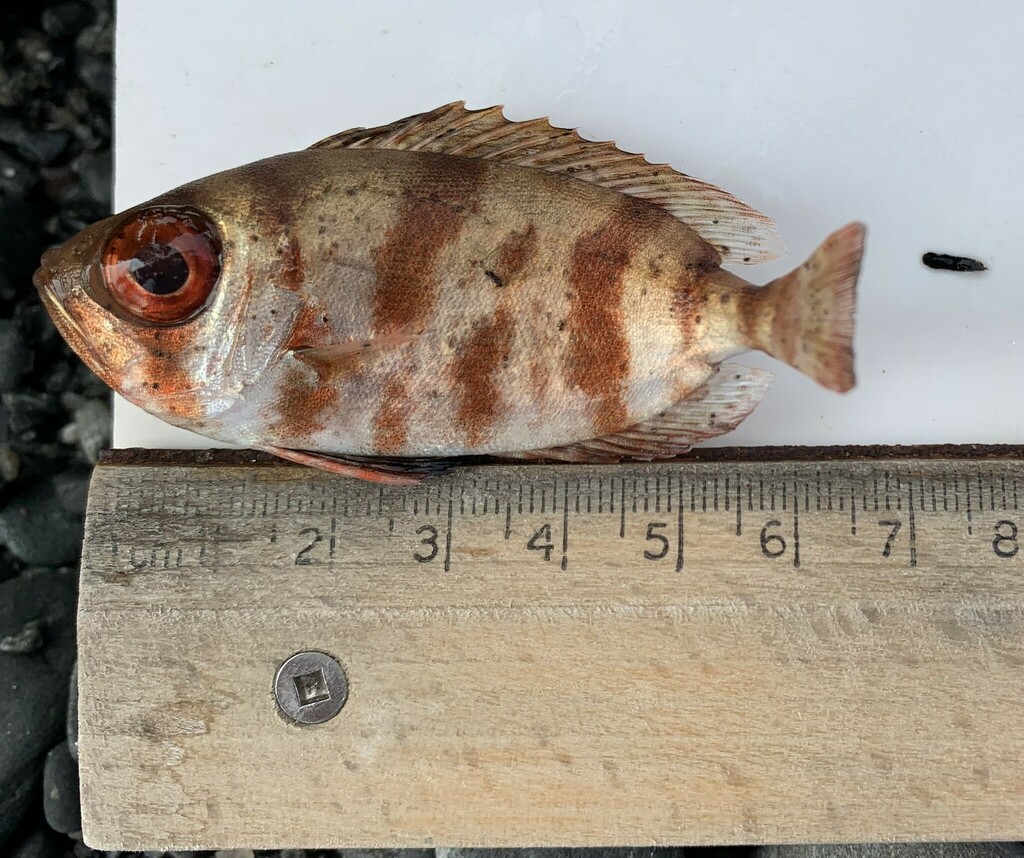
Priacanthus arenatus, the Atlantic bigeye, is a species of marine ray finned fish, a bigeye in the family Priacanthidae. It is found in the mid-northern Atlantic ocean and has been known to be found in the Black and Mediterranean Seas. It lives on rocky bottom ocean floors and coral reefs. The Atlantic Bigeye generally feeds at night on small fish, bristle worms and crustaceans.
From the article Priacanthus arenatus on Wikipedia (CC BY-SA), quoted section by section
Description
The Atlantic bigeye is a small to medium sized perciform fish. Almost all parts of the fish are entirely reddish-orange, including the eyes. The dorsal fin has 10 spines, and 14 rays. The anal fin has 3 spines and 15 rays. Atlantic bigeye are commonly found at around 14 in. The IGFA world record is 50 cm, or about 20", caught in 2001. The eyes of the Atlantic bigeye are large, due to being primarily nocturnal feeders. Atlantic bigeye form small aggregations near the bottom of the ocean at night.
Range & habitat
Atlantic bigeye are widely distributed across both the Northern and Southern Atlantic Ocean. It is widely distributed throughout the subtropical and tropical regions of the Atlantic. In the Western Atlantic, the Atlantic bigeye is distributed from the Northeastern United States to Northern Argentina. Juvenile fish in the Western Atlantic occasionally stray as far North as Nova Scotia in Canada due to the Gulf Stream, though these fish do not stay for long in the area as the Atlantic bigeye cannot survive cold water temperatures. In the Eastern Atlantic, they are found from West Morocco to Northern Angola. A single individual was reported in the Mediterranean Sea off Sardinia, Italy, in 1979. They are found at several levels of the water column, from 10 m to over 250 m, though they most commonly occur between 30 m and 50 m. Juveniles tend to be pelagic in the upper levels of the water column.
Wikipedia: “Distribution”
At the table
Atlantic bigeye are a minor commercial species, often caught as bycatch. Low numbers are taken by trawling, spearing, and hook-and-line. The flesh is marketed fresh, and is considered to be of excellent quality. Atlantic bigeye is also occasionally targeted by recreational anglers who fish at night, though many consider it a nuisance fish as they are very common bycatch while fishing for much larger porgy, grouper or snapper. It also reportedly has a foul odor when caught, reminiscent of rotting garbage.
== References ==
Wikipedia: “Uses”
Where it lives
Recorded sightings
—
geo-referenced records in GBIF, from museums, herbaria and field observers.
Drag the globe to turn it. Dots are where records exist, not a range map; darker means more records.
In the stacks
Searching the stacks…
Every page naming Priacanthus arenatus in the Biodiversity Heritage Library →
This page is assembled live from iNaturalist, GBIF, Wikipedia, the Source Library and the Internet Archive. It is not yet part of the hand-edited codex. iNaturalist taxon 179478.