- Animals
- ›Chordates
- ›Vertebrates
- ›Ray-finned Fishes
- ›Spiny-rayed fishes
- ›Butterflyfishes, Angelfishes, and Allies
- ›Bigeyes
- ›Priacanthus
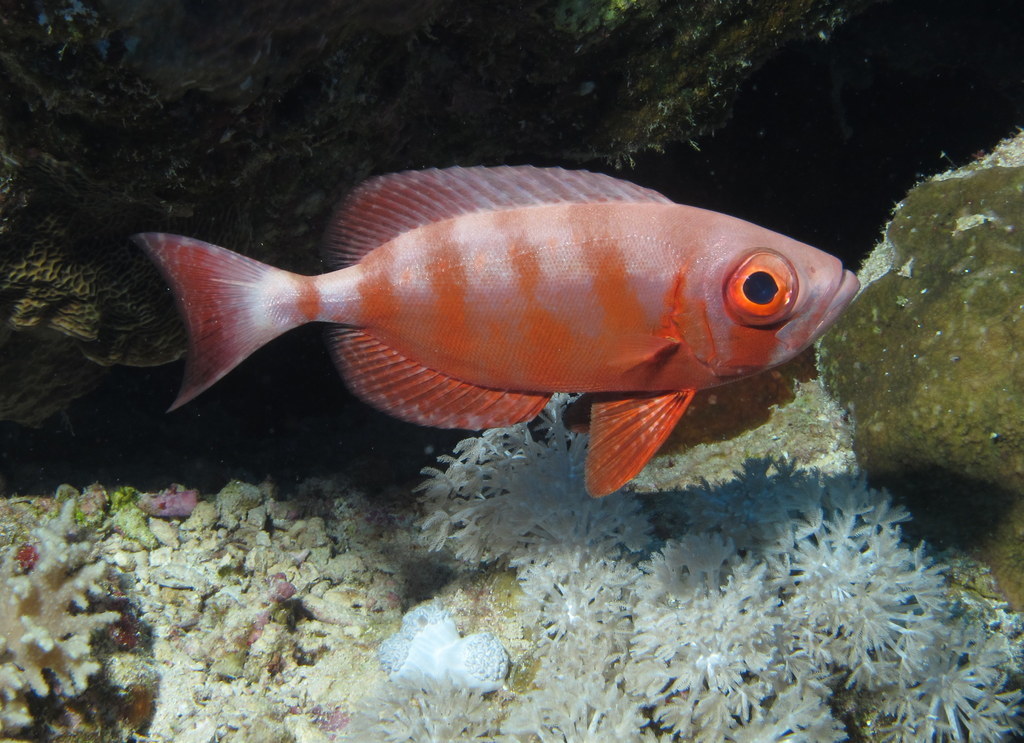
Crescent-tail Bigeye
Priacanthus hamrur
Priacanthus hamrur, the lunar-tailed bigeye, goggle eye, or moontail bullseye, is a species of marine fishes belonging to the family Priacanthidae.
From the article Priacanthus hamrur on Wikipedia (CC BY-SA), quoted section by section
Description
At sexual maturity the size of Priacanthus hamrur reaches 18–19 cm (7.1–7.5 in) in males, 19.1–20.0 cm (7.5–7.9 in) in females, but males can reach a maximum length of 45 cm. The body of the crescent-tail bigeye is relatively deep, strongly compressed laterally. The eyes are very large and red (even in case of silver livery). The mouth is oblique with a protruding lower jaw and small conical teeth. The extremity of the lower lip is above the median line of the body. The dorsal fin has 13 to 15 soft rays. The pelvic fins are very large. The caudal fin has a concave indented margin which may be crescent-shaped (hence the common name). The body of these fishes goes through various phases of color, which may vary from orange to entirely red or entirely silver, or silver with six broad red bands (the first red bar crosses the eye). It is also capable of quickly changing the color. Sometimes it has a row of about fifteen small dark spots along the lateral line or large spots on upper side. The fins are red to light pink. This species is rather similar and can be confused with Priacanthus blochii and with Heteropriacanthus cruentatus. Both these last species have the caudal fin only slightly rounded.
Range & habitat
This species is uncommon but widespread in the Indo-Pacific, from the Red Sea and southern Africa to French Polynesia, southern Japan, and Australia. It has been reported also from Easter Island. Two records have been reported from the Mediterranean Sea off Tunisia and Turkey respectively.
Wikipedia: “Distribution”
Where it lives
Recorded sightings
—
geo-referenced records in GBIF, from museums, herbaria and field observers.
Drag the globe to turn it. Dots are where records exist, not a range map; darker means more records.
In the stacks
Searching the stacks…
Every page naming Priacanthus hamrur in the Biodiversity Heritage Library →
This page is assembled live from iNaturalist, GBIF, Wikipedia, the Source Library and the Internet Archive. It is not yet part of the hand-edited codex. iNaturalist taxon 84116.