- Animals
- ›Chordates
- ›Vertebrates
- ›Ray-finned Fishes
- ›Spiny-rayed fishes
- ›Butterflyfishes, Angelfishes, and Allies
- ›Emperor Breams
- ›Lethrininae
- ›Lethrinus
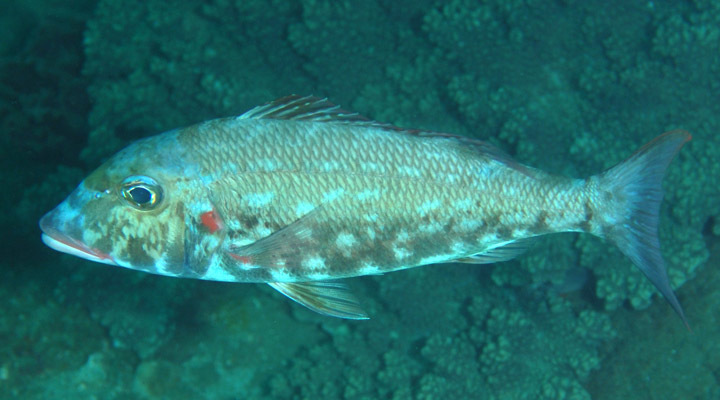
Spotcheek Emperor
Lethrinus rubrioperculatus
Lethrinus rubrioperculatus, the spotcheek emperor, red-eared emperor, red-ears, red-edged emperor, scarlet-cheek emperor, and spot cheek emperor, is a species of marine ray-finned fish belonging to the family Lethrinidae, the emperors or emperor breams. This species has a wide Indo-Pacific distribution.
From the article Lethrinus rubrioperculatus on Wikipedia (CC BY-SA), quoted section by section
Description
Lethrinus rubrioperculatus grows to and is brown or olive-grey in colour. It has small, scattered blotches that are irregular in chape. The Body depth 2.94 to 3.18 times in standard length. Body color is olive-gray or brown, with scattered irregular small black blotches. There is normally a red spot present on the top edge of the operculum. The lips are normally red. The fins are pinkish or pale in colour.
Range & habitat
Lethrinus rubrioperculatus is found in numerous locations, including East African waters, southern Japan and Taiwan, the Marquesas Islands, New Caledonia and the northern half of Australia.
Wikipedia: “Distribution”
What it does
Lethrinus rubrioperculatus eats mostly crustaceans, mollusks, echinoderms, and other fishes.
Wikipedia: “Diet”
Where it lives
Recorded sightings
—
geo-referenced records in GBIF, from museums, herbaria and field observers.
Drag the globe to turn it. Dots are where records exist, not a range map; darker means more records.
In the stacks
Searching the stacks…
Every page naming Lethrinus rubrioperculatus in the Biodiversity Heritage Library →
This page is assembled live from iNaturalist, GBIF, Wikipedia, the Source Library and the Internet Archive. It is not yet part of the hand-edited codex. iNaturalist taxon 55202.