- Animals
- ›Chordates
- ›Vertebrates
- ›Ray-finned Fishes
- ›Spiny-rayed fishes
- ›Butterflyfishes, Angelfishes, and Allies
- ›Emperor Breams
- ›Lethrininae
- ›Lethrinus
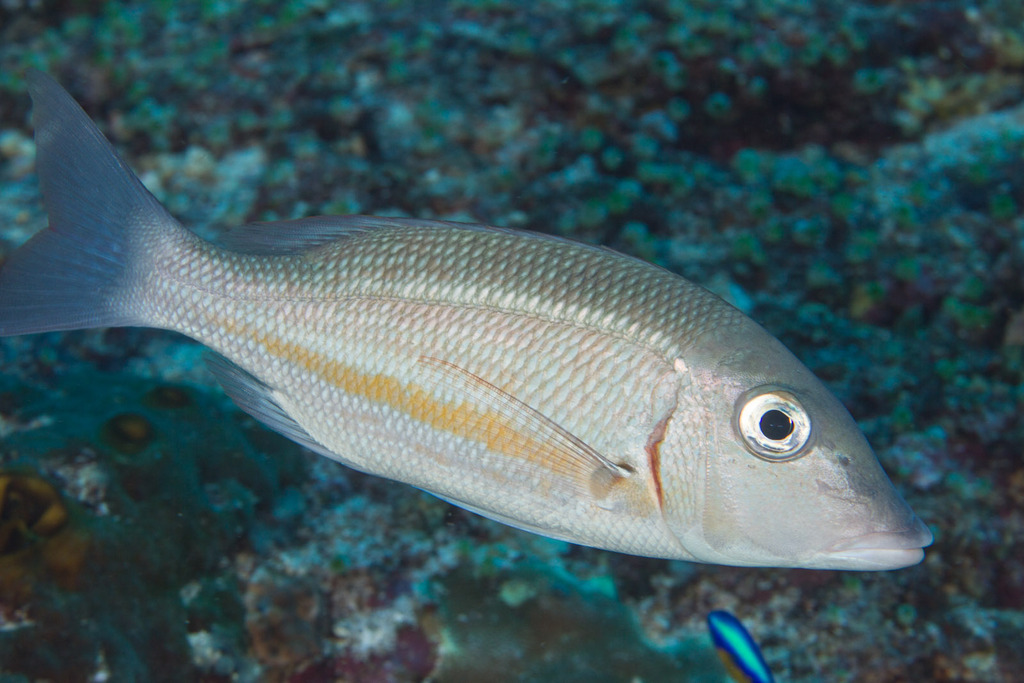
Orangestriped Emperor
Lethrinus obsoletus
Lethrinus obsoletus, the orange-striped emperor, yellow-banded emperor or yellowstripe emperor, is a species of marine ray-finned fish belonging to the family Lethrinidae, the emperors or emperor breams. This species has a wide Indo-Pacific distribution.
From the article Lethrinus obsoletus on Wikipedia (CC BY-SA), quoted section by section
Description
Lethrinus obsoletus has its dorsal fin supported by 10 spines and 9 soft rays, while there are 2 spines and 8 soft rays supporting its anal fin. The body is moderately deep, the depth fitting into its standard length 2.4 to 2.8 times. The dorsal profile of the head around the eye is straight or a little convex, and on the snout it is also slightly convex. The teeth in the jaws at the sides of the mouth are rounded or conical. The axilla of the pectoral fin is densely scaled. The overall colour is light tan to olive-brown, with a horizontal yellow-orange stripe along the lower flank between the base of the pectoral fin to the caudal peduncle. There are two indistinct yellowish orange stripes above the main stripe, and there are a number of wide, faint, vertical and oblique dark and light coloured bands on the head, with white spots sometinmes showing under the eyes. The fins are whitish or yellowish brown, and are sometimes blotched. This species has a maximum published total length of 60 cm (24 in), although 30 cm (12 in) is more typical.
Range & habitat
Lethrinus obsoletus has a wide distribution in the Indian and Western Pacific oceans. It is found along the coast of eastern Africa from the Red Sea south to Sodwana Bay in South Africa. It is found across the Indian Ocean into the Pacific as far as the Ryukyu Islands, Tonga and Samoa. In Australian waters it is found at Rowley Shoals, Scott Reef and Hibernia Reef off Western Australia, the Cocos (Keeling) Islands, Ashmore Reef in the Timor Sea and along the northern Great Barrier Reef off Queensland. The orange-striped emperor is typically found in seagrass beds, as well as over sand and rubble areas in lagoons and in reefs. The juveniles prefer seagrass beds; as they grow, they begin to live in reefs. They are found as deep as 30 m (98 ft).
Wikipedia: “Distribution and habitat”
In human culture
Lethrinus obsoletus has the specific name obsoletus, which means "worn out" or "decayed". This appears to be an allusion to the faint yellow-purple stripe, which was described as "orange-yellow" in contemporaneous accounts.
Wikipedia: “Etymology”
Where it lives
Recorded sightings
—
geo-referenced records in GBIF, from museums, herbaria and field observers.
Drag the globe to turn it. Dots are where records exist, not a range map; darker means more records.
In the stacks
Searching the stacks…
Every page naming Lethrinus obsoletus in the Biodiversity Heritage Library →
This page is assembled live from iNaturalist, GBIF, Wikipedia, the Source Library and the Internet Archive. It is not yet part of the hand-edited codex. iNaturalist taxon 344594.