- Animals
- ›Chordates
- ›Vertebrates
- ›Ray-finned Fishes
- ›Spiny-rayed fishes
- ›Mackerels, Tunas, Butterfishes, and Allies
- ›Scombroidei
- ›Mackerels, Tunas, and Bonitos
- ›Scombrinae
- ›Thunnus
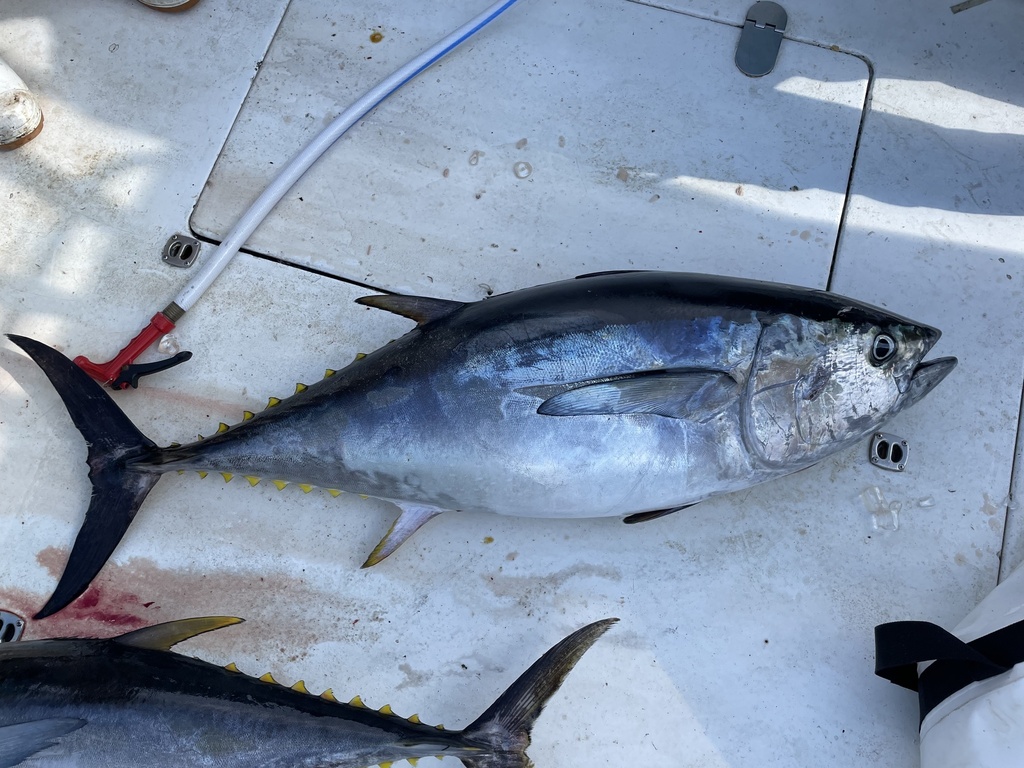
Bigeye Tuna
Thunnus obesus
The bigeye tuna (Thunnus obesus) is a species of true tuna of the genus Thunnus, belonging to the wider mackerel family Scombridae. Bigeye tuna are found in the open waters of all tropical and temperate oceans, but not in the Mediterranean Sea.
From the article Bigeye tuna on Wikipedia (CC BY-SA), quoted section by section
Description
Bigeye tuna can grow up to 2.5 m (98 in; 8.2 ft) in length. Maximum weight of individuals probably exceeds 180 kg (400 lb), with the all-tackle angling record standing at 178 kg (392 lb 7 oz). They are large, deep-bodied, streamlined fish with large heads and eyes. The pectoral fins are very long, reaching back beyond the start of the second dorsal fin in juveniles and the space between the first and second dorsal fin in adults. They have 13 or 14 dorsal spines.
What it does
Bigeye tuna primarily feed on epipelagic and mesopelagic fish, crustaceans and cephalopods.
Wikipedia: “Diet”
In human culture
Conventional tagging data and counts of growth increments in otoliths (ear bones) of bigeye tuna have recorded a maximum age of 16 years. Recorded lengths at which sexual maturity is attained varies geographically with a length at which 50% of fishes sampled are mature of 135 cm (53 in) in the eastern Pacific Ocean and 102–105 cm (40–41 in) in the western Pacific Ocean. This translates to an age of maturity of 2–4 years. Differences in methods of studies may contribute to this variability. Spawning takes place across most months of the year in tropical regions of the Pacific Ocean, becoming seasonal at higher latitudes when sea surface temperatures are above 24 °C (75 °F). In the northwestern tropical Atlantic spawning occurs in June and July, and in January and February in the Gulf of Guinea, which is the only known Atlantic nursery area.
Wikipedia: “Life history”
Where it lives
Recorded sightings
—
geo-referenced records in GBIF, from museums, herbaria and field observers.
Drag the globe to turn it. Dots are where records exist, not a range map; darker means more records.
In the stacks
Searching the stacks…
Every page naming Thunnus obesus in the Biodiversity Heritage Library →
This page is assembled live from iNaturalist, GBIF, Wikipedia, the Source Library and the Internet Archive. It is not yet part of the hand-edited codex. iNaturalist taxon 114125.