- Animals
- ›Chordates
- ›Vertebrates
- ›Ray-finned Fishes
- ›Spiny-rayed fishes
- ›Cichlids and Allies
- ›Cichlids
- ›African Cichlids
- ›Maylandia
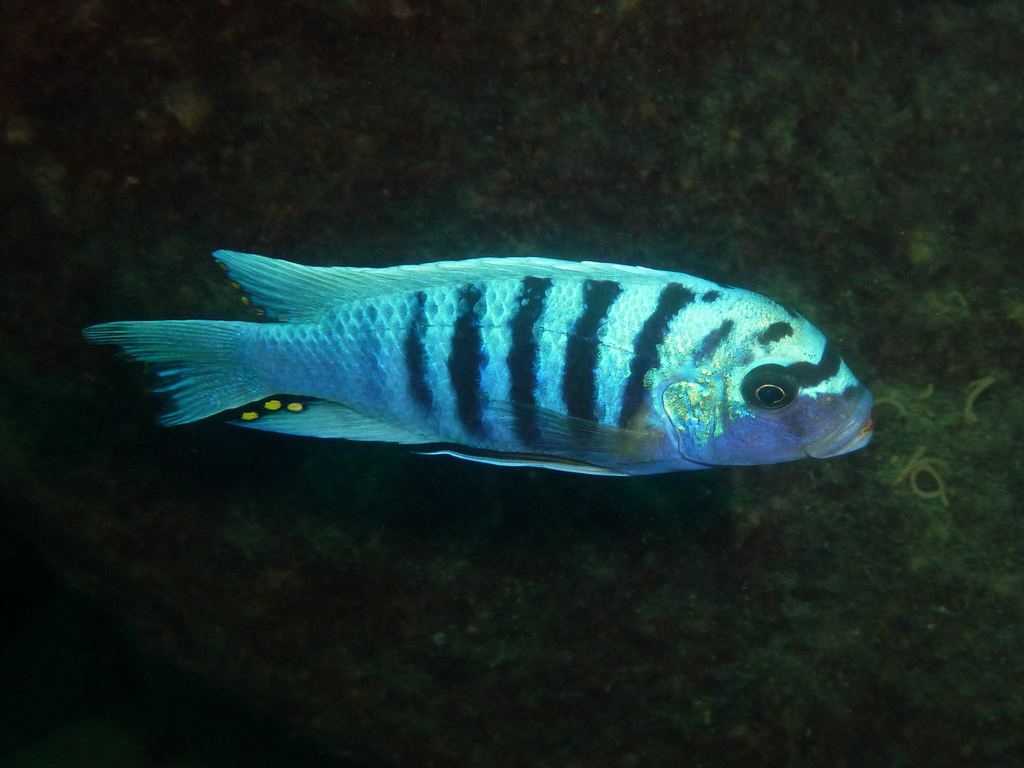
Zebra Mbuna
Maylandia zebra
The zebra mbuna (Maylandia zebra) is a species of cichlid endemic to Lake Malawi in Africa. This species can reach a length of 11.3 cm (4.4 in). It feeds on aufwuchs, a surface layer of mostly algal material that grows on rocks. This cichlid is a mouthbrooder and the female broods the eggs in her mouth for about three weeks. This fish can sometimes be found in the aquarium trade.
From the article Zebra mbuna on Wikipedia (CC BY-SA), quoted section by section
Description
The zebra mbuna has a single dorsal fin with sixteen to nineteen spines and seven to ten soft rays. The anal fin has three to four spines and six to nine soft rays. It grows to a maximum length of 11.3 cm (4.4 in) SL. The male fish varies in colour in different parts of its range, in some locations having a dark head, throat and belly and in others a blue head, whitish throat and grey/blue belly. In both cases the body is bright blue with up to eight grey/black bars, the dorsal fin is blue and the anal fin is blue to grey, with one to five orange to yellow spots. The female zebra mbuna is polymorphic, that is to say it occurs in two different colour forms. In one morph the head and body colour is pale brownish-grey, with similar coloured dorsal, anal and caudal fins, the pectoral fins have grey rays and clear membranes, and the black pelvic fins have white leading edges. In the other colour morph the throat is brown and the head and body are dark brown to black, the body having blue highlights. The dorsal and caudal fins are a similar brown/black colour and so are the anal fins, but on them, the trailing edges have a number of yellow spots. The pectorals have brown rays and clear membranes, and the black pelvic fins have white leading edges.
Range & habitat
The zebra mbuna is endemic to Lake Malawi where it is found in rocky areas, both where there is sediment and where the rock is bare at depths between 6 and 28 m (20 and 92 ft).
Wikipedia: “Distribution and habitat”
Where it lives
Recorded sightings
—
geo-referenced records in GBIF, from museums, herbaria and field observers.
Drag the globe to turn it. Dots are where records exist, not a range map; darker means more records.
In the stacks
Searching the stacks…
Every page naming Maylandia zebra in the Biodiversity Heritage Library →
This page is assembled live from iNaturalist, GBIF, Wikipedia, the Source Library and the Internet Archive. It is not yet part of the hand-edited codex. iNaturalist taxon 105370.