- Animals
- ›Chordates
- ›Vertebrates
- ›Ray-finned Fishes
- ›Spiny-rayed fishes
- ›Needlefishes, Halfbeaks, and Allies
- ›Flyingfishes
- ›Parexocoetus
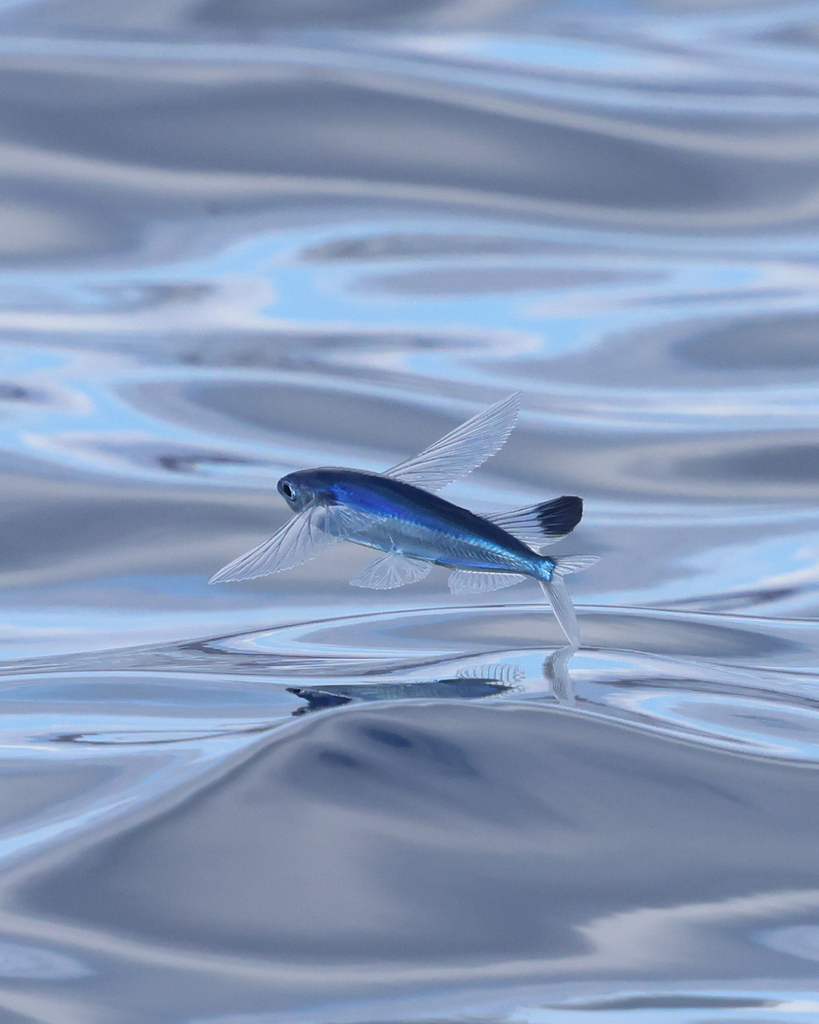
Sailfin Flyingfish
Parexocoetus brachypterus
The sailfin flyingfish (Parexocoetus brachypterus) is a member of the flying fish family. Like other members its family, P. brachypterus is known for its ability to leap out of the water and glide above its surface. Its distribution range encompasses the Atlantic, Indian, and Pacific Oceans. It is an epipelagic fish and can be found in coastal waters but is rarely encountered in open oceans. They are known to spawn during September to April in the...
From the article Sailfin flying fish on Wikipedia (CC BY-SA), quoted section by section
Description
The sailfin flying fish is stocky as far as flying fish are concerned. It has comparatively small pectoral fins and a long dorsal fin relative to other flying fish. One distinguishing feature is its blunt snout. It displays countershading. One average, P. brachypterus measure 110-130 mm in length. Females of the species are usually slightly longer and heavier than the males.
Range & habitat
This species is dispersed globally in coastal and sub-coastal waters. It is found in the Atlantic, Pacific, and Indian Oceans. In the Western Atlantic Ocean, it can be found off the shores of northern Florida to Brazil, as well as in the Gulf of Mexico and the Caribbean Sea.
Wikipedia: “Distribution and habitat”
What it does
When spawning sailfin flying fish aggregate in large numbers, with groups estimated to contain up to one million members in some cases. The individuals in such aggregations display high-energy jumping, gliding and swimming. Groups contain an unequal sex ratio, with males being approximately three times more abundant than females. Small groups usually containing 3-4 fish have been observed during spawning events. Such groups are thought to consist of one female being pursued by several males; these observations are consistent with the sex rations observed in the group as a whole. There are two spawning periods during the year, one from September to January, and one from March to August. Unlike other species of flying fish, it is unsure whether or not fertilized eggs need to attach themselves to flotsam. There are reports that this species’ eggs may be free-floating.
Wikipedia: “Behavior”
Where it lives
Recorded sightings
—
geo-referenced records in GBIF, from museums, herbaria and field observers.
Drag the globe to turn it. Dots are where records exist, not a range map; darker means more records.
In the stacks
Searching the stacks…
Every page naming Parexocoetus brachypterus in the Biodiversity Heritage Library →
This page is assembled live from iNaturalist, GBIF, Wikipedia, the Source Library and the Internet Archive. It is not yet part of the hand-edited codex. iNaturalist taxon 317281.