- Animals
- ›Chordates
- ›Vertebrates
- ›Ray-finned Fishes
- ›Carps, Characins, Catfishes and Allies
- ›Minnows, Suckers, Carps, and Loaches
- ›Loaches
- ›True Loaches
- ›Lepidocephalichthys
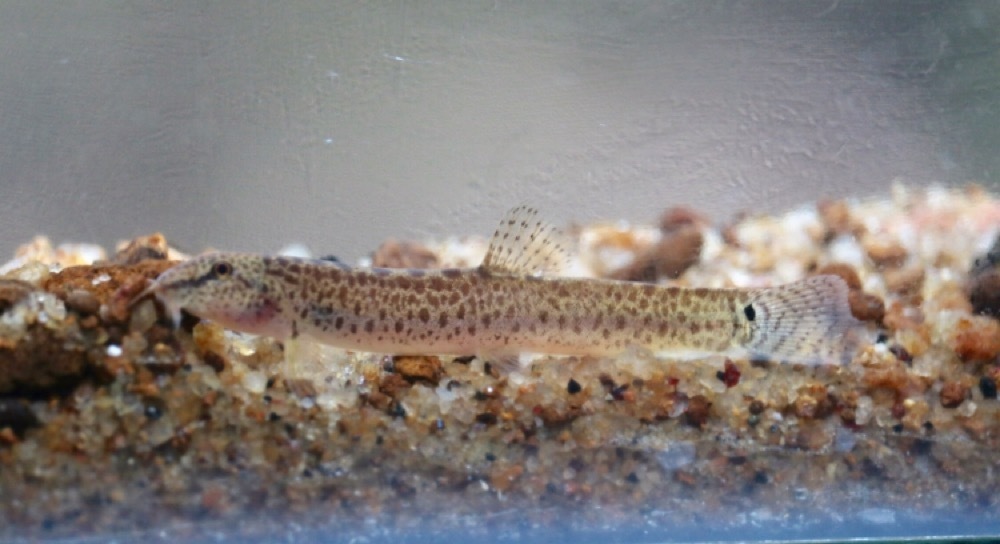
Lepidocephalichthys jonklaasi
Lepidocephalichthys jonklaasi, known as the Jonklaas's loach or the spotted loach, is an endemic fish species restricted to the wet zone of Sri Lanka. The species was first recorded from the Wilpita area (Daraniyagala 1952). It is currently known from 12 locations in the wet zone including Beraliya, Dombagaskandha, Madakada, Gilimale, Hiyare, Kottawa, Kanneliya, Weddagala, Nakiyadeniya, Pahiyangala and Boralugoda. It is recorded from a wide range of altitudes. Due to its restricted range and the threats to its habitat Lepidocephalichthys jonklaasi, is listed as an Endangered species. The species has already begun to disappear from some of the sites mentioned above due to destruction and fragmentation of its habitat and many other threats that are operating on the species.
Named in honor of Rodney Jonklaas (1925–1989), a Sri Lankan diver who was an underwater photographer and also a zoo administrator.
From the article Lepidocephalichthys jonklaasi on Wikipedia (CC BY-SA), quoted section by section
Description
Members of the genus Lepidocephalichthys have a sharp, erectile spine on their cheeks. In some species the spine is sharp enough to puncture easily one's hand during handling of the live fish. However, it is not venomous or harmful. These fish have an ancillary respiratory mechanism where they swallow air, which is then used to oxygenate the blood that passes through the walls of the intestines. Unlike the case of the channids and anabantids, the air is not expelled through the mouth or gills, but via the anus. This enables them to survive in very poorly oxygenated water although in Sri Lanka, by and large, they occur in habitats that do not require this facility and are not generally considered as "air breathers". The loaches are small, eel-like or worm-like fish, often attractively colored. They have (often rudimentary) cycloid scales and three pairs of barbells. Mature males in many species have highly modified pectoral fins (Roberts, 1989). Little is known about the breeding habits of the members of this family Cobitidae and only a few species have been bred in captivity to date.
Related species and diagnosis. Also Lepidocephalichthys thermalis is found in Sri Lanka. Jayaram (1981) reports that at least six other species occur in the north-eastern part of India (Assam to Burma). …
Wikipedia: “Morphology”
Range & habitat
Very little is known of the biology of this species. It has been recorded by Pethiyagoda only from its type locality in Wilpita, Akuressa. This stream traverses through thick forest with dense undergrowth. The stream is very shallow and the substrate is entirely of fallen leaves and silt. The flow of water in the stream is very slow, in terms of volume perhaps only several litres per minute. The fish are not visible from the surface, being always concealed beneath leaf debris in the water.
Wikipedia: “Habitat and microhabitats”
Where it lives
Recorded sightings
—
geo-referenced records in GBIF, from museums, herbaria and field observers.
Drag the globe to turn it. Dots are where records exist, not a range map; darker means more records.
In the stacks
This page is assembled live from iNaturalist, GBIF, Wikipedia, the Source Library and the Internet Archive. It is not yet part of the hand-edited codex. iNaturalist taxon 104199.