- Animals
- ›Chordates
- ›Vertebrates
- ›Ray-finned Fishes
- ›Carps, Characins, Catfishes and Allies
- ›Minnows, Suckers, Carps, and Loaches
- ›Carps and Minnows
- ›Danios
- ›Danionins
- ›Danio
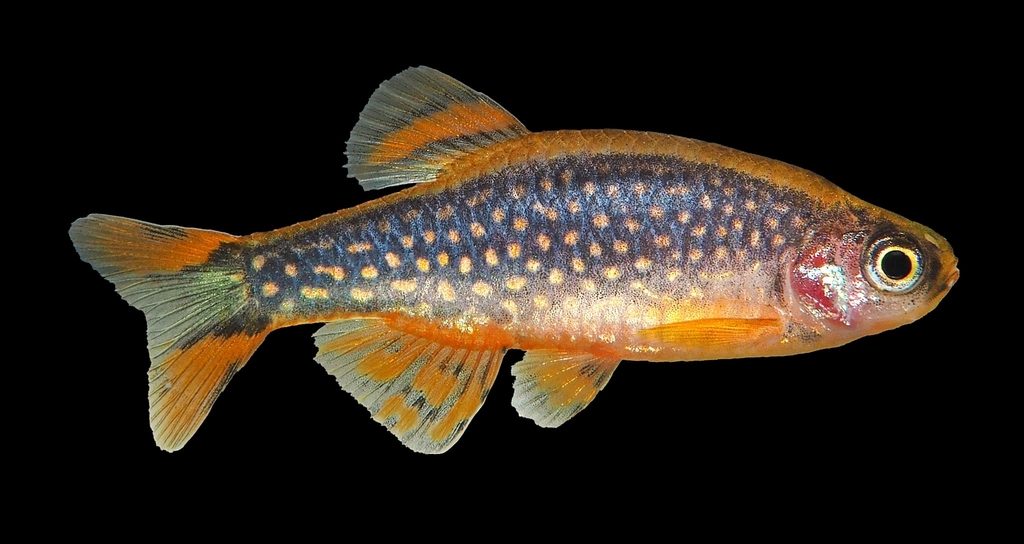
Galaxy Rasbora
Danio margaritatus
Danio margaritatus, the celestial pearl danio, often referred to in the aquarium trade as galaxy rasbora or Microrasbora sp. 'Galaxy', is a small freshwater ray-finned fish belonging to the family Danionidae. This fish is from Myanmar and Northern Thailand (in Salween basin). It has so far been found only in a very small area near Hopong east of Inle Lake, at an elevation of over 1,000 m (3,400 ft). Its habitat is part of the Salween basin, namely the Nam Lang and Nam Pawn Rivers. Discovered in 2006, the species quickly appeared in the aquarium trade, where its small size and bright colours made it an instant hit.
From the article Danio margaritatus on Wikipedia (CC BY-SA), quoted section by section
Description
This is a small, plump danionin with a markedly blunt snout, measuring 2–2.5 cm standard length,a few individuals are able to reach 3 cm. The body is about three times as long as it is high. In general shape, it resembles Danio erythromicron more than any other known species.
This species shows some sexual dimorphism: males have a bright-blue background color (dull blue-green in females), and their fins are more brightly colored. The tail end of their bodies (the caudal peduncle) is also higher than in females. The body is sprinkled with small, pearly dots. The back is bronzy green, and the belly in females is yellowish-white. The gill covers are transparent, letting the blood-red gills shine through. The males will prominently display their unpaired fins to conspecifics. All fins, save the pectoral fins, show two parallel black lines with a bright red area in between; on the tail fin, this pattern is present twice (once on each lobe) and the outer black band is vestigial. Females have a weaker version of the pattern in the tail and dorsal fins only, sometimes in the anal fin, too. A courting male develops a red belly and the flanks brighten and darken, making the pearly spots stand out even more, with the back appearing paler than the flanks and also standing out. …
What it does
The fish lives in small ponds created by seeping groundwater or overflow from small brooks or springs. Water temperature in January is rather low (22–24 °C), but as the habitat is very shallow, it heats up quickly during hot spells, thus D. margaritatus is probably tolerant of temperatures above 26 °C. As in most water bodies in the Inle drainage, the water is slightly alkaline. The habitat is heavily vegetated with Hydrocharitaceae similar to Elodea (water weed). The celestial pearl danio shares its habitat with a very few fish species: a Microrasbora similar to M. rubescens, a rosy loach (Yunnanilus, possibly a new species, and the dwarf snakehead Channa harcourtbutleri. The latter species presumably is the only known significant predator of D. margaritatus. The species is locally fished for food to some extent; it is dried and bought as a protein source by poor people. A can of some 500 D. margaritatus sold for food fetched about 25 kyat (about 2 UK pounds/3.9 US$/2.7 EUR) before the fish was discovered for the aquarium trade.
Reproduction. The spawning behavior has significant consequences for captive breeding (see below). The celestial pearl danio appears to be adapted to somewhat ephemeral habitats. It does not have a dedicated spawning season, nor do the females lay continuously. Rather, they produce small batches of around 30 eggs per spawning episode. …
Wikipedia: “Ecology”
Where it lives
Recorded sightings
—
geo-referenced records in GBIF, from museums, herbaria and field observers.
Drag the globe to turn it. Dots are where records exist, not a range map; darker means more records.
In the stacks
Searching the stacks…
Every page naming Danio margaritatus in the Biodiversity Heritage Library →
This page is assembled live from iNaturalist, GBIF, Wikipedia, the Source Library and the Internet Archive. It is not yet part of the hand-edited codex. iNaturalist taxon 187323.