- Animals
- ›Chordates
- ›Vertebrates
- ›Ray-finned Fishes
- ›Carps, Characins, Catfishes and Allies
- ›Minnows, Suckers, Carps, and Loaches
- ›Carps and Minnows
- ›True Minnows
- ›North American Minnows
- ›Pogonichthys
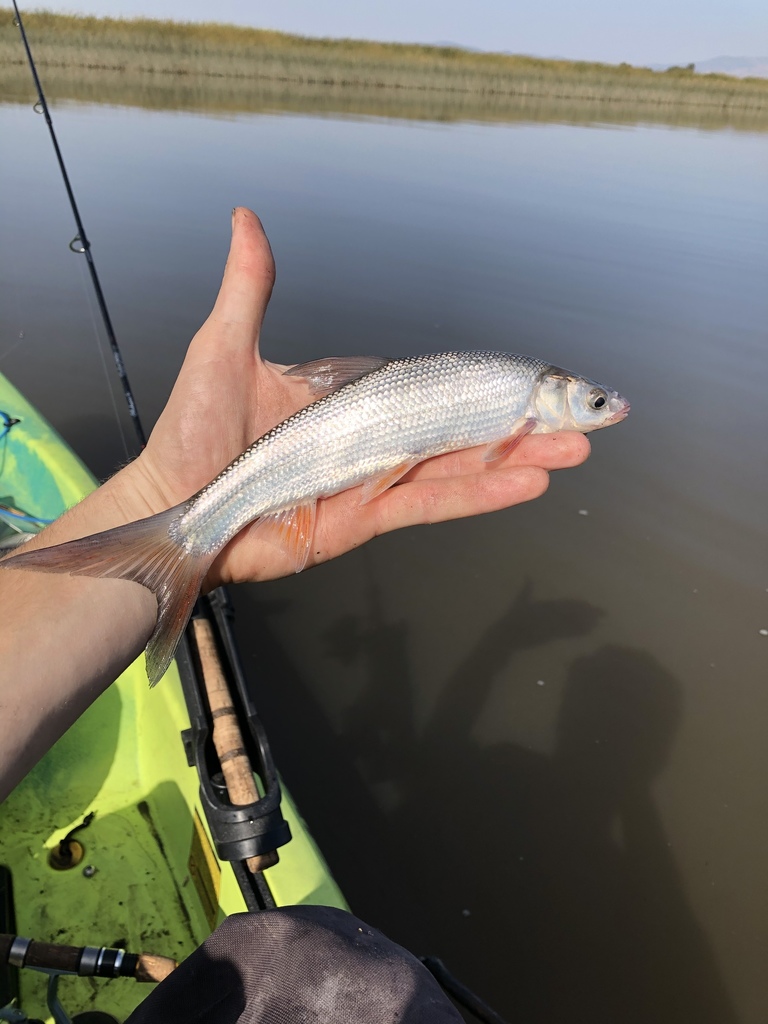
Sacramento Splittail
Pogonichthys macrolepidotus
The splittail (Pogonichthys macrolepidotus), also called Sacramento splittail, is a species of freshwater ray-finned fish belonging to the family Leuciscidae, the shiners, daces and minnows. This fish is native to the low-elevation waters of the Central Valley in California. It was first described by William O. Ayres in 1854. It is the sole living member of its genus, the Clear Lake splittail P. ciscoides having become extinct in the 1970s.
From the article Sacramento splittail on Wikipedia (CC BY-SA), quoted section by section
Description
The distinctive feature of the splittail is the larger upper lobe of its caudal fin, which is almost twice as long as the head. The tail is deeply forked and very large. The head is slightly conical with a relatively large eye, and there are tiny barbels at the corners of the mouth. The lateral line is slightly decurved. The dorsal fin has 9–10 rays, while the pectoral fins have 16–19 rays, the pelvic fin 8–9 rays, and the anal fin 7–9 rays. The color is silver on the sides, with a dusky olive gray on the back. During the breeding season, the fins pick up a red-orange tinge, and the males become darker and develop white tubercles on the head and at the bases of the fins.
Range & habitat
Their range is the lower-elevation waters of the Central Valley, extending to San Francisco Bay. Although once found as far north as Redding, they are now only rarely seen in the upper Sacramento River. They were once caught from southern San Francisco Bay and in Coyote Creek (Santa Clara County), but are now restricted to the Sacramento Delta, Suisun Bay, and the lower parts of Sonoma Creek, Petaluma River and Napa River. They are tolerant of moderate levels of salinity and/or alkalinity, often being found in brackish sloughs. This distinguishes the splittail from most other cyprinids, which can only live in freshwater.
Wikipedia: “Range”
What it does
Splittail are bottom feeders, consuming bottom-dwelling invertebrates and detritus, generally in areas of low to moderate current. In Suisun Bay, opossum shrimp (mostly Neomysis mercedis), amphipods such as Corophium, and copepods are favorite foods, while in the Sacramento Delta they eat clams, crustaceans, and insect larvae. During periods of high water levels (February/March), splittails will move into flooded areas to look for earthworms.
Wikipedia: “Diet”
Where it lives
Recorded sightings
—
geo-referenced records in GBIF, from museums, herbaria and field observers.
Drag the globe to turn it. Dots are where records exist, not a range map; darker means more records.
In the stacks
Searching the stacks…
Every page naming Pogonichthys macrolepidotus in the Biodiversity Heritage Library →
This page is assembled live from iNaturalist, GBIF, Wikipedia, the Source Library and the Internet Archive. It is not yet part of the hand-edited codex. iNaturalist taxon 109930.