- Animals
- ›Chordates
- ›Vertebrates
- ›Ray-finned Fishes
- ›Carps, Characins, Catfishes and Allies
- ›Minnows, Suckers, Carps, and Loaches
- ›Carps and Minnows
- ›Danios
- ›Rasborines
- ›Rasbora
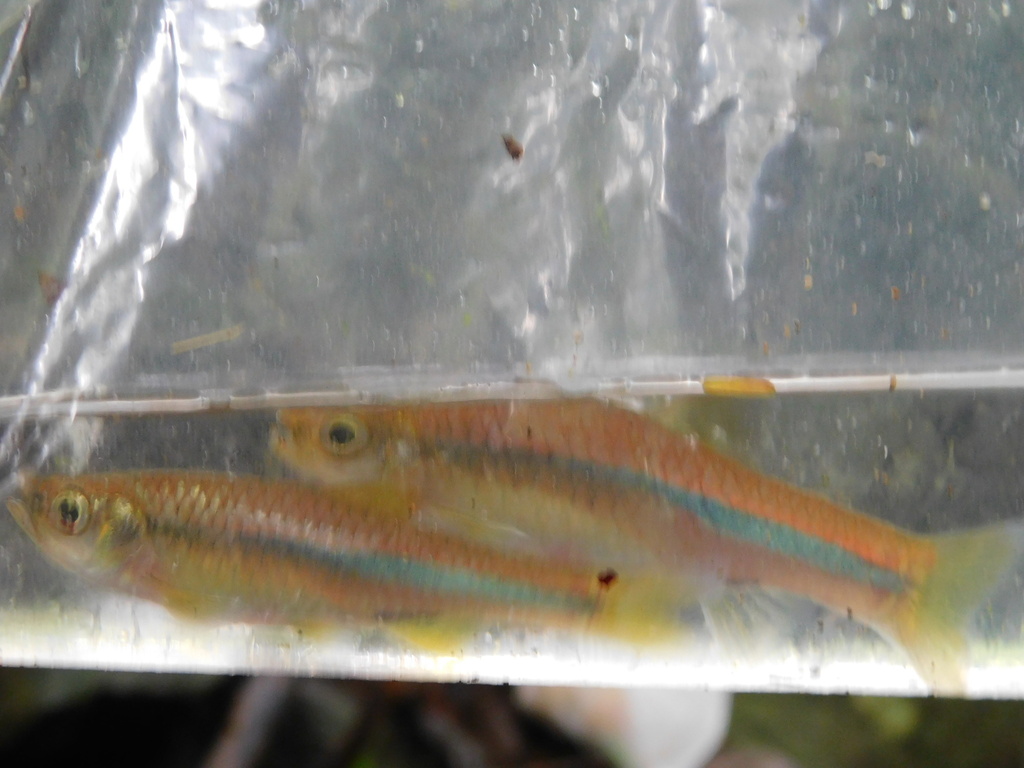
Yellow Rasbora
Rasbora lateristriata
The yellow rasbora (Rasbora lateristriata) is a species of ray-finned fish in the genus Rasbora from Southeast Asia. It is a primarily freshwater fish originally from Java island in Indonesia. It is known as the wader pari fish in the Indonesian language. It was a protein source for the local community.
The taxonomy, phylogeny, and distributional boundaries have not been fully studied.
From the article Yellow rasbora on Wikipedia (CC BY-SA), quoted section by section
Description
Dorsal spines (total): 2; Dorsal soft rays (total): 7; Anal spines: 3; Anal soft rays: 5. Preserved color dark brown dorsally, whitish to yellowish on sides and below; scales margined with minute dark spots; opercle with silvery black spot. 12 scales between nape and dorsal. Mouth strongly oblique with anterior end as high as upper margin of pupil; maxillary extends posteriorly below anterior margin of eye. Lateral line complete, reaching caudal, with 7 rows of scales between lateral lines over middle of caudal peduncle.
Wikipedia: “Morphology”
Range & habitat
The species can be found in Indonesia, Thailand, Malaysia, Vietnam, Philippines, Singapore and the United States. The distribution is fairly reliable according to their genus distribution in which they are native to freshwater habitats in South, Southeast Asia and southeast China. A journal has stated that R. lateristriata had a west-to-east direction of divergence and migration from the Miocene to the Plio-Pleistocene. R. lateristriata is often considered to be widely distributed from Sumatra, Java, Bali, across Wallace's Line, to Lombok and the Sumbawa Islands of Indonesia (e.g., Froese and Pauly, 2015).
Wikipedia: “Distribution”
What it does
It is a type of riverine fish found in mountainous streams that are in shallow areas, and have relatively fast flowing water and plenty of gravel at the river floor. The fish is an omnivorous feeder which feeds on phytoplankton, zooplankton, insect larvae, leaves and small caterpillars. It feeds continuously through the day and night. It is hunted by snake head and red devil fish in the natural ecosystem.
Wikipedia: “Habitat and feeding habits”
Where it lives
Recorded sightings
—
geo-referenced records in GBIF, from museums, herbaria and field observers.
Drag the globe to turn it. Dots are where records exist, not a range map; darker means more records.
In the stacks
Searching the stacks…
Every page naming Rasbora lateristriata in the Biodiversity Heritage Library →
This page is assembled live from iNaturalist, GBIF, Wikipedia, the Source Library and the Internet Archive. It is not yet part of the hand-edited codex. iNaturalist taxon 613503.