- Animals
- ›Chordates
- ›Vertebrates
- ›Ray-finned Fishes
- ›Carps, Characins, Catfishes and Allies
- ›Minnows, Suckers, Carps, and Loaches
- ›Carps and Minnows
- ›True Minnows
- ›Old World Minnows
- ›Parachondrostoma
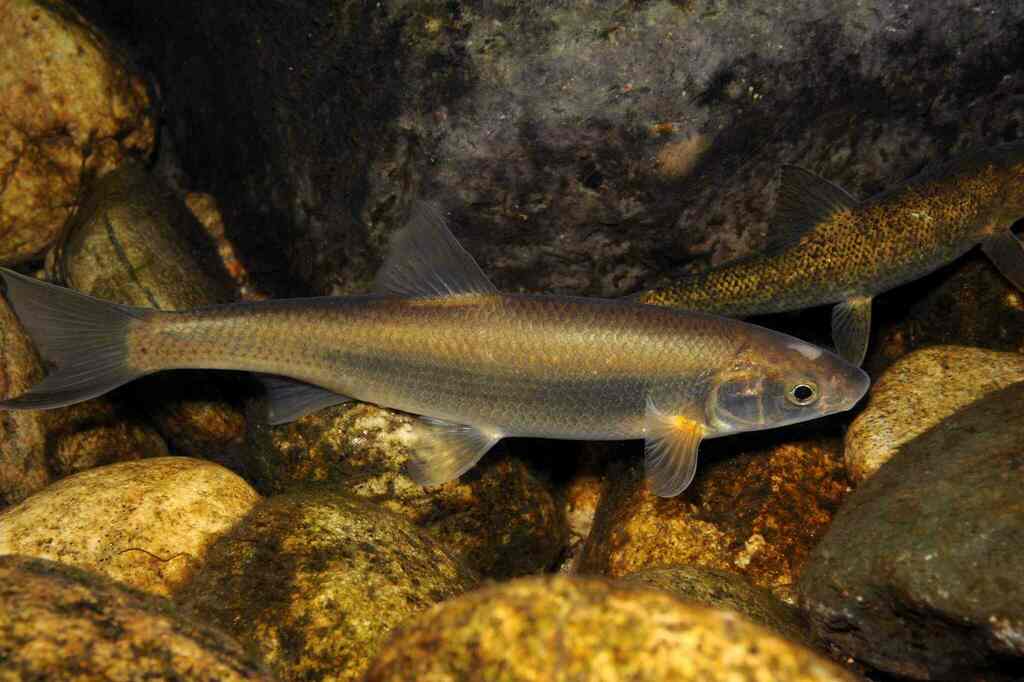
Soiffe
Parachondrostoma toxostoma
The South-west European nase (Parachondrostoma toxostoma), also known as the French nase, soiffe or soffie, is a species of freshwater ray-finned fish belonging to the family Leuciscidae, which includes the daces. Eurasian minnows and related fishes. This species is found in southern France, Switzerland and northern Spain.
From the article South-west European nase on Wikipedia (CC BY-SA), quoted section by section
Description
Parachondrostoma toxostoma has its dorsal fin supported by 3 spines and between 7 and 9 soft rays while its anal fin is supported by 3 spines and between 8 and 11 soft rays. The caudal fin has 17 to 19 fin rays. The body is elongated, and this fish has a maximum total length of 30 cm (12 in) with a maximum published weight of 350 g (12 oz).
Range & habitat
Parachondrostoma toxostoma is found in the Garonne, Dordogne and Adour drainage basins in France and in the rivers daring into the Mediterranean in France and Switzerland from the Berre to the Rhône. It has also been introduced into the Loire river system but it is currently restricted to Haute-Loire, here it is claimed the common nase (Chondrostoma nasus), another introduced species, is competing with the French nase. This species prefers streches of rivers and streams with a current and with rocky or stony substrates, it will enter reservoirs and canals too.
Wikipedia: “Distribution and habitat”
In human culture
Parachondrostoma toxostoma belongs to the genus Parachondrostoma, this name places the prefix para-, meaning "near to" or "similar to" in front of the genus name Chondrostoma, which is a combination of chondros, a word meaning "gristle" or "cartilage", with stoma, meaning "mouth". This is an allusion to the horny plates in the mouths of the fishes in Chondrostoma. The specific name, toxostoma, combines toxon, meaning "bow", with stoma, which means "mouth", a reference to the arched shape of the mouth.
Wikipedia: “Etymology”
Where it lives
Recorded sightings
—
geo-referenced records in GBIF, from museums, herbaria and field observers.
Drag the globe to turn it. Dots are where records exist, not a range map; darker means more records.
In the stacks
Searching the stacks…
Every page naming Parachondrostoma toxostoma in the Biodiversity Heritage Library →
This page is assembled live from iNaturalist, GBIF, Wikipedia, the Source Library and the Internet Archive. It is not yet part of the hand-edited codex. iNaturalist taxon 108446.