- Animals
- ›Chordates
- ›Vertebrates
- ›Ray-finned Fishes
- ›Spiny-rayed fishes
- ›Rivulines, Killifishes, and Livebearers
- ›Cyprinodontoidei
- ›Splitfins
- ›Mexican Splitfins
- ›Ameca
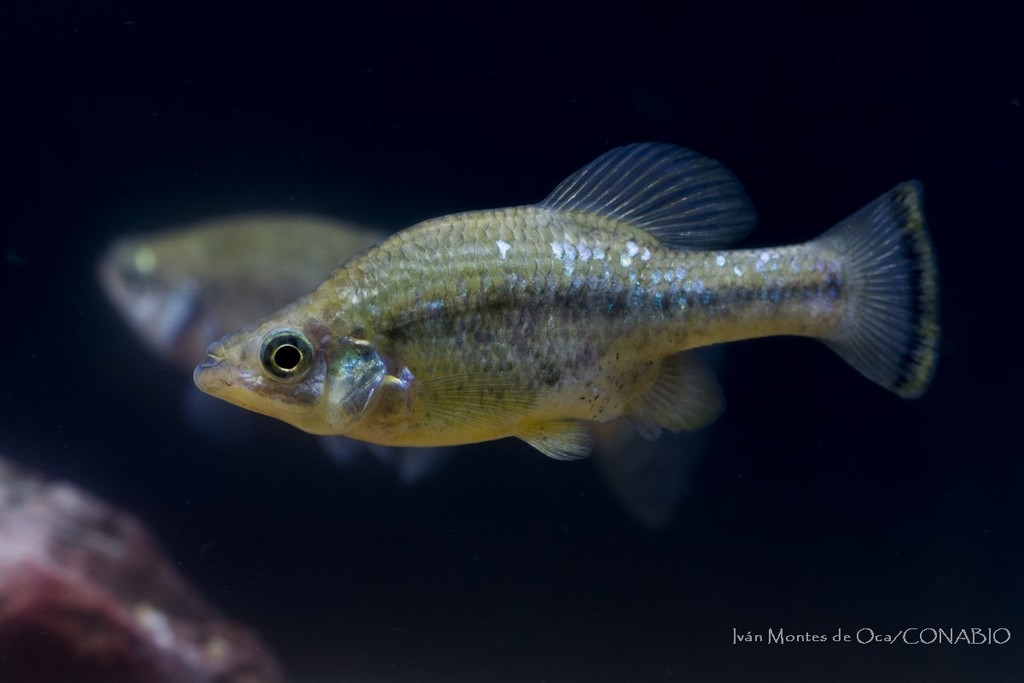
Butterfly Splitfin
Ameca splendens
The butterfly splitfin or butterfly goodeid (Ameca splendens) is a bony fish from the monotypic genus Ameca
of the splitfin family (Goodeidae). It was formerly found throughout the Ameca River drainage in Mexico; the type locality is Rio Teuchitlán in the vicinity of Teuchitlán, Jalisco, near the town of Ameca. The species was historically only found in an area about 10 miles (15 km) in diameter but in the early 21st century, searches have found it in a few other locations in the region, up to 100 km away at Cuyacapán.
From the article Butterfly splitfin on Wikipedia (CC BY-SA), quoted section by section
Description
As its common name implies, it is indeed quite an attractive fish. In a dominant mature male specimen the large dorsal fin is like the caudal fin washed with black. A yellow band stretches along the caudal's back margin. The body of both sexes is ochre, with silvery sides and a brownish back, which in males usually have numerous glittering metallic scales. Females and immatures having black dots on the sides and ochre fins. The fins of males intensify in color when they are excited, and depending on their mood, they can show more or less strongly a black band along the side. For the first two weeks or so after birth, the young are entirely silvery. Males can also be told apart from females because their anal fin's front part splits off and transforms to a blunt, flexible andropodium used for mating. As usual in live-bearers, males are the smaller sex, reaching some 3 in (7–8 cm) total length at best, with females being able to grow up to 4 in (10 cm) under good conditions.
What it does
In its former natural habitat, the bedrock is limestone, resulting in a hard and alkaline water with a general hardness of 6-10 dGH, while the temporary (carbonate) hardness is usually between 7 and 11°. The pH is around 8, and temperature varies little between the seasons, but ranges between about 70 and 85 °F (20 and 30 °C) between day and night. The vegetation is largely limited to algae and Ceratophyllum hornworts. The remnant wild population coexists with the native blackfin goodea (Goodea atripinnis) and Lerma live-bearer (Poeciliopsis infans), as well as with the common molly (Poecilia sphenops), Oreochromis tilapias, and the bluegill (Lepomis macrochirus) which presumably have all been introduced. Among groups of A. splendens, a loose dominance hierarchy develops, in particular in confined environments. Males chase each other about, with the dominant male(s) showing the most splendid coloration. Submissive males will try to retreat from attacks, typically towards the surface, and may shake their head as a calming signal.
Like other Goodeidae, butterfly splitfins mate by internal fertilization and spawn fully developed young. The females become sexually mature at about six months of age and can give birth every six to 10 weeks according to the water temperature and the condition of the fish. …
Wikipedia: “Ecology”
Where it lives
Recorded sightings
—
geo-referenced records in GBIF, from museums, herbaria and field observers.
Drag the globe to turn it. Dots are where records exist, not a range map; darker means more records.
In the stacks
Searching the stacks…
Every page naming Ameca splendens in the Biodiversity Heritage Library →
This page is assembled live from iNaturalist, GBIF, Wikipedia, the Source Library and the Internet Archive. It is not yet part of the hand-edited codex. iNaturalist taxon 93842.