- Animals
- ›Chordates
- ›Vertebrates
- ›Ray-finned Fishes
- ›Spiny-rayed fishes
- ›Rivulines, Killifishes, and Livebearers
- ›Cyprinodontoidei
- ›Splitfins
- ›Mexican Splitfins
- ›Characodon
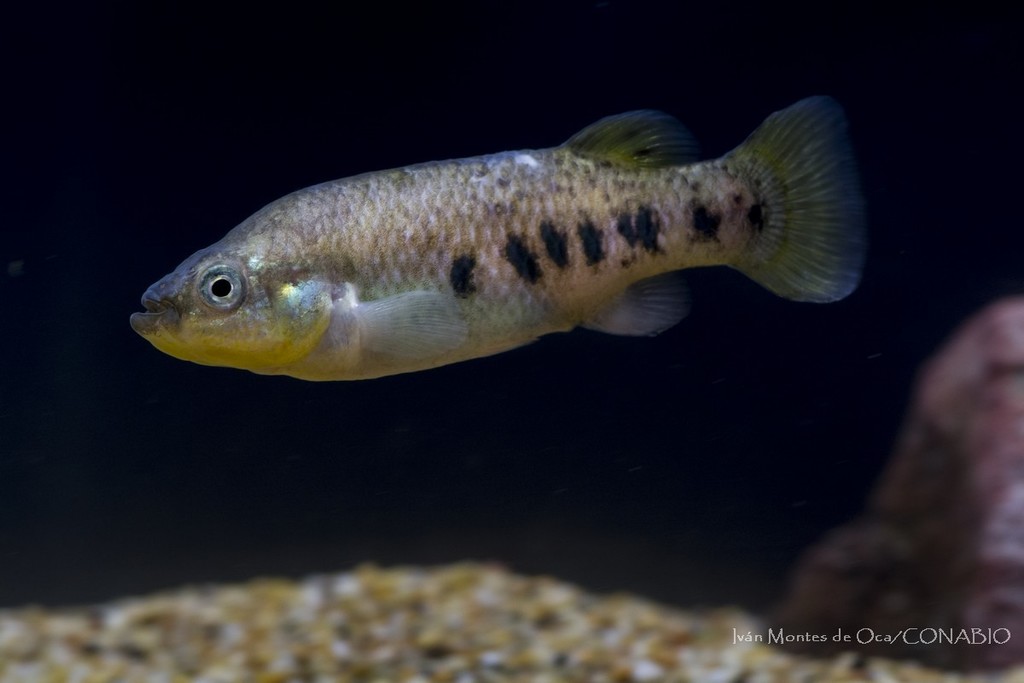
Rainbow Characodon
Characodon lateralis
The rainbow goodeid (Characodon lateralis) is a species of critically endangered freshwater fish in the family Goodeidae, and are endemic to Mexico. Specifically, they are found in shallow springs and ponds in the Durango and Coahuila area. They were first identified in 1866 by Albert Günther.
From the article Rainbow goodeid on Wikipedia (CC BY-SA), quoted section by section
Description
The rainbow goodeid is a small sexually dimorphic fish, averaging 42mm in size for males and 65mm for females. The phenotype exhibited varies greatly due to the separation of its populations. Head shape is the greatest variant between groups. Males are generally more colorful and larger-bodied, showing a blue or green body with red accents and a silver luster. They exhibit a modified anal fin (andropodium), used for aiding sperm transfer in internal fertilization. The unpaired fins are yellow, black, or red in color. A black band is often seen on or near the anal fin. The dorsal and anal fin bases are longer than the female's. Females are less colorful, with grey or green bodies with semi-transparent scales. Instead of banding on the fins, females exhibit a few oval-shaped spots on the frontal plane, between the anal fin and mid body.
Wikipedia: “Anatomy”
Range & habitat
The rainbow goodeid is typically found in freshwater, shallow springs or marshes with little to no current and plentiful submerged vegetation. It is sensitive to change in its habitat, and susceptible to the invasive species continually being introduced into its environment. They are endemic to northern Mexico, in the Durango and Coahuila regions. They prefer a pH range of 6.0-8.0 and a dH of 9-19. Their preferred temperature and latitude range is 18°C-27°C and 24°N-23°N, respectively. Clear to turbid water is ideal for this species, with a substrate consisting of sand, mud, silt, clay, rocks, or a marl bed. Most of their time is spent near the bed of the pond or stream. They do not migrate. The species is endemic to a relatively small area, being native to few bodies of water in Durango, Mexico. They have been found in the Abraham Gonzalez spring, around the El Salto waterfall on the Rio Tunal River, Los Berros, distributaries of the upper Rio Mezquital River, springs connected to Laguna El Toboso, and a private property in La Constancia. However, there may be locations in more remote areas that have not been surveyed. Many of the springs that they inhabit have dried up or been overcrowded with invasive species, so the number of suitable locations has been decreasing.
Wikipedia: “Habitat”
What it does
C. lateralis uses internal fertilization and is distinct from many other fish for displaying viviparity and matrotrophy. This means that the female keeps the embryo inside her body and gives birth to free-swimming offspring. Sexual maturity is reached after 5 months in females. The offspring are born live, ranging in 5-20 fry in each birth. The average length of gestation is 55 days. Nutrients to the offspring are provided by a structure similar to a placenta.
Wikipedia: “Reproduction”
Where it lives
Recorded sightings
—
geo-referenced records in GBIF, from museums, herbaria and field observers.
Drag the globe to turn it. Dots are where records exist, not a range map; darker means more records.
In the stacks
Searching the stacks…
Every page naming Characodon lateralis in the Biodiversity Heritage Library →
This page is assembled live from iNaturalist, GBIF, Wikipedia, the Source Library and the Internet Archive. It is not yet part of the hand-edited codex. iNaturalist taxon 97296.