- Animals
- ›Chordates
- ›Vertebrates
- ›Ray-finned Fishes
- ›Spiny-rayed fishes
- ›Perches, Scorpionfishes, Sticklebacks, and Allies
- ›Sculpins and Allies
- ›Grunt Sculpins
- ›Rhamphocottus
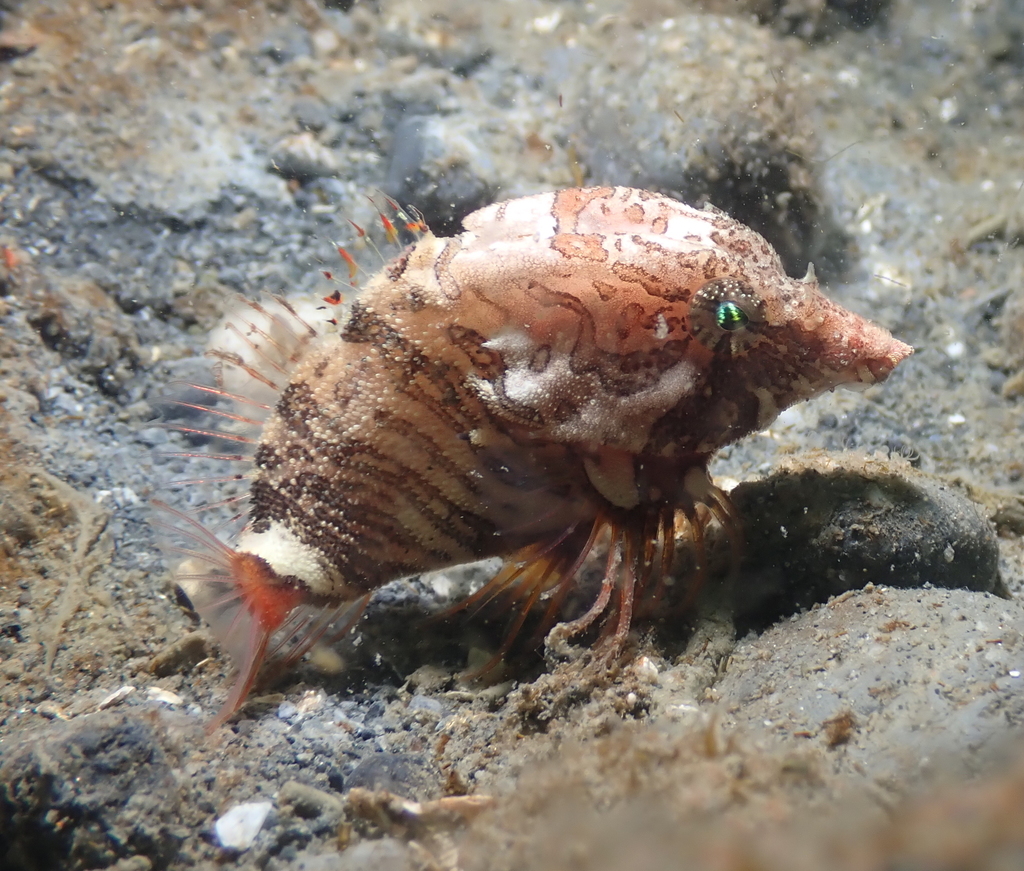
Grunt Sculpin
Rhamphocottus richardsonii
The grunt sculpin or grunt-fish (Rhamphocottus richardsonii) is a small fish mainly found in the eastern Pacific Ocean. The grunt sculpin generally remains close to shore and is often found in empty giant barnacle shells. The common name comes from reports that the fish vibrate or "grunt" when held. Its defining feature is its tendency to "hop" along the ocean floor on its orange fins. The short, stout body of the grunt sculpin has a long, small mouth which is adapted for eating smaller prey.
From the article Grunt sculpin on Wikipedia (CC BY-SA), quoted section by section
Description
The largest recorded length for the grunt sculpin is only 8.9 cm. Its main features are its big head, short, stout body, long pig snout, and orange fins. The body is usually a yellow color with brown stripes contrasted by its very orange pectoral fins. Compared to other sculpins, it has a small mouth with a longer snout affecting its feeding habits. Although it can swim in an abnormal manner with its head pointing up, it mainly "hops" along the bottom of the ocean using its several pectoral fins. It's phenotypically classified by its pectoral fins being separated from the upper lobe, the presence of anal and dorsal fin stays, and its hypural-parhypural bone being made of a singular piece.
Range & habitat
The grunt sculpin is found around the coasts in the eastern Pacific Ocean, stretching from southern California to the Bering Sea, although it has also been seen off of the coast of Japan. In these regions, the grunt sculpin resides in a variety of habitats such as rocky shores, kelp forest, sandy beaches, and reefs. In these habitats, it generally remains in shallower waters (as shallow as two meters) but it has been found at depths of 165 meters. It prefers to shelter in empty giant barnacles, but it will also live in debris under piers and floats in the absence of giant barnacles. Within the barnacles, the grunt sculpin will stick out its fins and wave them around to try to mimic the appearance and movement of the cirri of a living barnacle.
Wikipedia: “Distribution and habitat”
What it does
The grunt sculpin has a small mouth for a sculpin, therefore it mainly preys on small crustaceans but sometimes small fishes and worms as well. Classifying whether R. richardsonii are ram or suction feeders is difficult as it has physical features of both types and it feeds on both prey types (elusive and grasping) with similar success, though it fares better with smaller elusive prey. Ram feeders envelop the prey with a quick movement of their body while suction feeders use negative pressure to draw water and prey into their mouths. Elusive prey are prey that can initiate evasive maneuvers while grasping prey tend to hold onto the substrate to avoid being eaten. R. richarsonii tend to attack with lower velocities and from shorter distances (less than half its body length away) in comparison to other Cottidae fishes.
Wikipedia: “Diet”
Where it lives
Recorded sightings
—
geo-referenced records in GBIF, from museums, herbaria and field observers.
Drag the globe to turn it. Dots are where records exist, not a range map; darker means more records.
In the stacks
Searching the stacks…
Every page naming Rhamphocottus richardsonii in the Biodiversity Heritage Library →
This page is assembled live from iNaturalist, GBIF, Wikipedia, the Source Library and the Internet Archive. It is not yet part of the hand-edited codex. iNaturalist taxon 51881.