- Animals
- ›Chordates
- ›Vertebrates
- ›Ray-finned Fishes
- ›Spiny-rayed fishes
- ›Perches, Scorpionfishes, Sticklebacks, and Allies
- ›Scorpionfishes and Allies
- ›Typical Flatheads
- ›Elates
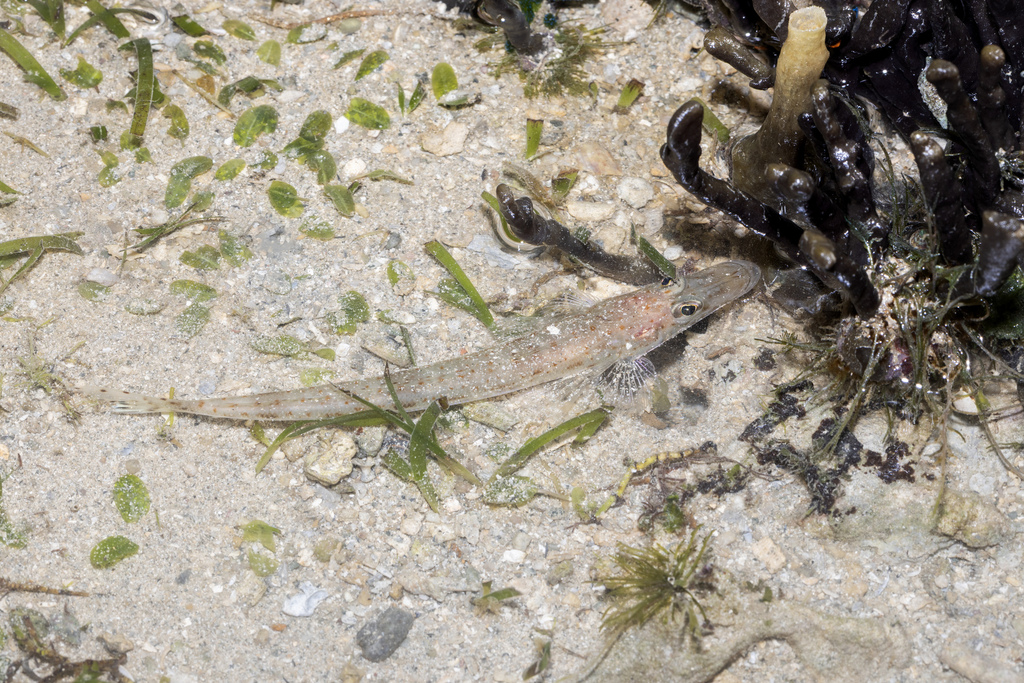
Dwarf Flathead
Elates ransonnettii
The dwarf flathead (Elates ransonnettii) is a species of marine ray-finned fish belonging to the family Platycephalidae, the flatheads. It is found in the Indo-Pacific. It is the only species in the monotypic genus Elates.
From the article Dwarf flathead on Wikipedia (CC BY-SA), quoted section by section
Description
The dwarf flathead has 6 spines in its first dorsal fin and 13-14 soft rays in both the second dorsal fin and the anal fin. The body is elongated with a moderately flattened head with a relatively small mouth which ends in front of the eye, below the front nostril. There is a single long bayonet-like spine on the preoperculum, often extending past the rear margin of the operculum, with no accessory spine. The supraorbital ridge is smooth and there is a preorbital spine and a preocular spine. There are two spines on the suborbital ridge, a short spine under the front part of the eye and a long spine below the rear of the eye/ There are two distinct patches of vomerine teeth. The lappet on the iris is a simple lobe. The caudal fin has an elongated filament extending from its upper lobe. This species is sandy coloured with a dusky coloured blotch on the operculum and there are a few oval blotches along the flanks> The dorsal and caudal fins are marked with dark spots. The maximum published total length of this species is 19 cm (7.5 in), although 15 cm (5.9 in) is more typical.
Range & habitat
The dwarf flathead is found in inshore and continental shelf waters in the Indo–West Pacific from the Gulf of Thailand and the Philippines to Papua New Guinea and south to Australia. In Australia it occurs from off Exmouth in Western Australia to Pine Peak Island in Queensland. It was reported twice in the Mediterranean Sea, off Italy in 2005 and Croatia in 2010, likely introduced via ballast water. It is found in sandy areas at depths between 5 and 95 m (16 and 312 ft), although there is a record from 221 m (725 ft).
== References ==
Wikipedia: “Distribution and habitat”
In human culture
Elates is Greek for "leader" or "driver", Jordan and Seale did not explain their choice of this name. The specific name honours the Austrian diplomat, painter, lithographer, biologist and explorer Eugen von Ransonnet-Villez who collected fishes in Singapore and sent them, including specimens of this species, to Steindachner.
Wikipedia: “Etymology”
Where it lives
Recorded sightings
—
geo-referenced records in GBIF, from museums, herbaria and field observers.
Drag the globe to turn it. Dots are where records exist, not a range map; darker means more records.
In the stacks
Searching the stacks…
Every page naming Elates ransonnettii in the Biodiversity Heritage Library →
This page is assembled live from iNaturalist, GBIF, Wikipedia, the Source Library and the Internet Archive. It is not yet part of the hand-edited codex. iNaturalist taxon 368616.