- Animals
- ›Chordates
- ›Vertebrates
- ›Ray-finned Fishes
- ›Spiny-rayed fishes
- ›Perches, Scorpionfishes, Sticklebacks, and Allies
- ›Sculpins and Allies
- ›Typical Sculpins
- ›Cottus
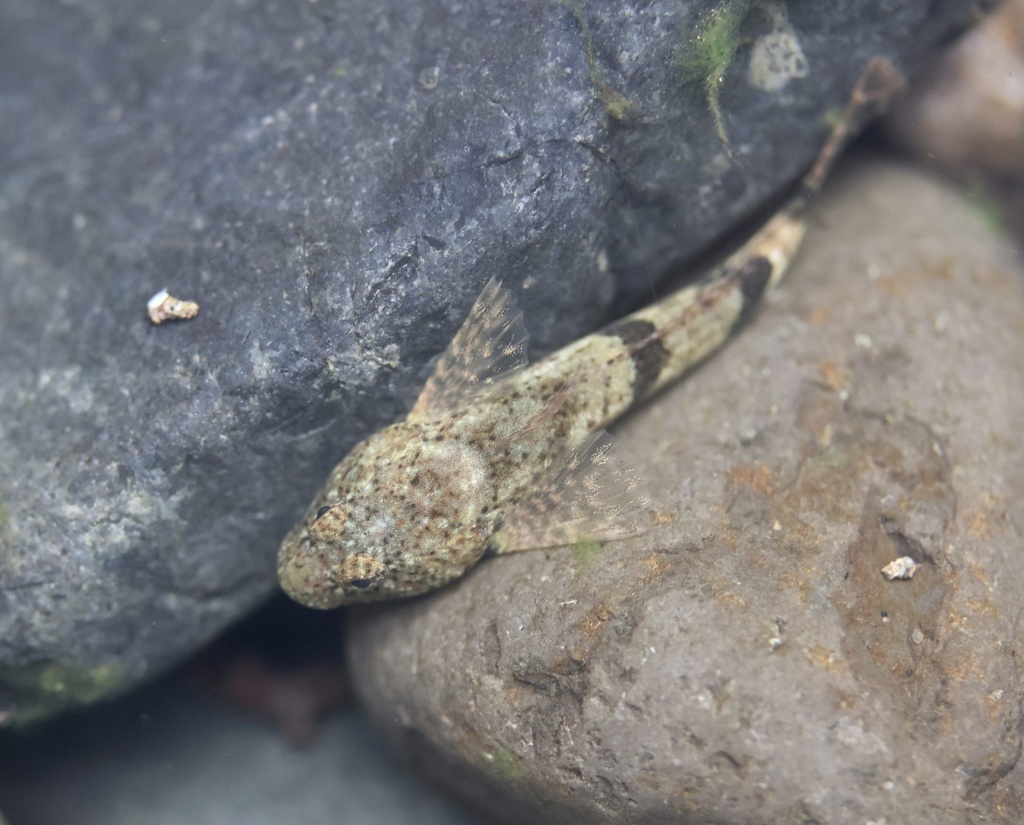
Torrent Sculpin
Cottus rhotheus
The torrent sculpin (Cottus rhotheus) is a species of ray-finned fish belonging to the family Cottidae, the typical sculpins. It is found in the United States and Canada, inhabiting upper Fraser River drainage in British Columbia to the Nehalem River in Oregon (including the Columbia River drainage of British Columbia, Washington, Idaho, Montana and Oregon. It reaches a maximum length of 150 mm. It prefers swift waters of small to large rivers with stable gravel or rubble bottoms, and rocky lake shores.
From the article Torrent sculpin on Wikipedia (CC BY-SA), quoted section by section
Range & habitat
C. rhotheus is a widespread species that is a bottom-dwelling fish, persisting in high numbers. They are commonly found within the Columbia River Basin. This consists of British Columbia, Washington, Idaho, Montana, and Oregon regions. It also lives in the upper Fraser River system in British Colombia, the coastal drainage systems in Nehalem River within Oregon, and the coastal drainage systems in Pudget Sound within Washington. C. rhotheus has a wide range of habitats that mostly consist of lotic water systems. They are present within medium to large streams and can be found in lakes further north. Their distribution is patchy within the Lake Washington basin. There are four other sculpin species which inhabit the Lake Washington basin with higher numbers, including 25 native species and 20 introduced species. Introduced, or non-native species, can cause increased competition and predation on sculpins, weakening their population numbers. Within the Cedar River, C. rhotheus is the most abundant species of sculpin. C. rhotheus has a cold water-adapted physiology that allows them to live within streams along the Pacific Northwest which are inhabitable for most fish species.
Wikipedia: “Distribution”
In human culture
Sculpins present in freshwater can be categorized into two distinct types of groups based on the stages present in larvae; pelagic or benthic. Torrent sculpins are classified as the benthic group. The C. rhotheus larvae stage disperses slowly and they don't migrate, unlike the pelagic group. On average, torrent sculpins become sexually mature around age 2. Spawning for C. rhotheus can occur from April to June. Within the lower Columbia River, spawning time was between late May and mid-July; with the average water temperature being 9 °C to 16 °C. Torrent sculpins were assessed for maturity by applying a small amount of pressure to see if milt or eggs were expressed. If males and females expressed these characteristics, or if their abdomens were soft or urogenital pores were swollen, they were classified as sexually mature (adult). C. rhotheus adults continue to guard nests even if egg mortality is high and water levels decline. Males guard nests by attacking any potential intruders that come close to the nest. C. rhotheus males fan the eggs using their pectoral fins and clean them using their anal fins. …
Wikipedia: “Life history”
Where it lives
Recorded sightings
—
geo-referenced records in GBIF, from museums, herbaria and field observers.
Drag the globe to turn it. Dots are where records exist, not a range map; darker means more records.
In the stacks
Searching the stacks…
Every page naming Cottus rhotheus in the Biodiversity Heritage Library →
This page is assembled live from iNaturalist, GBIF, Wikipedia, the Source Library and the Internet Archive. It is not yet part of the hand-edited codex. iNaturalist taxon 98587.