- Animals
- ›Chordates
- ›Vertebrates
- ›Ray-finned Fishes
- ›Spiny-rayed fishes
- ›Wrasses and allies
- ›False scorpionfishes, wrasses, and parrotfishes
- ›Wrasses and Parrotfishes
- ›Fairy wrasses and allies
- ›Cirrhilabrus
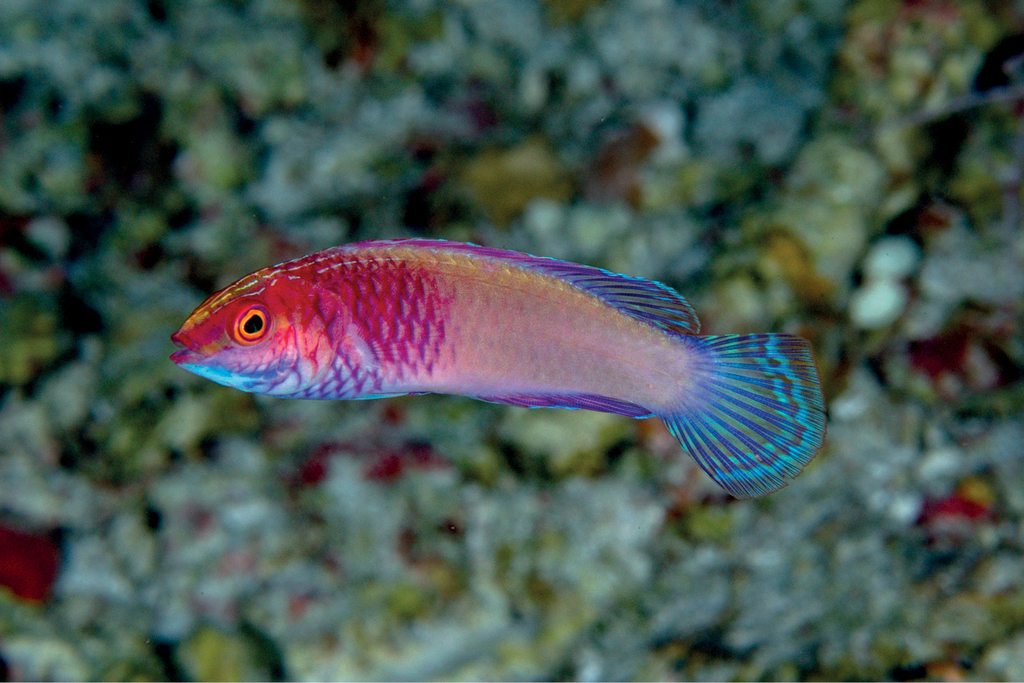
Rose-veiled Fairy Wrasse
Cirrhilabrus finifenmaa
Cirrhilabrus finifenmaa, also known by its common name rose-veiled fairy wrasse, is a rainbow-colored wrasse that is native to the reefs of the Maldives.
From the article Cirrhilabrus finifenmaa on Wikipedia (CC BY-SA), quoted section by section
Description
C. finifenmaa is a teleost that belongs to the Labridae family, one of the most diverse families of fishes in the world. Fossils from this family are present off the coast of Italy dating back from the Eocene period. However, others argue that Labridae could be as old at 90 million years. Cirrhilabrus finifenmaa individuals have ornate colors: the anterior body is magenta, the central region is dark purple, and the posterior body is an orange-pink color. Fins are a mix of purple and blue hues. The lateral line is interrupted and is composed of 22-26 porous scales. Members of this group have scales with a crosshatched pattern present in the anterior body. The tenth to eleventh dorsal-fin spine is the longest. Scales are present on the magenta anterior body, particularly on the chest and isthmus. The scales are cycloid. Nearly all the soft rays are branched. There are fifteen rays on the pectoral fins. Members of this species have small mouths with the maxilla nearly contacting the orbit. C. finifenmaa individuals have three pairs of teeth on the upper jaw and one pair on the lower jaw. In males, the interspinous membranes of the dorsal fins extend beyond dorsal-fin spines. The caudal fin is rounded, and the pectoral fins are short. Male and female specimens differ slightly in color. …
Range & habitat
Cirrhilabrus finifenmaa individuals are found at a depth of around 50 meters in warm mesophotic coral ecosystems. Mesophotic coral systems have photosynthetic organisms like algae and coral; they also occur at depths of around 30 to 150 meters in tropical and subtropical regions. However, researchers believe that members of this newly described species are likely present in deeper waters since C. finifenmaa often inhabit loose coral bottom waters. This new species belongs to the Cirrhilabrus jordani species complex, which is a group of fairy wrasses that form a clade within the Indian Ocean. Species belonging to this complex are often distributed across the Indo-Pacific.
Wikipedia: “Distribution”
What it does
Very little is known about the reproduction of Cirrhilabrus finifenmaa. However, it has been observed in the general Cirrhilabrus genus. Each male territory is composed of one or two female herds. Each herd comprises 5 to 40 female individuals. Females do move between male territories. Cirrhilabrus follows a promiscuous mating system in which multiple matings of both sexes without any apparent pair bonding occurs. Previously, it was observed that spawning occurs from July to September, but some scientists argue it can happen year-round. Courtship behavior begins a few hours prior to spawning. Males will flash, rush, and loop. When flashing, a male will swim in proximity to a female while rapidly fluttering his caudal fin. Body color also changes. Rushing will then ensue where a male suddenly veers towards a female from the rear. Lastly, looping begins. Looping is when the male quickly ascends and descends, and then spawning occurs. Researchers observed that members of Cirrhilabrus do not group spawn; they pair spawn. During spawning, a male quickly approaches a female from behind, and together they dash upwards, reverse direction, and return to the herd. Eggs and sperm are released at the height of ascent, and this occurs quickly. Members of the Labridae family produce about thirty to a few thousand eggs per female. Afterwards, the male will continue courting other females. …
Wikipedia: “Reproduction”
At the table
Members of the Labridae family, particularly those living in or near coral reefs, have a diverse diet including corals, crustaceans, mollusks, and other fishes. Recently, it has been observed that the mucosa produced by the buccal cavity plays a role in prey acquisition. The Cirrhilabrus genus has a large amount of mucus secretion from cells of the buccal cavity, a trait uncommon in other planktivores. Their diet consists highly of amorphous organic matter. Cirrhilabrus eat by plucking small, suspended prey/material with suction rather than filtering the water column. Scientists believe that the mucus is not primarily related to particle retention, but it is used to help ingest gelatinous materials.
Wikipedia: “Food habits”
In human culture
C. finifenmaa was spotted by John Ernest Randall in 1983 and was initially thought to be an adult version of C. rubrisquamis, a fish from the Chagos Archipelago island chain. The researchers who described C. finifenmaa suggested that C. rubrisquamis may be synonymous with C. wakanda. C. finifenmaa was first described as a separate species in 2022 by a team of researchers from the University of Sydney, the Maldives Marine Research Institute (MMRI), the Field Museum, and the California Academy of Sciences as part of the Hope for Reefs project. Ahmed Najeeb, a biologist at the MMRI, co-authored the paper announcing the discovery, making him the first Maldivian to describe a new species. The species is named after the Dhivehi word finifenmaa, meaning rose, due to its coloration.
Wikipedia: “Discovery and etymology”
Where it lives
Recorded sightings
—
geo-referenced records in GBIF, from museums, herbaria and field observers.
Drag the globe to turn it. Dots are where records exist, not a range map; darker means more records.
In the stacks
Searching the stacks…
Every page naming Cirrhilabrus finifenmaa in the Biodiversity Heritage Library →
This page is assembled live from iNaturalist, GBIF, Wikipedia, the Source Library and the Internet Archive. It is not yet part of the hand-edited codex. iNaturalist taxon 1376774.