On eBird ↗
African Green Bee-eater
Live sightings near you, the range map, bar charts of when it is seen, and Macaulay Library photos and recordings.
African Green Bee-eater
Merops viridissimus
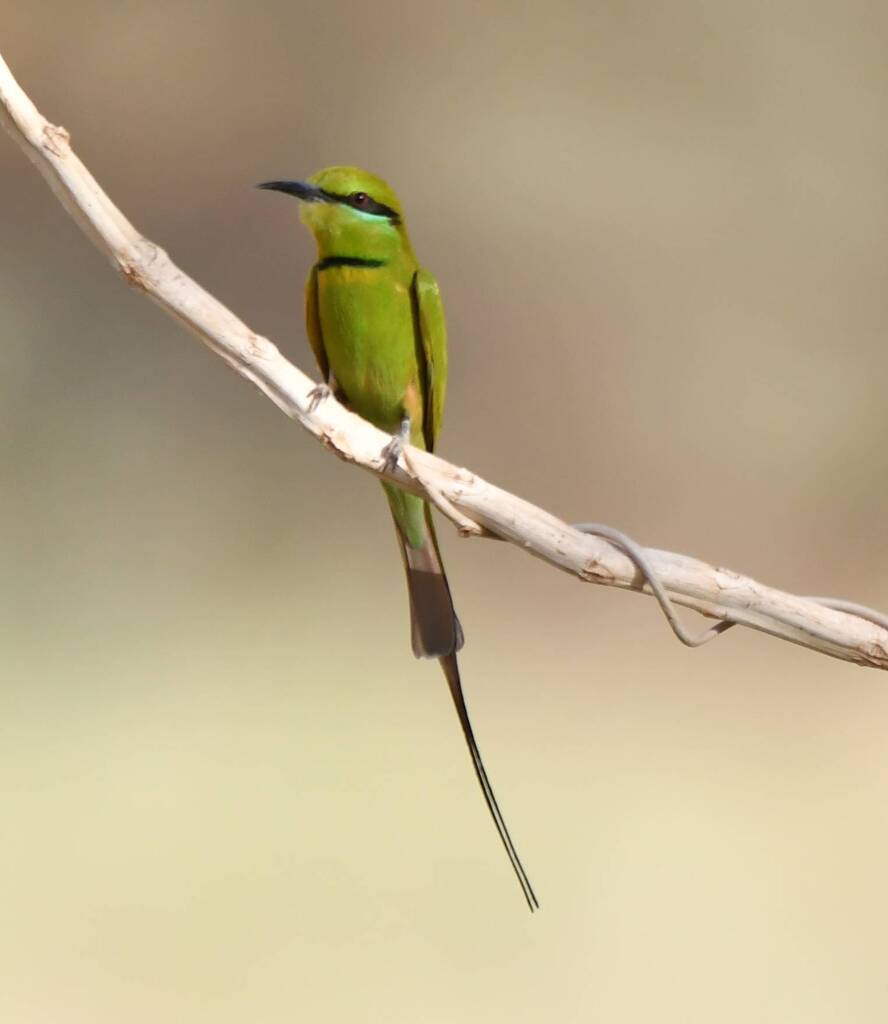
The African green bee-eater (Merops viridissimus) is a species of bird in the family Meropidae. It is found throughout arid Sahel region of Africa from Senegal east to Ethiopia, and has expanded its range north to Egypt over the past few decades.
From the article African green bee-eater on Wikipedia (CC BY-SA), quoted section by section
Description
It is 16–18 centimetres (6.3–7.1 in) long excluding the elongated central tail feathers, which are an additional 8–10 cm (3.1–3.9 in) long. The head and body plumage is dull yellowish-green except for a slender black eyestripe with a very narrow blue line on the lower edge, and a black crescent at the top of the breast below the throat. The most distinctive traits of this species are that its throat is also yellowish-green, in contrast to the blue throats of M. orientalis and M. cyanophrys, and the central tail feathers are much longer. The wing and tail feathers are bronzed coppery-green above, and coppery-orange below. The iris is red, the bill is black, and the legs are dark grey. The juveniles are paler and duller overall, lack the elongated tail feathers and black throat crescent. The species also differs from M. orientalis and M. cyanophrys in its voice.
Range & habitat
It is found throughout semiarid regions of Africa, its distribution roughly coinciding with the Sahel. It ranges from coast to coast, reaching its western extent in Senegal and eastern extent in Ethiopia. The species has taken advantage of changes to agriculture and increased irrigation in this region, and has thus increased in abundance, expanding its range along the Nile. It colonised Egypt prior to 2001 and now ranges as far north as the Nile Delta. Due to this increasing population and it benefiting from human habitat modification, it is not thought to be under threat.
== References ==
Wikipedia: “Distribution”
Listen
Looking for field recordings…
Where it lives
Recorded sightings
—
geo-referenced records in GBIF, from museums, herbaria and field observers.
Drag the globe to turn it. Dots are where records exist, not a range map; darker means more records.
In the stacks
Searching the stacks…
Every page naming Merops viridissimus in the Biodiversity Heritage Library →
This page is assembled live from iNaturalist, GBIF, Wikipedia, the Source Library and the Internet Archive. It is not yet part of the hand-edited codex. iNaturalist taxon 1430300.