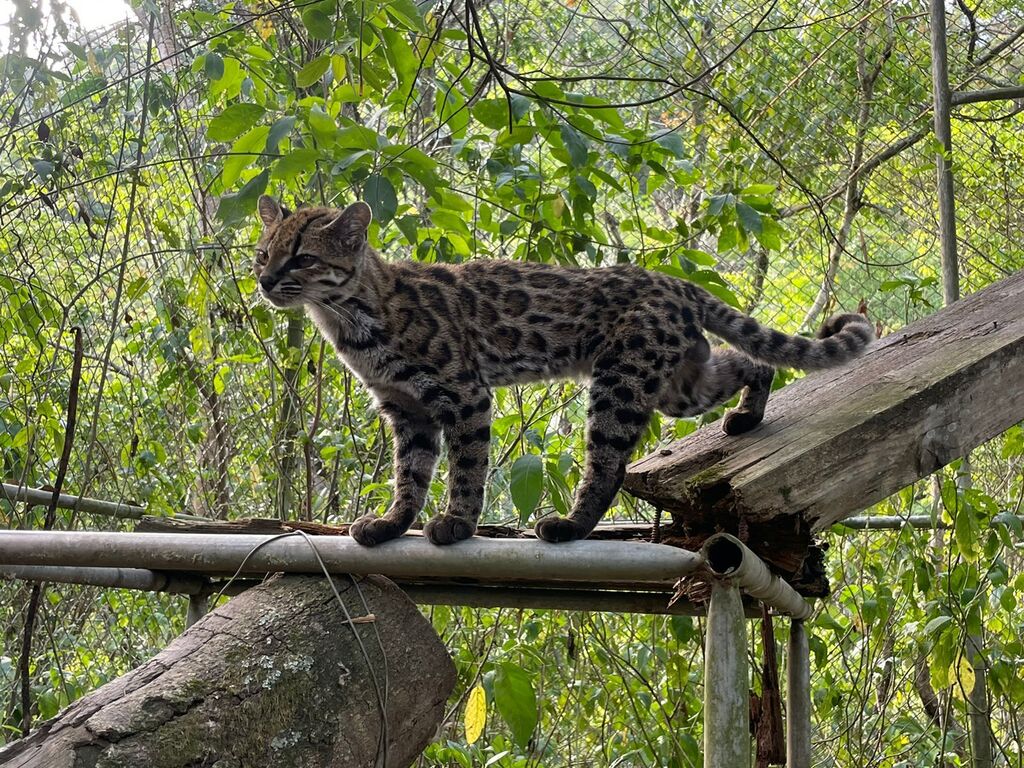


Tilcayo
Leopardus tilcayo Nogales-Ascarrunz, Aliaga-Rossel, Lescroart & Eizirik in Lescroart et al., 2026
The tilcayo (Leopardus tilcayo; til-KYE-oh; Spanish pronunciation: [tilˈkaʝo] ), or tilcayo tiger cat, is a species of small wild cat in the genus Leopardus native to Bolivia. Identified through a genetic study of tiger cats published in September 2026, the tilcayo is the first extant cat species formally described since 1923. The tilcayo was already known to local communities under that name. Its appearance is similar to that of other tiger cat species such as the oncilla, and its status as a genetically distinct population was not documented by zoologists until the 2026 study.
- Recorded from
- South America
From Wikipedia (CC BY-SA), quoted section by section
Description
The fur of the tilcayo is light brown with irregularly shaped rosettes. Its rosettes are large and dark brown to black in color, and are either open or partially closed –they do not coalesce. It also has short, round ears, long whiskers, and a scrunched-up face. Like many species in the Leopardus genus, it is smaller than a domestic cat. It has a head–body length of 42.5–50 cm (16.7–19.7 in), with a tail length of 25–26.5 cm (9.8–10.4 in). It weighs 1.5–2.0 kg (3.3–4.4 lb). The tilcayo so closely resemble other tiger cat species they are considered a cryptic species, difficult to distinguish from others by morphology alone.
Range & habitat
The tilcayo was found near the town of Arapata in Nor Yungas province, in the Bolivian department of La Paz, at an elevation of 1,570 m (5,150 ft). This locality is positioned in the mountainous Yungas forest region, a cloud forest, on the eastern slope of the Andes mountain range.
In human culture
The name "tilcayo" was already used for the species by local communities in the region. Publications on Bolivian fauna predating 2026 associate the term tilcayo with Leopardus tigrinus. It was originally reported that the exact etymology of the term is unknown, as it did not appear to be of Spanish, Quechuan, or Aymara origin. The term has been passed down in the local communities through generations, with its meaning reportedly lost in transfer. However, in an interview following the announcement of the species identification, Nogales-Ascarrunz stated that native Aymara speakers had reached out through social media suggesting that the term likely comes from t'ili kayu (lit. 'tiny foot').
Where it has been recorded
Recorded sightings
—
geo-referenced records in GBIF, from museums, herbaria and field observers.
Drag the globe to turn it. Dots are where records exist, not a range map; darker means more records.
In the stacks
Searching the stacks…
Every page naming Leopardus tilcayo in the Biodiversity Heritage Library →
References
- Lescroart, Jonas, Paola Nogales-Ascarrunz, Molly Cassatt-Johnstone, A. Bonilla-Sánchez, et al. (2026). Phylogenomics and museomics reveal five distinct species of tiger cats in South America. Current Biology, Vol. 36.
From the Catalogue of Life (catalogueoflife.org), compiled from its specialist databases; CC BY 4.0. This name in the Catalogue of Life.