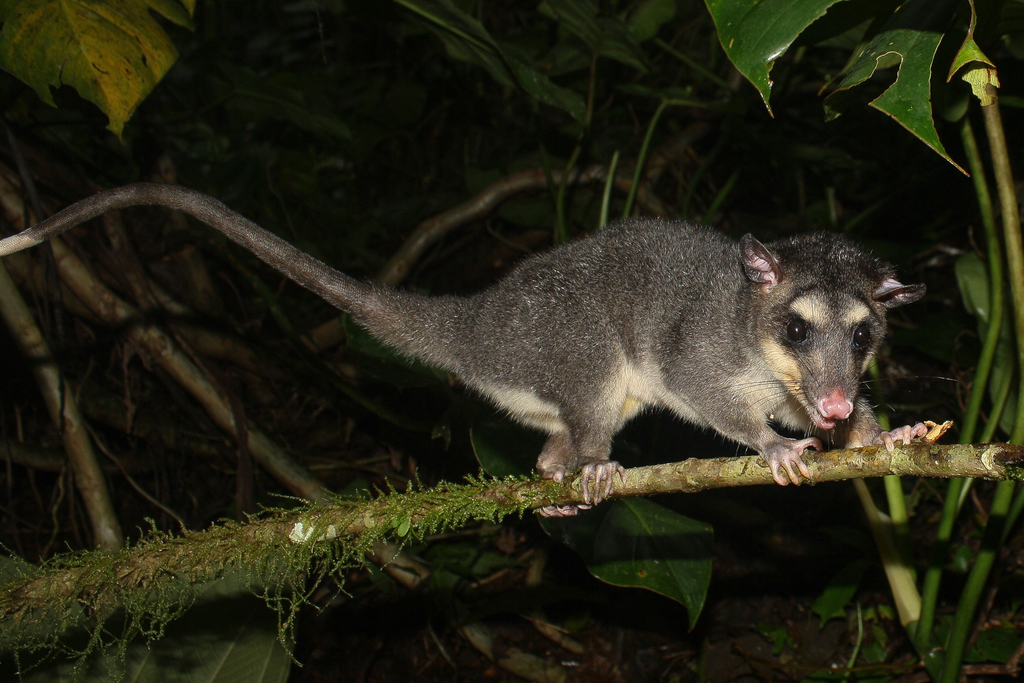


Southern Four-eyed Opossum
Philander quica (Temminck, 1824)
The southern four-eyed opossum (Philander quica) is a species of opossum from South America.
- Recorded from
- South America
- Also published as
- Didelphis quica Temminck, 1824
From Wikipedia (CC BY-SA), quoted section by section
Description
The upper fur on this species is grayish, with darker underfur and darker near the ears and face. The underside is yellowish to whitish, with some gray colors near the sides, between the forearms, and on the bottom of the neck and jaw. It has two spots above each eye that are the same color as the underside. The tail is bald, and gray for half to two-thirds of its length, then white on the distal half to distal third. This species ranges in size from 230 mm (9.1 in) to 620 mm (24 in), averaging 487 mm (19.2 in). The tail length averages 262 mm (10.3 in) of this length, ranging from 170 mm (6.7 in) to 320 mm (13 in). Despite this wide range of sizes, there is no physical difference between populations across their range.
Range & habitat
This species is found in southern Brazil, northeastern Argentina, and eastern Paraguay. Its range likely comes into contact with that of the common four-eyed opossum (P. canus) where the Atlantic Rainforest comes into contact with other forests, in Brazil and Paraguay. This is the only Philander species known from the Atlantic Rainforest. This species is endemic to the Atlantic Rainforest, where it occupies almost all habitats within the region. It has been recorded from lowland forests, submontane forests, costal scrub, and even agricultural fields.
What it does
Similar to its congeners, this species is a true omnivore, consuming fruits, flowers, seeds, invertebrates, carrion, and small vertebrates. This species specifically has been recorded feeding on seeds, birds, mammals, reptiles, and various invertebrates, with birds and beetles being the most common prey items. This species is primarily terrestrial, nocturnal, and solitary. Litters average roughly 3-6 young per litter.
== References ==
In human culture
"quica" seems to come from a native name for this species. It is derived from the Portuguese word "cuíca", itself derived from a Tupi word.
Where it has been recorded
Recorded sightings
—
geo-referenced records in GBIF, from museums, herbaria and field observers.
Drag the globe to turn it. Dots are where records exist, not a range map; darker means more records.
In the stacks
Searching the stacks…
Every page naming Philander quica in the Biodiversity Heritage Library →
References
- Burgin, Connor J., Don E. Wilson, Russell A. Mittermeier, Anthony B. Rylands, et al. (2020). Illustrated Checklist of the Mammals of the World. Vol. 1. Monotremata to Rodentia.
From the Catalogue of Life (catalogueoflife.org), compiled from its specialist databases; CC BY 4.0. This name in the Catalogue of Life.