Voalavo
Voalavo Carleton & Goodman, 1998
Voalavo is a genus of rodent in the subfamily Nesomyinae, found only in Madagascar. Two species are known, both of which occur in mountain forest above 1250 m (4100 ft) altitude; the northern voalavo lives in northern Madagascar and the eastern voalavo is restricted to a small area in the central part of the island. The genus was discovered in 1994 and formally described in 1998. Within Nesomyinae, it is most closely related to the genus Eliurus, and DNA sequence data suggest that the current definitions of these two genera need to be changed.
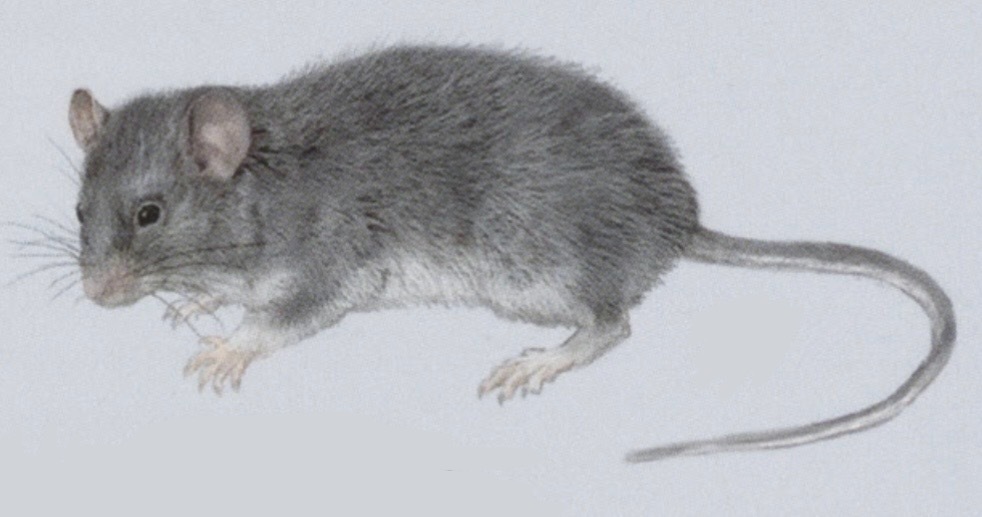
Species of Voalavo are small, gray, mouse-like rodents, among the smallest nesomyines. They lack the distinctive tuft of long hairs on the tail that is characteristic of Eliurus. The tail is long and females have six mammae. In Voalavo, there are two glands on the chest (absent in Eliurus) that produce a sweet-smelling musk in breeding males. In the skull, the facial skeleton is long and the braincase is smooth. The incisive foramina (openings in the front part of the palate) are long and the bony palate itself is smooth. The molars are somewhat hypsodont (high-crowned), though less so than in Eliurus, and the third molars are reduced in size and complexity.
2 species · 2 branches
From Wikipedia (CC BY-SA), quoted section by section
Description
Voalavo is a small rodent resembling a mouse with gray fur. Species of the genus are among the smallest known nesomyines, close in size only to Monticolomys koopmani. In terms of external morphology, Voalavo is barely different from Eliurus; fur coloration patterns, general morphology of the feet, and number of mammae (six) are all the same in both genera. However, all species of Eliurus have a pronounced tuft of elongated hairs at the tip of the tail, a feature that is absent in Voalavo, although the latter does have slightly longer hairs near the tip. The tail is longer than the head and body. Relative tail length in northern voalavo (136% of head and body length) is comparable to that of the longest-tailed species of Eliurus, Grandidier's tufted-tailed rat and Petter's tufted-tailed rat, but V. antsahabensis has a somewhat shorter tail. Furthermore, the pads of the feet are larger in Eliurus, and specifically, the thenar pad (located at the middle of the tarsus) is circular and fairly small in Voalavo, but longer and larger in Eliurus. On the chest, Voalavo species have a gland that produces a sweet-swelling musk in breeding males; this gland is absent in Eliurus. …
Range & habitat
Both species of Voalavo occur in montane forest. Northern voalavo is restricted to the Northern Highlands, where it is found at 1,250–1,950 m (4,100–6,400 ft) altitude in Marojejy and Anjanaharibe-Sud. The known range of eastern voalavo is restricted to the vicinity of Anjozorobe at 1,250–1,425 m (4,101–4,675 ft) altitude. Although most of the 450 km (280 mi) between the ranges of the two species consists of montane forest—suitable habitat for Voalavo—the area is bisected by the low-lying Mandritsara Window, which may serve as a barrier between the two species. Subfossil remains of Voalavo have been found in the former Mahajanga Province (northwestern Madagascar). Very little is known of the ecology of eastern voalavo, but northern voalavo is thought to be largely terrestrial with some scansorial (tree-climbing) abilities. It is active during the night, bears up to three young per litter, and probably eats fruits and seeds. Various parasites have been recorded on northern voalavo, including mites and Eimeria.
Where it has been recorded
Recorded sightings
—
geo-referenced records in GBIF, from museums, herbaria and field observers.
Drag the globe to turn it. Dots are where records exist, not a range map; darker means more records.
In the stacks
Searching the stacks…
Every page naming Voalavo in the Biodiversity Heritage Library →
References
- Goodman, Steven M., Daniel Rakotondravony, Hary N. Randriamanantsoa, and Marlène Rakotomalala-Raz... (2005). A new species of rodent from the montane forest of central eastern Madagascar (Muridae: Nesomyinae: Voalavo). Proceedings of the Biological Society of Washington, Vol. 118, No. 4.
- Musser, Guy G., and Michael D. Carleton / Wilson, Don E., and DeeAnn M. Reeder, eds. (2005). Superfamily Muroidea. Mammal Species of the World: A Taxonomic and Geographic Reference, 3rd Ed., Vol. 2.
From the Catalogue of Life (catalogueoflife.org), compiled from its specialist databases; CC BY 4.0. This name in the Catalogue of Life.