- Animals
- ›Chordates
- ›Vertebrates
- ›Mammals
- ›Therians
- ›Placental Mammals
- ›Primates, Rodents, and Allies
- ›Rodents
- ›Mice, Rats, and Hamsters
- ›Muroids
- ›Old World Mice and Rats
- ›Murines
- ›Typical Old World Rats
- ›Rattus
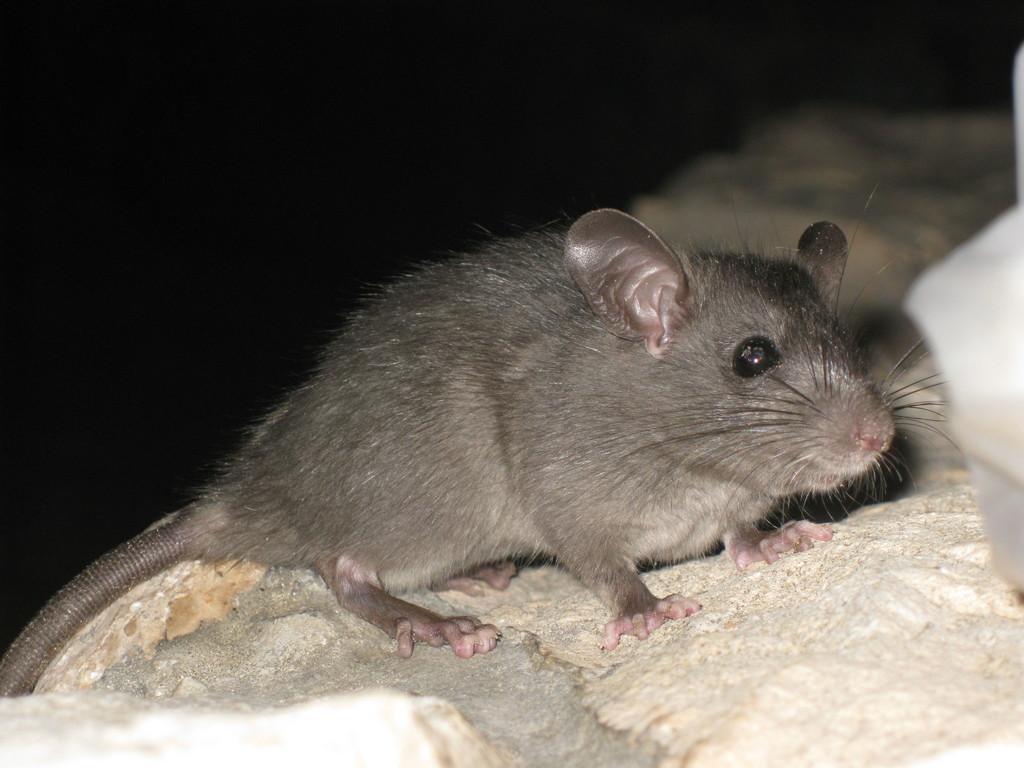
Black Rat
Rattus rattus
The black rat (Rattus rattus), also known as the roof rat, ship rat, or house rat, is a common long-tailed rodent of the stereotypical rat genus Rattus, in the subfamily Murinae. It is a generalist omnivore that can live on a wide variety of foods. It associates extensively with humans, and most populations are synanthropic. It likely originated in the Indian subcontinent, but is now found worldwide.
The black rat is black to light brown in colour with a lighter underside. It is a prominent pest to farmers because it feeds on a wide range of agricultural crops. It is sometimes kept as a pet, though most domestic rats are a subspecies of the brown rat. In parts of India, it is considered sacred and respected, notably at the Karni Mata Temple in Deshnoke.
From the article Black rat on Wikipedia (CC BY-SA), quoted section by section
Description
A typical adult black rat is 12.75 to 18.25 cm (5.02 to 7.19 in) long, not including a 15 to 22 cm (5.9 to 8.7 in) tail, and weighs 75 to 230 g (2.6 to 8.1 oz), depending on the subspecies. Despite its name, the black rat exhibits several colour forms. It is usually black to light brown in colour with a lighter underside. In England during the 1920s, several variations were bred and shown alongside domesticated brown rats. This included an unusual green-tinted variety. The species has three colour variants:
Roof rat (R. rattus rattus) – slate black with a gray underside Alexandrine rat (R. rattus alexandrinus) – agouti and grey through slate grey Fruit rat (R. rattus frugivorus) – agouti and pure white. Tail length varies among subspecies, but is typically longer than the rat's head and body combined. Both R. rattus alexandrinus and R. rattus frugivorus display a tendency for longer tails than other sub-species. The baculum of R. rattus is similar in structure to that of R. norvegicus, and composed of cartilage at the tip, with the base being built of bone. As with R. norvegicus, the phallus is covered in spines.
Skull. Among all three variants, skull size and shape is roughly constant.
Range & habitat
The black rat originated in India and Southeast Asia, and spread to the Near East and Egypt, and then throughout the Roman Empire, reaching Great Britain as early as the 1st century AD. Europeans subsequently spread it throughout the world. The black rat is again largely confined to warmer areas, having been supplanted by the brown rat (Rattus norvegicus) in cooler regions and urban areas. In addition to the brown rat being larger and more aggressive, the change from wooden structures and thatched roofs to bricked and tiled buildings favoured the burrowing brown rats over the arboreal black rats. In addition, brown rats eat a wider variety of foods, and are more resistant to weather extremes. Black rat populations can increase exponentially under certain circumstances, perhaps having to do with the timing of the fruiting of the bamboo plant, and cause devastation to the plantings of subsistence farmers; this phenomenon is known as mautam in parts of India. Black rats are thought to have arrived in Australia with the First Fleet, and subsequently spread to many coastal regions in the country. Black rats adapt to a wide range of habitats. In urban areas they are found around warehouses, residential buildings, and other human settlements. They are also found in agricultural areas, such as in barns and crop fields. …
Wikipedia: “Distribution and habitat”
What it does
The black rat has a wide home range, typically foraging in a home range of 0.28–1.2 ha (0.69–2.97 acres). Its home range is highly dependent on its gender, as male rats range can be up to thrice that of female rats. Its home range also differs depending on the type of forest; home ranges in the southern beech forests of the South Island, New Zealand appear to be much larger than the non-beech forests of the North Island. Due to the limited number of rats that are studied in home range studies, the estimated sizes of rat home ranges in different rat demographic groups are inconclusive.
Social behaviour. The black rat is generally territorial, although the territory is typically a small subset of the full range. Female black rats have no hierarchy, and are generally more aggressive, while male rats tend to flee when attacked unless females are present. Like its relative R. norvegicus, R. rattus often huddle in groups. Rats are at their most aggressive when they have just reached adulthood, but do not tend to lose status as they grow older, and younger rats are often singled out as enemies by older females. Older females and male rats of high status rarely fight among themselves, although they are occasionally fought by younger rats. Although rattus and norvegicus can coexist in the same habitat, R. …
Wikipedia: “Behaviour and ecology”
Listen
Looking for field recordings…
Where it lives
Recorded sightings
—
geo-referenced records in GBIF, from museums, herbaria and field observers.
Drag the globe to turn it. Dots are where records exist, not a range map; darker means more records.
In the stacks
Searching the stacks…
Every page naming Rattus rattus in the Biodiversity Heritage Library →
This page is assembled live from iNaturalist, GBIF, Wikipedia, the Source Library and the Internet Archive. It is not yet part of the hand-edited codex. iNaturalist taxon 44575.