- Animals
- ›Chordates
- ›Vertebrates
- ›Mammals
- ›Therians
- ›Placental Mammals
- ›Primates, Rodents, and Allies
- ›Rodents
- ›Mice, Rats, and Hamsters
- ›Muroids
- ›Old World Mice and Rats
- ›Murines
- ›Australasian Mice and Rats
- ›Pseudomys
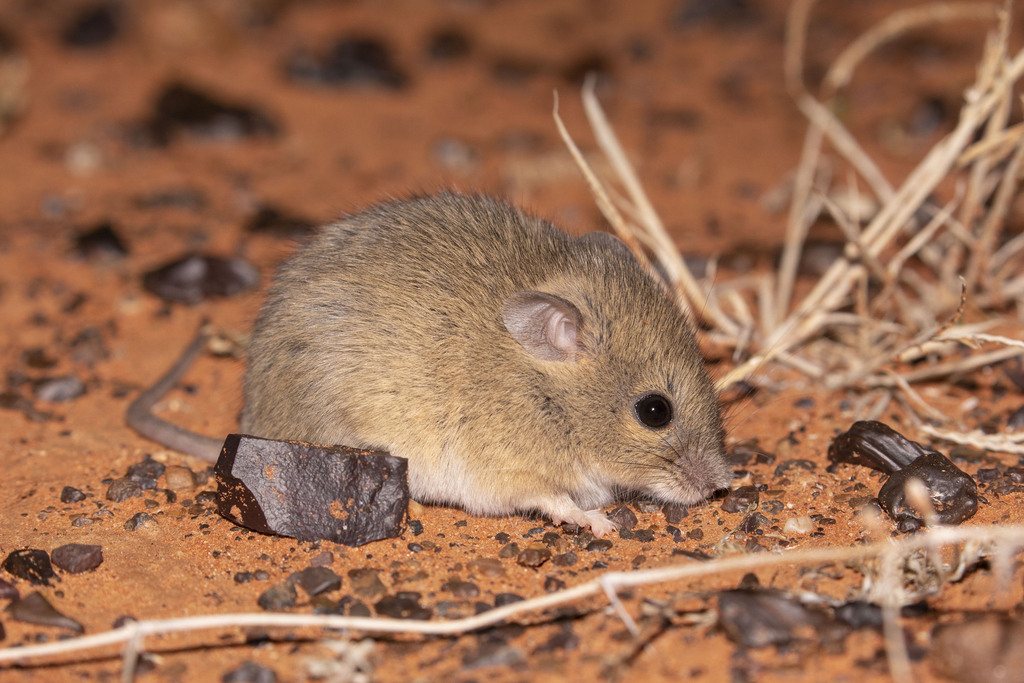
Plains Mouse
Pseudomys australis
The plains rat (Pseudomys australis), also known as the palyoora, plains mouse and eastern mouse, is a conilurine rodent native to arid and semi-arid Australia. Referred to as the pallyoora or yarlie by Indigenous groups, the plains rat was once widely distributed across central Australia, including north-west New South Wales and south-west Queensland; however, habitat degradation due to grazing, introduced predators and drought have contributed to its decline. Consequently, the plains rat has been listed as 'presumed extinct' in New South Wales and Victoria, 'endangered' in the Northern Territory and Queensland and 'vulnerable' in Western Australia and South Australia. While recent research has indicated the presence of the plains rat in areas such as the Fowlers Gap and Strzelecki Desert regions of New South Wales and within the Diamantina National Park in Queensland, there are only five sub-populations currently recognised nationally, none of which coincide with recent discoveries of the plains rat. As the current population trend of the plains rat has been listed as 'declining' by the International Union for the Conservation of Nature (IUCN), the IUCN conservation status for the species is 'vulnerable'.
From the article Plains rat on Wikipedia (CC BY-SA), quoted section by section
Range & habitat
The primary extant population of the plains rat can be divided into five broad geographic zones: 1) the Arcoona Tableland, SA; 2) the Southern Lake Eyre region, SA; 3) the Moon Plain region, SA; 4) the Oodnadatta region (including Witjira National Park), SA/NT; and, 5) the Andado Station and Mac Clark Conservation Reserve, NT. These areas are characterised by access to boulders, small stones and gilgais (depressions and water soaks) and are consistent with the plain rat's primary habitat type of stone-covered plains. Historically, the plains rat was widely distributed across a broad range of habitats including river flats, grasslands, sand ridges and lowland shrubs; however, the current assumed distribution of the plains rat is limited to the gibber (stone-covered) plains in central-northern South-Australia. These areas are characterised by cracking clay, productive depressions and minor drainage lines which support low open scrublands and ephemeral grass or herb lands. While an individual's home range is roughly 1.6 hectares, colonies may extend beyond their preferred habitat type in search of drought refuges, essentially increasing their home range. These refuges are usually areas of higher shelter and food availability with more productive vegetation types. …
Wikipedia: “Distribution and habitat”
What it does
The plains rat constructs a complex system of shallow connected tunnels beneath the cracking clay of gibber plains, emerging only at night to feed on seeds, stems and arthropods. The home range of an adult is roughly 1.6 hectares. During non-breeding periods both sexes live together in colonies of up to 20 individuals; however, during breeding periods one male occupies a burrow with up to three females. During breeding cycles males becoming increasingly agitated and both sexes are known to stand on their hind feet and squeal loudly when threatened. Whilst breeding is not regularly seasonal, young is generally produced after sexual maturity is reached at 8–10 weeks and after a gestation period of 30–31 days. Litter sizes usually consist of four young but up to seven young can be produced in one litter. The lifespan of the plains rat is generally two years; however, their survival often depends on resource availability. Thus, during years of consecutively high rainfall, their lifespan can approach 4.5 years. Similarly, during severe drought most will only survive one year.
Wikipedia: “Behaviour and ecology”
Listen
Looking for field recordings…
Where it lives
Recorded sightings
—
geo-referenced records in GBIF, from museums, herbaria and field observers.
Drag the globe to turn it. Dots are where records exist, not a range map; darker means more records.
In the stacks
Searching the stacks…
Every page naming Pseudomys australis in the Biodiversity Heritage Library →
This page is assembled live from iNaturalist, GBIF, Wikipedia, the Source Library and the Internet Archive. It is not yet part of the hand-edited codex. iNaturalist taxon 45205.