- Animals
- ›Chordates
- ›Vertebrates
- ›Mammals
- ›Therians
- ›Placental Mammals
- ›Primates, Rodents, and Allies
- ›Rodents
- ›Squirrels, Dormice, and Mountain Beavers
- ›Squirrels
- ›Typical and Flying Squirrels
- ›Flying Squirrels
- ›Petaurista
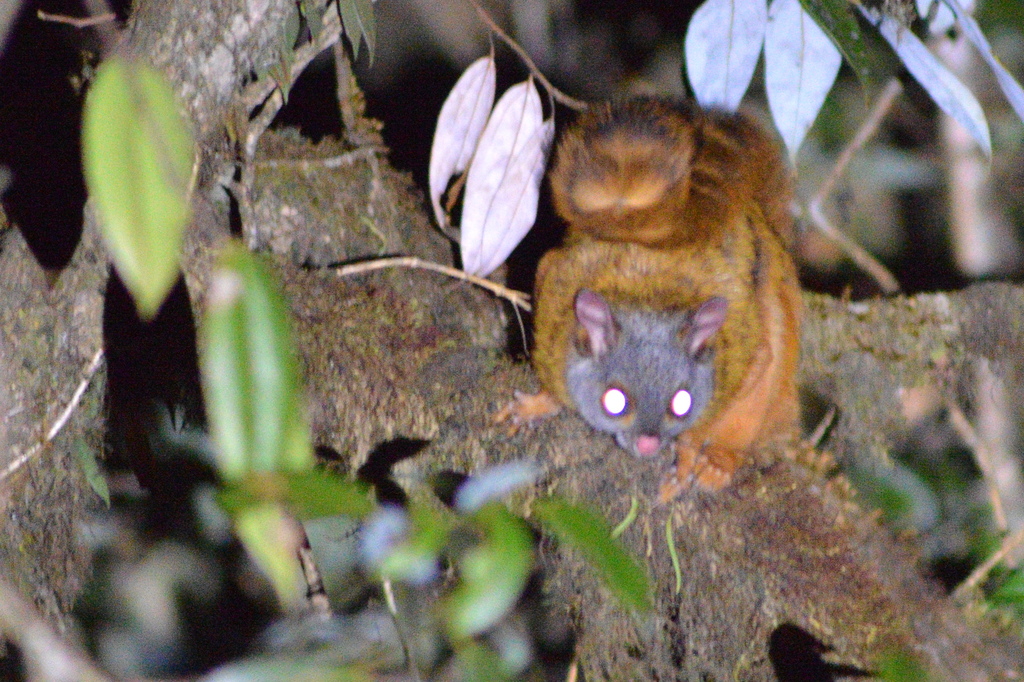
Grey-headed Giant Flying Squirrel
Petaurista caniceps
The spotted giant flying squirrel (Petaurista elegans), also known as the lesser giant flying squirrel, is a species of rodent in the family Sciuridae. It is found in hill and mountain forests at altitudes of 200–4,000 m (660–13,120 ft) in Southeast Asia north to central China and the east Himalayan region, although the northern populations sometimes are regarded as separate species as the grey-headed giant flying squirrel (P. caniceps), Chindwin giant flying squirrel (P. sybilla) and P. marica. Two of these, as well as a few other populations, lack the white spots on the upperparts for which it is named. Although a large flying squirrel, it is a relatively small giant flying squirrel.
Like other flying squirrels, it is nocturnal and able to glide (not actually fly like a bat) long distances between trees by spreading out its patagium, skin between its limbs. A rather noisy species that has a drawn-out cry that often can be heard at night, it spends the day in a tree hollow, or, less often, on a cliff ledge or in a nest made of vegetation in a tree. It feeds on fruits, seeds, leaves, buds and flowers, and has one, occasionally two, young per litter.
From the article Spotted giant flying squirrel on Wikipedia (CC BY-SA), quoted section by section
Description
The spotted giant flying squirrel has a head-and-body length of about 29.5–40 cm (11.5–15.5 in), tail length of 34–40.5 cm (13.5–16 in) and weighs 760–1,560 g (1.68–3.44 lb). This makes it a large species of flying squirrel, but the smallest giant flying squirrel in its range. The underparts are light orange-brown to pale rufous, but especially the colour of the head, upperparts and tail vary considerably depending on subspecies. The first group of subspecies has a black tail with only the base rufous-brown. In P. e. punctata of the Thai-Malay Peninsula, the head and upperparts are rufous-brown, somewhat darker on the midback. The upperparts from the top of the head and shoulders to the rump have many relatively large white spots, although on occasion they are more restricted. P. e. banksi of highlands of northern Borneo is similar, except that its upper head, nape and back are black, resulting in a clear contrast with the rich rufous-brown flanks and tail base. It has white spots above as in P. e. punctata, but these can be absent in young. The Sumatran P. e. sumatrana resembles P. e. punctata, but has fewer white spots that mostly are distributed on the mid-back. The Javan P. e. elegans and P. e. slamatensis (the latter likely is a synonym of the former) resemble P. e. …
Wikipedia: “Appearance”
Listen
Looking for field recordings…
Where it lives
Recorded sightings
—
geo-referenced records in GBIF, from museums, herbaria and field observers.
Drag the globe to turn it. Dots are where records exist, not a range map; darker means more records.
In the stacks
Searching the stacks…
Every page naming Petaurista caniceps in the Biodiversity Heritage Library →
This page is assembled live from iNaturalist, GBIF, Wikipedia, the Source Library and the Internet Archive. It is not yet part of the hand-edited codex. iNaturalist taxon 1279899.