- Animals
- ›Chordates
- ›Vertebrates
- ›Mammals
- ›Therians
- ›Placental Mammals
- ›Primates, Rodents, and Allies
- ›Rodents
- ›Mice, Rats, and Hamsters
- ›Muroids
- ›Old World Mice and Rats
- ›Murines
- ›Typical Old World Rats
- ›Micromys
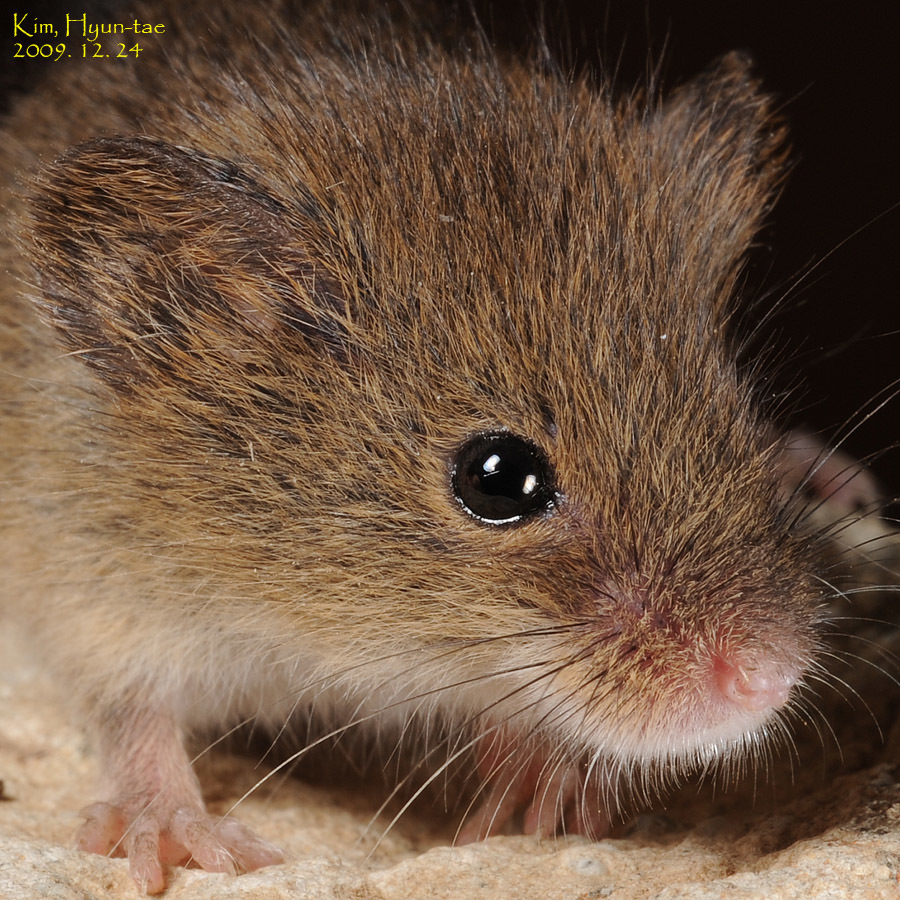
Eurasian Harvest Mouse
Micromys minutus
The harvest mouse (Micromys minutus) is a small mouse native to Europe and Asia. It is typically found in fields of cereal crops, such as wheat, rice and oats, in reed beds and in other tall ground vegetation, such as long grass and hedgerows. It has reddish-brown fur with white underparts and a naked, highly prehensile tail, which it uses for climbing. It is the smallest European rodent; an adult may weigh as little as 4 grams (0.14 oz). It eats chiefly seeds and insects, but also nectar and fruit. Breeding nests are spherical constructions carefully woven from grass and attached to stems well above the ground.
From the article Eurasian harvest mouse on Wikipedia (CC BY-SA), quoted section by section
Description
The harvest mouse ranges from 55 to 75 mm (2.2 to 3.0 in) long, and its tail from 50 to 75 mm (2.0 to 3.0 in) long; it weighs from 4 to 11 g (0.14 to 0.39 oz), or about half the weight of the house mouse (Mus musculus). Its eyes and ears are relatively large. It has a small nose, with short, stubble-like whiskers, and thick, soft fur, somewhat thicker in winter than in summer. The upper part of the body is brown, sometimes with a yellow or red tinge; the under-parts range from white to cream coloured. It has a prehensile tail which is usually bicoloured and furless at the tip. The mouse's rather broad feet are adapted specifically for climbing, with a somewhat opposable, large outermost toe, allowing it to grip stems with each hindfoot and its tail, thus freeing the mouse's forepaws for food collection. Its tail is also used for balance.
Range & habitat
The harvest mouse is common in all east coast counties of England, reaching the North York Moors. It also inhabits less favourable habitats, such as woodlands and forests in the west. Harvest mice reside in a large variety of habitats, from hedgerows to railway banks. Harvest mice seem to have an affinity for all types of cereal heads, except for maize (Zea mays). Harvest mice typically like using monocotyledons for their nest-building, especially the common reed (Phragmites australis) and Siberian iris (Iris sibirica). Most harvest mice prefer wetlands for their nesting habitats. Harvest mice in Japan like making wintering nests near the ground from grasses that are dried, which indicates that they require vegetative cover in the winter, as well as in the warmer seasons. Grasslands with a mix of perennials and annual grasses are required to balance the increases in nesting periods and the mice's need to secure nutrients. Habitat selection might be the result of differences in the structure of the landscape of grasslands and wetlands in the area.
Wikipedia: “Habitat and distribution”
What it does
Harvest mice have a short lactation period of 15–16 days. They spend most of their life in long grass and other vegetation such as reedbeds, rushes, ditches, cereals and legumes. They are very skilled at climbing among grasses due to their tail. They grasp leaves and stems with their feet and tail, which leaves their hands free for other tasks. These tasks can include grooming and feeding. Harvest mice have a prehensile tail that functions as an extra limb during climbing. During the lactation period, the pups are able to climb a vertical bar by the time they first emerge from their nest. At 3–7 days they learn hand grasping, and at 6–9 days they learn food grasping. Between 6–11 days, they adopt a quadrupedal stance, and at 10-11 there is tail prehension, and righting at 10–12 days. The righting response in harvest mice develops earlier, but takes longer to master than the other skills the pups learn. They cannot climb horizontally by the time they are weaned, suggesting that horizontal climbing is not as essential as vertical climbing.
Wikipedia: “Behaviour”
In human culture
The genus Micromys most likely evolved in Asia and is closely related to the long-tailed climbing mouse (Vandeleuria) and the pencil-tailed tree mouse (Chiropodomys). Micromys first emerged in the fossil record in the late Pliocene, with Micromys minutus being recorded from the Early Pleistocene in Germany. They underwent a reduction in range during glacial periods, and were confined to areas in Europe that were free of ice. During the mid-Pleistocene, Micromys minutus also lived in parts of Asia. This suggests that they spread towards Asia when the ice sheets started to melt. Other evidence suggests that Micromys minutus could have been introduced accidentally through agricultural activities during Neolithic times. Before the harvest mouse had been formally described, Gilbert White reported their nests in Selborne, Hampshire:
They never enter into houses; are carried into ricks and barns with the sheaves; abound in harvest; and build their nests amidst the straws of the corn above the ground, and sometimes in thistles. They breed as many as eight at a litter, in a little round nest composed of the blades of grass or wheat. One of these nests I procured this autumn, most artificially platted, and composed of the blades of wheat; perfectly round, and about the size of a cricket-ball. …
Wikipedia: “History”
Listen
Looking for field recordings…
Where it lives
Recorded sightings
—
geo-referenced records in GBIF, from museums, herbaria and field observers.
Drag the globe to turn it. Dots are where records exist, not a range map; darker means more records.
In the stacks
Searching the stacks…
Every page naming Micromys minutus in the Biodiversity Heritage Library →
This page is assembled live from iNaturalist, GBIF, Wikipedia, the Source Library and the Internet Archive. It is not yet part of the hand-edited codex. iNaturalist taxon 45316.