- Animals
- ›Chordates
- ›Vertebrates
- ›Mammals
- ›Therians
- ›Placental Mammals
- ›Ungulates, Carnivorans, and Allies
- ›Carnivorans
- ›Felids
- ›Small Cats
- ›Leopardus
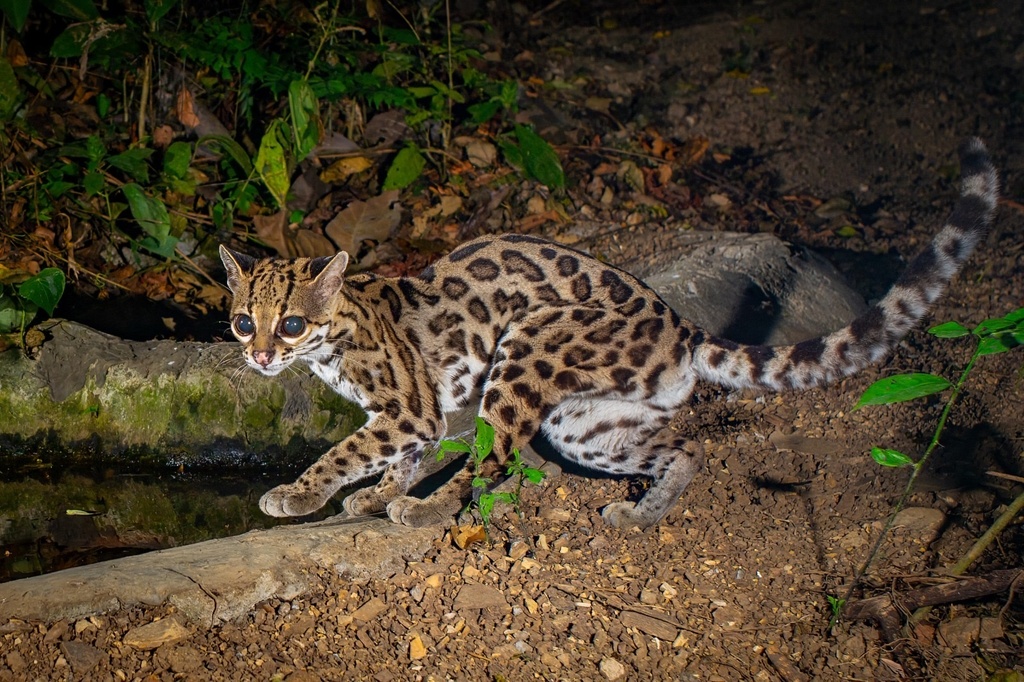
Margay
Leopardus wiedii
The margay (Leopardus wiedii) is a small wild cat native to Mexico, Central and South America. A solitary and nocturnal felid, it lives mainly in primary evergreen and deciduous forests.
Until the 1990s, it was hunted for the wildlife trade. Since 2008, it has been listed as Near Threatened on the IUCN Red List, as the population is thought to be declining due to loss of habitat and deforestation.
From the article Margay on Wikipedia (CC BY-SA), quoted section by section
Description
The margay is very similar to the larger ocelot (Leopardus pardalis) in appearance, although the head is a little shorter, the eyes larger, and the tail and legs longer. It weighs from 2.6 to 4 kg (5.7 to 8.8 lb), with a body length of 48 to 79 cm (19 to 31 in) and a tail length of 33 to 51 cm (13 to 20 in). Unlike most other cats, the female possesses only two teats. Its fur is brown and marked with numerous rows of dark brown or black rosettes and longitudinal streaks. The undersides are paler, ranging from buff to white, and the tail has numerous dark bands and a black tip. The backs of the ears are black with circular white markings in the center.
Wikipedia: “Characteristics”
Range & habitat
The margay is distributed from the tropical lowlands in Mexico through Central America to Brazil and Paraguay. In Mexico it has been recorded in 24 of the 32 states, ranging northward up the coastal lowlands and Sierra Madres as far north as of Coahuila, Nuevo Leon, and Tamaulipas on the US border in the east and southern Sonora in the west. The southern edge of its range reaches Uruguay and northern Argentina. It inhabits almost exclusively dense forests, ranging from tropical evergreen forest to tropical dry forest and high cloud forest. The margay has sometimes been observed in coffee and cocoa plantations. The only record from the United States was collected sometime before 1852 near Eagle Pass, Maverick County, Texas, and it is currently considered locally extinct in Texas. The margay's presence in the United States is considered "uncertain" by the IUCN Red List.
Wikipedia: “Distribution and habitat”
What it does
The margay is a skillful climber, and colloquially it is sometimes called the tree ocelot because of this ability. It spends most of the time in trees, leaping after and chasing birds and monkeys through the treetops. It can turn its ankles up to 180 degrees, so it can grasp branches equally well with its fore and hind paws, and it is able to jump up to 12 ft (3.7 m) horizontally. It also utilizes its long tail to maintain balance while climbing. Morphological adaptation such as these is a strong indication that the margay is well equipped to thrive in ecosystems such as rainforests in which vegetation provides the wild with protection from possible threats. Additionally, scientists who have conducted behavioral studies on margays found that population density was higher in environments with a substantial amount of trees and minimal human disturbance. It is usually solitary and lives in home ranges of 11–16 km2 (4.2–6.2 sq mi). It uses scent marking to indicate its territory, including urine spraying and leaving scratch marks on the ground or on branches. Its vocalisations all appear to be short range; it does not call over long distances.
Diet. …
Wikipedia: “Behavior and ecology”
Listen
Looking for field recordings…
Where it lives
Recorded sightings
—
geo-referenced records in GBIF, from museums, herbaria and field observers.
Drag the globe to turn it. Dots are where records exist, not a range map; darker means more records.
In the stacks
Searching the stacks…
Every page naming Leopardus wiedii in the Biodiversity Heritage Library →
This page is assembled live from iNaturalist, GBIF, Wikipedia, the Source Library and the Internet Archive. It is not yet part of the hand-edited codex. iNaturalist taxon 41988.