- Animals
- ›Chordates
- ›Vertebrates
- ›Mammals
- ›Therians
- ›Placental Mammals
- ›Ungulates, Carnivorans, and Allies
- ›Carnivorans
- ›Felids
- ›Small Cats
- ›Leopardus
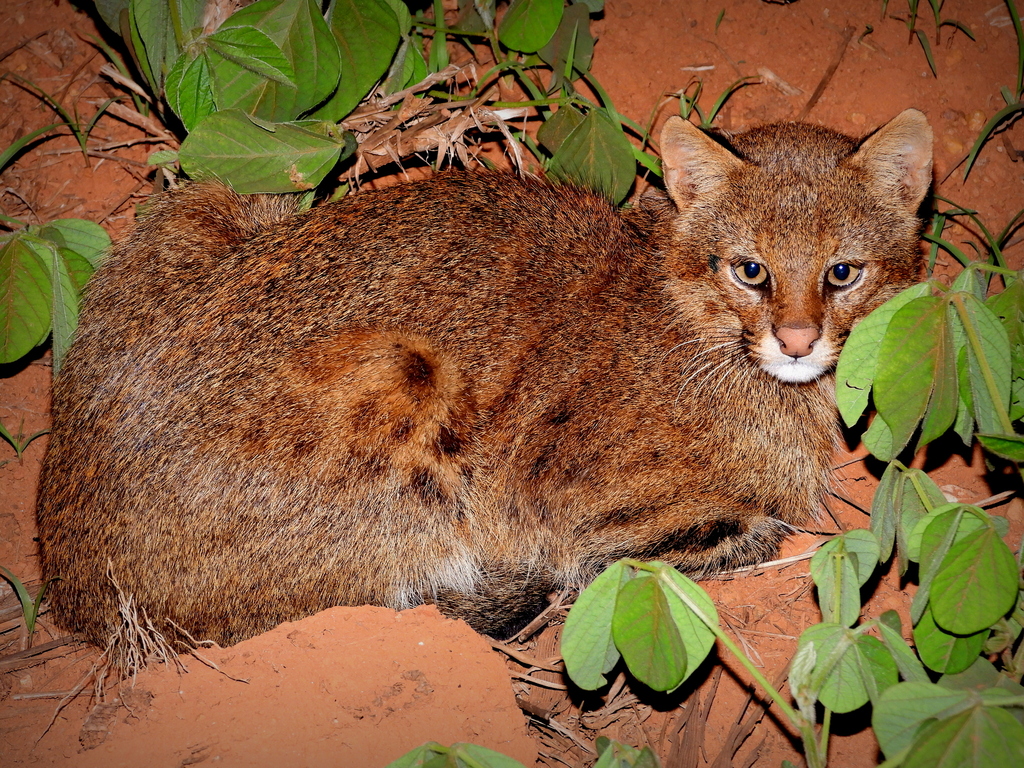
Pantanal Cat
Leopardus braccatus
The Pantanal cat (Leopardus colocola braccatus) is a Pampas cat subspecies, a small wild cat native to South America. It is named after the Pantanal wetlands in central South America, where it inhabits mainly grassland, shrubland, savannas and deciduous forests.
From the article Pantanal cat on Wikipedia (CC BY-SA), quoted section by section
Description
The Pantanal cat is brown agouti on the back with a little darker spinal crest. In the face it has two transverse dark lines across each cheek. Its ears are reddish on their base, creamy-white on the outer side and bordered with a black band. Its throat is whitish and blending into orangish towards the sides and on the belly. It has some dark brown rosettes on the flanks and stripes on the legs between elbow and wrist. The tip of the tail and paws are black. It is about the size of a domestic cat. There is a single report of a wild melanistic individual from Brazil, although this coat pattern has also been observed in some captive specimens.
Wikipedia: “Characteristics”
Range & habitat
Pantanal cats are found from sea level to 2,000 metres (6,600 ft) in east-central Brazil, Uruguay, and neighbouring regions of central South America (Bolivia, Paraguay and Argentina). Within this region, they inhabit a range of habitats from open grassland to dense forest and dry forest, although they are specifically named for the Pantanal wetlands of Brazil, Bolivia and Paraguay. It has also been reported from agricultural land, and therefore must have some limited tolerance for human disturbance.
Wikipedia: “Distribution and habitat”
What it does
The Pantanal cat is diurnal and solitary. It feeds on small mammals such as cavies, ground-dwelling birds, small lizards, and snakes. Home ranges are between 3 and 37 km2 (1.2 and 14.3 sq mi).
Wikipedia: “Ecology and behaviour”
In human culture
In 1994, it was suggested that its distinct pelage colour, pattern and cranial measurements warrant a specific status. But results of phylogeographic analysis did not support this. The validity of the genetic work has been questioned. Others regarded it as "likely [a] distinct species". In 2017, it was considered a subspecies of the Pampas cat by IUCN assessors. In 2020, it was further recognized as a full species based on morphological, molecular, geographical, and ecological differences. One further population (L. munoai) traditionally recognized as a subspecies of the Pantanal cat when it is deemed distinct, has also been elevated to full species status. Hybrids between the Pantanal cat and oncilla are known from Brazil.
Wikipedia: “Taxonomic history”
Listen
Looking for field recordings…
Where it lives
Recorded sightings
—
geo-referenced records in GBIF, from museums, herbaria and field observers.
Drag the globe to turn it. Dots are where records exist, not a range map; darker means more records.
In the stacks
Searching the stacks…
Every page naming Leopardus braccatus in the Biodiversity Heritage Library →
This page is assembled live from iNaturalist, GBIF, Wikipedia, the Source Library and the Internet Archive. It is not yet part of the hand-edited codex. iNaturalist taxon 1240544.