- Animals
- ›Chordates
- ›Vertebrates
- ›Mammals
- ›Therians
- ›Placental Mammals
- ›Ungulates, Carnivorans, and Allies
- ›Bats
- ›Yangochiroptera
- ›Vespertilionoid Bats
- ›Evening Bats
- ›Vesper Bats
- ›Eptesicini
- ›Histiotus
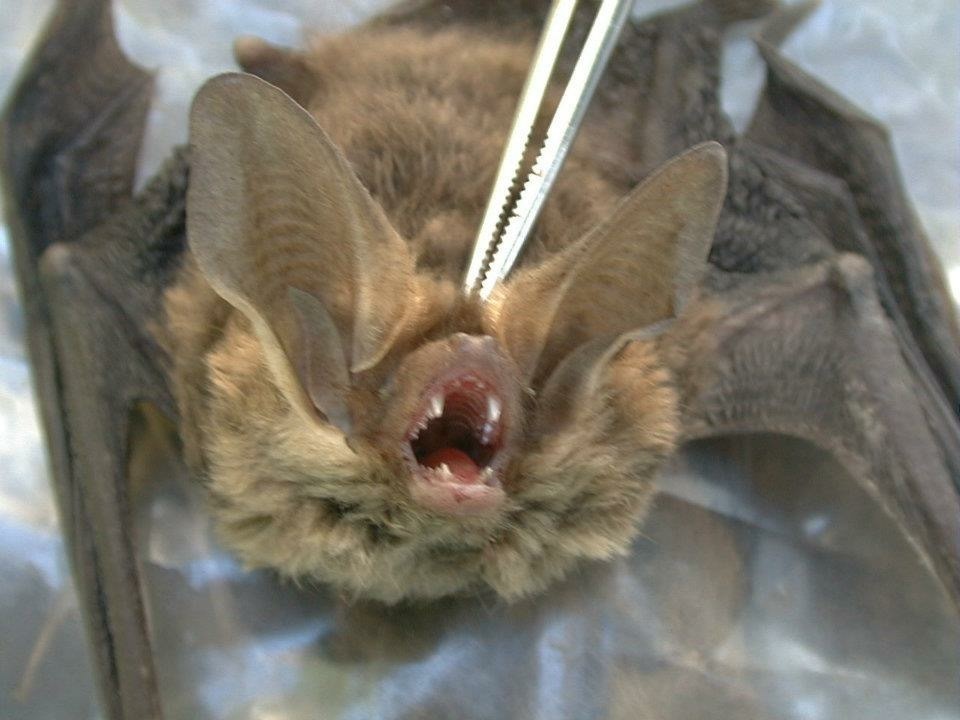
Southern Big-eared Brown Bat
Histiotus magellanicus
The southern big-eared brown bat (Histiotus magellanicus) is a species of bat from the family Vespertilionidae. Although current taxonomy treats the southern big-eared brown bat as a separate species, it is often treated as a subspecies of the small big-eared brown bat. It lives in the forests of southern Argentina and Chile; though the population of the bat in the southern part of its habitat is low, there are no major concerns to justify anything lower than a Least Concern rating in the IUCN Red List.
From the article Southern big-eared brown bat on Wikipedia (CC BY-SA), quoted section by section
Description
This is a small bat, with a total length of 10 to 12 centimetres (3.9 to 4.7 in) and a wingspan of about 31 centimetres (12 in). Adults weigh from 10 to 18 grams (0.35 to 0.63 oz). The fur is soft and dark brown in colour across the whole of the body, allowing it to be distinguished from other members of the same genus which much paler, often whitish, underparts. The ears are large and moderately elongated with a well-developed tragus and are separated on the head, rather than being connected by a band of skin as in some closely related species. The skin of the ears and wing membranes is very dark brown.
Range & habitat
This is one of the most southerly bat species in the world, and is endemic to Chile and western and southern Argentina. In the north, it reaches as far as the southern part of the Maule Region in Chile, from which it is found southwards across Chile and neighbouring parts of Argentina as far as the Magellan Straits. South of the mainland, it is found across the whole of Tierra del Fuego, almost as far as Cape Horn. It is found primarily in forests, especially those dominated by southern beech trees, but has also been recorded from Matorral shrubland and Andean steppe country.
Wikipedia: “Distribution and habitat”
What it does
Bats in the genus Histiotus have the largest hearts, relative to body size, of any studied mammal. At 2.18% of total body mass, their hearts are about 63% larger than would be expected. The echolocation calls of the southern big-eared brown bat are medium broadband signals, lasting about 10 ms and sweeping down from 40 to 30 kHz. Breeding takes place in the summer, with lactating females having been recorded in November and December. Very little is known of the species' behaviour, but the bats are known to occasionally use natural cavities in standing dead trees or large living trees as roosting sites. This reliance on trees may mean that the recent introduction of beavers to Tierra del Fuego could post a future risk to the species.
== References ==
Wikipedia: “Biology and behaviour”
Listen
Looking for field recordings…
Where it lives
Recorded sightings
—
geo-referenced records in GBIF, from museums, herbaria and field observers.
Drag the globe to turn it. Dots are where records exist, not a range map; darker means more records.
In the stacks
Searching the stacks…
Every page naming Histiotus magellanicus in the Biodiversity Heritage Library →
This page is assembled live from iNaturalist, GBIF, Wikipedia, the Source Library and the Internet Archive. It is not yet part of the hand-edited codex. iNaturalist taxon 74438.