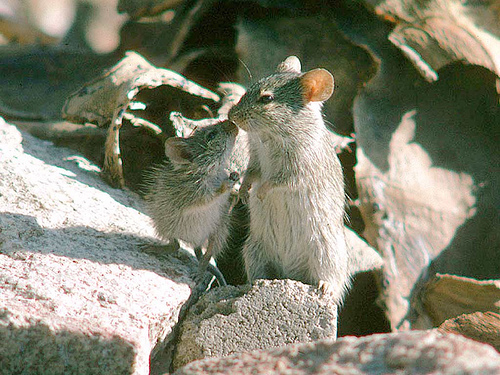
African Grass Rats
Arvicanthis Lesson, 1842
Arvicanthis (also commonly known as unstriped grass mice, unstriped grass rats, or kusu rats) is a genus of rodent from Africa. They are found in abundance in a variety of open habitats. They are also diurnal.
This genus is considered to be major agricultural pests.
- Also published as
- Isomys Sundevall, 1843
7 species · 7 branches
From Wikipedia (CC BY-SA), quoted section by section
Range & habitat
This genus has a wide distribution across Africa. However in their present state they are restricted the savannas of sub-Saharan Africa and the Nile Valley. The Horn of Africa contains four endemic species (A. abyssinicus, A. dembeensis, A. blicki and A. somalicus). They can also be found at a variety of different altitudes from arid grasslands up to the alpine moorlands at 4300 meters above sea level.
In human culture
They evolved during the early Pliocene epoch but experienced a period of rapid radiation during the early to middle Pleistocene epoch. This diversification started in Eastern Africa followed by repeated dispersals west (Sudano-Guinean savannas) and south (Masai steppe). Currently, their range is restricted from the sub-Saharan savannas to the Nile Valley. In contrast, their range during the Quaternary period included most of Northern Africa.
Where it has been recorded
Recorded sightings
—
geo-referenced records in GBIF, from museums, herbaria and field observers.
Drag the globe to turn it. Dots are where records exist, not a range map; darker means more records.
In the stacks
Searching the stacks…
Every page naming Arvicanthis in the Biodiversity Heritage Library →
References
- Rosevear, D. R. (1969). The Rodents of West Africa.
- Wilson, Don E., and DeeAnn M. Reeder, eds. (1993). Mammal Species of the World: A Taxonomic and Geographic Reference, 2nd Ed., 3rd Printing.
- Musser, Guy G., and Michael D. Carleton / Wilson, Don E., and DeeAnn M. Reeder, eds. (2005). Superfamily Muroidea. Mammal Species of the World: A Taxonomic and Geographic Reference, 3rd Ed., Vol. 2.
From the Catalogue of Life (catalogueoflife.org), compiled from its specialist databases; CC BY 4.0. This name in the Catalogue of Life.