- Plantas
- ›Plantas vasculares
- ›Plantas con flores
- ›pastos, palmeras y parientes (monocotiledóneas)
- ›Espárragos, orquídeas, cebollas y afines
- ›Cebollas, ajos y parientes
- ›Amaryllidoideae
- ›Haemantheae
- ›Scadoxus
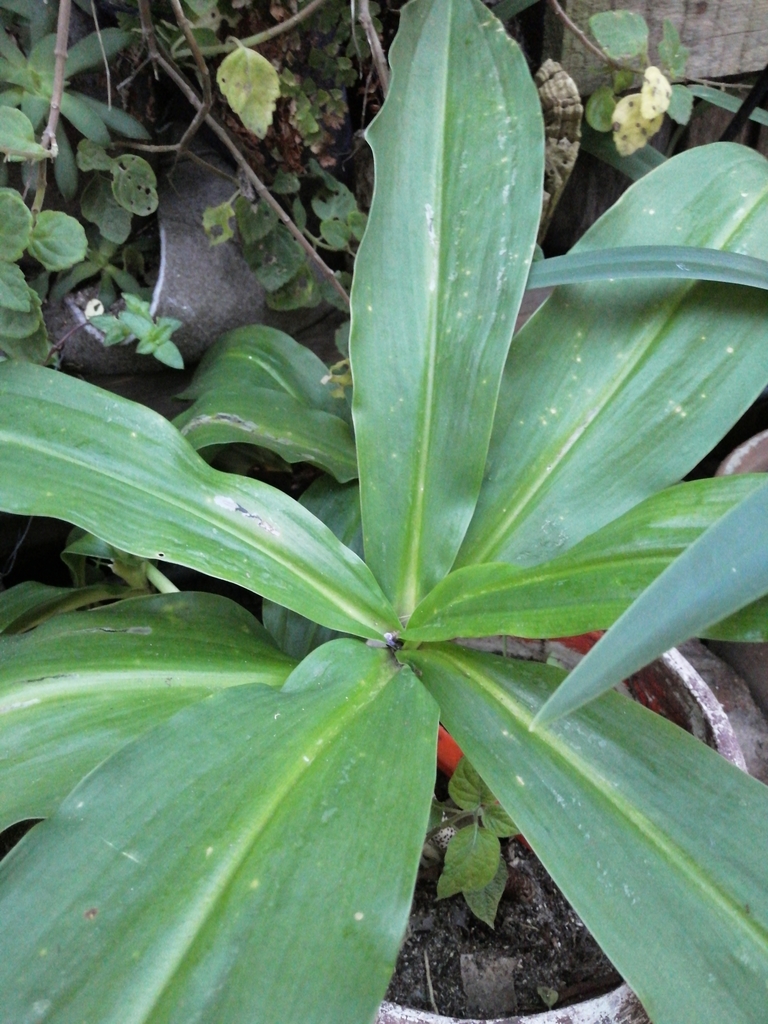
Scadoxus pole-evansii
Scadoxus pole-evansii, commonly known as the Inyanga fireball, is a herbaceous plant endemic to mountains in east Zimbabwe. It was only discovered for science in 1960. Similar in many respects to the more widely grown Scadoxus multiflorus, it is cultivated as an ornamental plant.
Del artículo Scadoxus pole-evansii de Wikipedia (CC BY-SA), citado sección por sección
Descripción
Scadoxus pole-evansii has a similar growth habit to Scadoxus multiflorus subsp. katherinae, growing from a bulb with attached rhizomes. The bases of the leaves are grouped to form a false stem or pseudostem. Plants may be 1.2 m (4 ft) tall. The flowers are borne in the form of an umbel on an upright leafless stalk (scape). The bracts under the umbels turn downwards and are generally withered during flowering. Individual flowers have salmon-pink to vermilion tepals, fused at the base to form a short tube, and with broad, spreading free segments at the end, each generally with five veins. The fruits are berries, red to orange in colour.
Wikipedia: «Description»
Distribución y hábitat
Scadoxus pole-evansii is endemic to the Nyanga region of east Zimbabwe. It grows in afromontane forest at 1,600–2,000 m (5,200–6,600 ft) in soil which is very open and humus-rich.
Wikipedia: «Distribution and habitat»
Toxicidad
The genus Scadoxus is known to have some strongly toxic species, containing poisonous alkaloids. These are lethal to animals, such as sheep and goats, that graze on the plants. Other species of Scadoxus have been used in parts of tropical Africa as components of arrow poisons and fishing poisons.
== References ==
Wikipedia: «Toxicity»
Cómo se cultiva
Material of Scadoxus pole-evansii was sent to England at the time of its discovery. It first flowered there in January 1963, at the RHS Garden, Wisley. The species was given the RHS Award of Merit in July 1969. In cultivation it requires similar conditions to the other tropical species of Scadoxus with a minimum temperature of 10 °C (50 °F) or more and an open, humus-rich growing medium. In the northern hemisphere it begins to grow in the summer, continues throughout the winter, and becomes dormant in the early spring. Pests are those of Scadoxus generally.
Wikipedia: «Cultivation»
Dónde vive
Avistamientos registrados
—
registros georreferenciados en GBIF, de museos, herbarios y observadores de campo.
Arrastra el globo para girarlo. Los puntos marcan dónde hay registros, no un mapa de distribución; más oscuro significa más registros.
En los depósitos
Buscando en los depósitos…
Todas las páginas que nombran Scadoxus pole-evansii en la Biodiversity Heritage Library →
Esta página se compone en directo a partir de iNaturalist, GBIF, Wikipedia, la Source Library y el Internet Archive. Aún no forma parte del códice editado a mano. Taxón 942575 de iNaturalist.