- Animales
- ›Insectos, arácnidos y crustáceos
- ›Hexápodos
- ›Insectos
- ›Insectos alados
- ›Moscas y mosquitos
- ›Brachycera
- ›Cyclorrhapha
- ›Schizophora
- ›Acalyptratae
- ›Opomyzoidea
- ›moscas minadoras de hojas
- ›Phytomyzinae
- ›Phytomyza
- ›Phytomyza ilicis
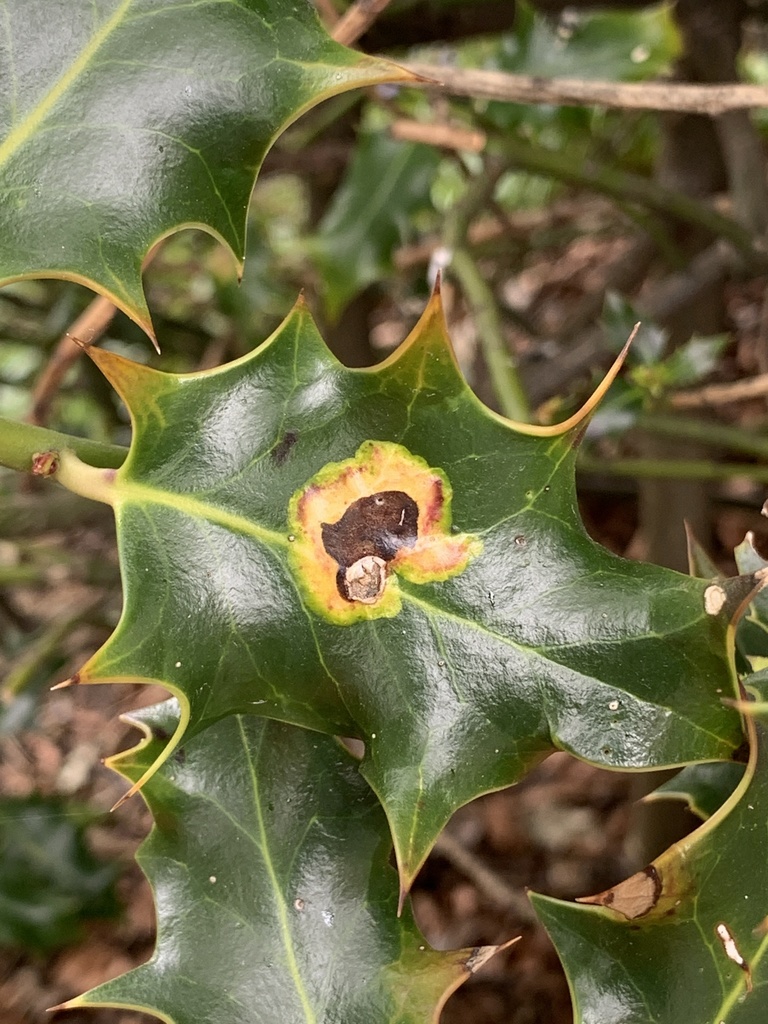
Phytomyza ilicis
Phytomyza ilicis, the holly leaf miner, is a leaf mining fly in the family Agromyzidae, whose larvae burrow into leaves of the holly tree (Ilex aquifolium) leaving characteristic pale trails or leaf mines.
Del artículo Phytomyza ilicis de Wikipedia (CC BY-SA), citado sección por sección
Descripción
Adults of P. ilicis are small with a wing length measuring 2.5–3 millimetres (0.098–0.118 in). They have red eyes and 6–8 pairs of acrostichal bristles on the thorax. Larvae are pale, leg-less maggots lacking a head capsule and thoracic and abdominal legs like most fly larvae. The dark-brown coloured puparium is formed from the hardened last larval skin.
Wikipedia: «Description»
Distribución y hábitat
The holly leaf miner is found throughout the holarctic on its host Ilex aquifolium. It is common and widespread in Europe and has been introduced into western Canada and north west USA. Its distribution is probably dependent upon average temperatures; Peterkin and Lloyd found it absent from areas where the mean temperatures of the coldest months of the year falls below −0.5 °C (31.1 °F).
Wikipedia: «Distribution»
Lo que hace
Female Agromyzidae insert an egg in the leaf tissue using an ovipositor. In the case of P. ilicis this poses a problem, because the leaf of the hostplant is unusually tough. Only during the annual flush in April, May, when new leaves unfold, is oviposition possible. Oviposition is in the underside of the petiole, or the basal part of the midrib. Oviposition induces the formation of a characteristic oviposition scar, enabling an estimate of the number of eggs that has been deposited. In a 1978 study, the maximum number of eggs laid per leaf was found to be five, with no more than two reaching the larval stage. The same study found an average of 38.6 eggs per 100 leaves on a single plant and that of these only 9.85% survive to produce viable, healthy larvae once natural mortality, and parasite and predatory factors are considered. The emerging larva tunnels within the midrib, in the direction of the leaf tip. Only around January it enters the leaf blade, and starts making a recognisable leaf mine.
In one study, comparing P. ilicis to P. ilicicola on Ilex plants it was demonstrated that there were an average of 0.23 mines per leaf (or one mine for every four or five leaves on a plant). Up to three mines may occur on a leaf – often much less than the number of oviposition scars, suggesting that intra-leaf competition has taken place. P. ilicis is univolitine. …
Wikipedia: «Life cycle»
Escuchar
Buscando grabaciones de campo…
Dónde vive
Avistamientos registrados
—
registros georreferenciados en GBIF, de museos, herbarios y observadores de campo.
Arrastra el globo para girarlo. Los puntos marcan dónde hay registros, no un mapa de distribución; más oscuro significa más registros.
En los depósitos
Buscando en los depósitos…
Todas las páginas que nombran Phytomyza ilicis en la Biodiversity Heritage Library →
Esta página se compone en directo a partir de iNaturalist, GBIF, Wikipedia, la Source Library y el Internet Archive. Aún no forma parte del códice editado a mano. Taxón 69629 de iNaturalist.