- Plantas
- ›Plantas vasculares
- ›Plantas con flores
- ›Magnolias, margaritas y parientes (dicotiledóneas)
- ›Margaritas, campánulas y afines
- ›margaritas, achicorias, cardos y parientes
- ›Margaritas, manzanillas, girasoles y parientes
- ›Helenieae
- ›Marshalliinae
- ›Marshallia
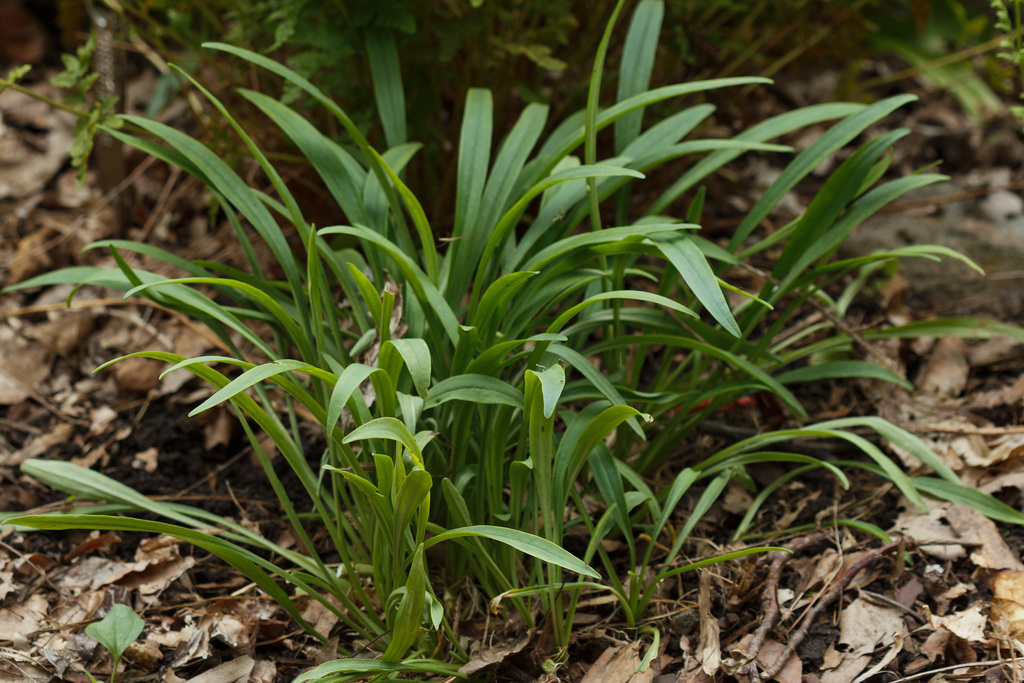
Marshallia mohrii
Marshallia mohrii, or Mohr's Barbara's buttons or Coosa Barbara's buttons, is a perennial herb species, endemic to the Southeastern United States, in several locations in Alabama, Georgia, and Florida. The first recorded discovery of the species was in 1882 by Dr. Charles Mohr, hence the botanical species name and common name.
Mohr's Barbara's buttons is currently listed as threatened on the Endangered Species List, and has been since 1988.
Del artículo Marshallia mohrii de Wikipedia (CC BY-SA), citado sección por sección
Descripción
Marshallia mohrii grows to around 1–2.5 ft in height, with 2.5 cm wide tubular-shaped flowers found in 2-6 flower masses. The flowers can range in color from white, to pale pink or lavender. The leaves of the plant are lanceolate to ovate in shape, ranging from 6–10 cm long and 2 cm wide, with three parallel veins. The leaves are larger and more numerous near the base of the stem. (Patrick, Krakow, 1995) The plant typically flowers from mid-May through June, with fruit being produced in July and August. (Tsao, Van Lonkhuyzen, 2000) The fruit is a 5-angled, 10-ribbed achene, about 4 mm long, with a hairy, resin-dotted surface. The fruit is topped by a crown (pappus) of five, narrowly triangular, sharply pointed scales, which are 1–3 mm long. The fruits are found among the sharply pointed bracts (chaff), which persist on the flower head. (Patrick, Krakow, 1995)
Wikipedia: «Description»
Distribución y hábitat
The Mohr's Barbara's buttons, Marshallia mohrii, requires wet, sandy clay soils, with alkaline pH, and high organic matter. Most currently known populations occur on soils of the Conasauga-Firestone Association. (Alabama Power Company, 2007) This is typically found along shale-bedded streams, especially in seasonally moist forest gaps, and in low swales extending onto roadside rights-of-way. Mohr's Barbara Button can survive in full sun or partial shade, often in association with grass-sedge communities. Two other endangered species have the same habitat requirements as the Mohr's Barbara Button: The Alabama Leather-Flower (Clematis socialis) and the Green Pitcher Plant (Sarracenia oreophila) are both listed as endangered, and occupy the same limited habitat. (Alabama Power Company, 2007)
Wikipedia: «Habitat»
Dónde vive
Avistamientos registrados
—
registros georreferenciados en GBIF, de museos, herbarios y observadores de campo.
Arrastra el globo para girarlo. Los puntos marcan dónde hay registros, no un mapa de distribución; más oscuro significa más registros.
En los depósitos
Buscando en los depósitos…
Todas las páginas que nombran Marshallia mohrii en la Biodiversity Heritage Library →
Esta página se compone en directo a partir de iNaturalist, GBIF, Wikipedia, la Source Library y el Internet Archive. Aún no forma parte del códice editado a mano. Taxón 67784 de iNaturalist.