- Plantas
- ›Plantas vasculares
- ›Plantas con flores
- ›Magnolias, margaritas y parientes (dicotiledóneas)
- ›Tomate, campanillas y afines
- ›Tomate, tabaco, petunias y parientes
- ›tomate, toloaches, chiles y parientes
- ›toloaches y floripondios
- ›Datura
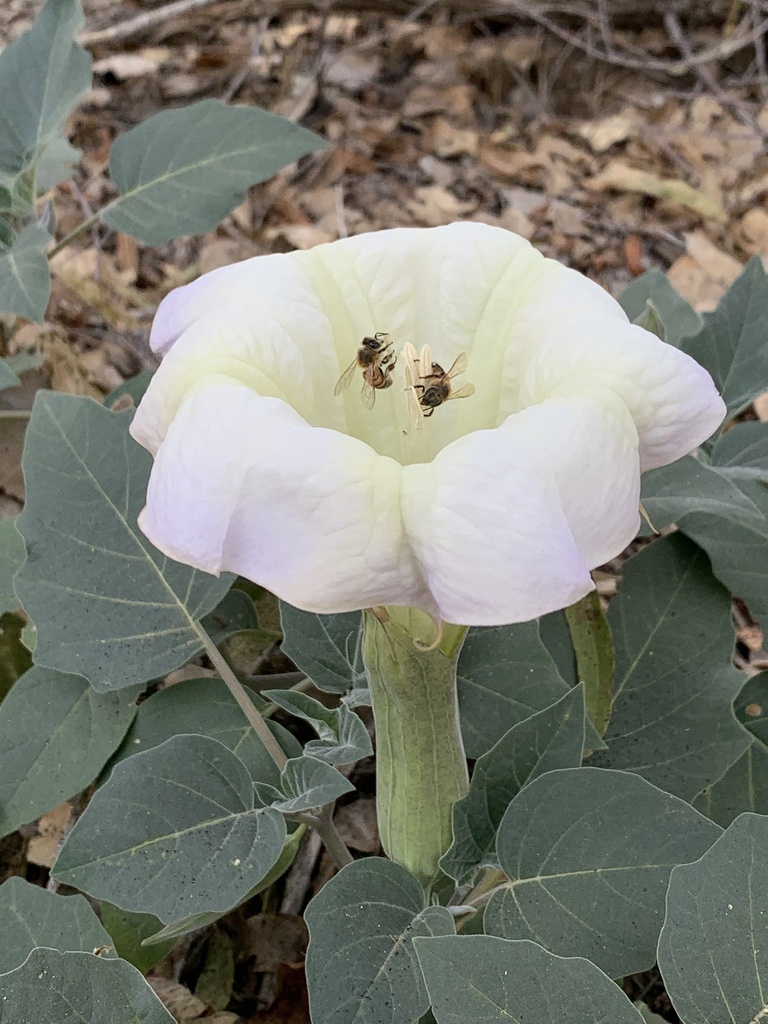
Toloache
Datura wrightii
Datura wrightii, commonly known as sacred datura, is a poisonous perennial plant species and ornamental flower of the family Solanaceae native to the Southwestern United States and northwestern Mexico. It is sometimes used as a hallucinogen due to its psychoactive alkaloids. D. wrightii is classified as an anticholinergic deliriant.
Del artículo Datura wrightii de Wikipedia (CC BY-SA), citado sección por sección
Descripción
It is a vigorous herbaceous perennial that grows 30 cm to 1.5 m tall and wide. The leaves are broad and rounded at the base, tapering to a point, often with wavy margins. The flowers are the most striking feature, being sweetly fragrant white trumpets up to 20 cm (7.9 in) long, sometimes tinted purple, especially at the margin. Five narrow points are spaced symmetrically around the rim. The plants often can be seen as a ground vine in habit, growing close to the ground and spreading in a very exposed environment with full direct sunlight (cleared roadside). D. wrightii, blooms from April through October. In clear weather, flowers open in the morning and evening and close during the heat of the day (depending on water availability); in cloudy weather, they may open earlier and last longer. The seeds are borne in a spiny, globular capsule 3 to 4 cm in diameter, which opens when fully ripe.
In Europe D. wrightii has often been confused with Datura innoxia as both are hairy with hanging spined fruits. They can be differentiated by the hairs on the stems and stalks, which for D. wrightii are densely appressed (visually and in photos this makes the stems look near-uniformly dull) and for D. innoxia projecting (making the stems dull at the edges and brighter, greener or shiny along the centre where the hairs project toward the eye). The flowers of D. …
Wikipedia: «Description»
Distribución y hábitat
Datura wrightii is found in northern Mexico and the adjoining southwestern U. S. states, as far north as Eastern Washington, in open / disturbed land and along roadsides with well-drained (sandy) soils. However it is perhaps most naturally abundant in the region of Southern California. It is also commonly planted as an ornamental, especially in xeriscapes due to its ruderal characteristics.
Invasive status. In Australia, it has been recorded as a garden escapee in New South Wales, Victoria, South Australia and Western Australia.
Wikipedia: «Distribution and habitat»
En medicina
Among the Zuni people, the powdered root is given as an anesthetic and a narcotic for surgery. They also apply a poultice of root and flower meal applied to wounds to promote healing. The Zuni used Datura as a way to render patients unconscious while broken bones were set.
Wikipedia: «Medicinal»
Toxicidad
All parts of Datura plants contain dangerous levels of anticholinergic tropane alkaloids and may be fatal if ingested by humans, livestock, or pets. In some places, it is prohibited to buy, sell or cultivate Datura plants. Unlike other types of datura, the roots are considered the most potent and alkaloid-rich part of this species.
Wikipedia: «Toxicity»
En la cultura humana
The American artist Georgia O'Keeffe (1887–1986) painted "jimson weed" several times. She was fond of the flowers, which grew wild around her New Mexico house. These paintings of the exotic white pinwheel blooms, hugely magnified, are among her most familiar works. In 2014 one such painting sold for $44 million, a record price for a female artist's work. Given the location of O'Keeffe's residence in the New Mexico desert, it is likely that she saw 'western' jimson weed. The plant is an element of Hunter S. Thompson's 1971 roman à clef novel, Fear and Loathing in Las Vegas: A Savage Journey to the Heart of the American Dream. In part 2, chapter 5 of the book, a jimsonweed experience is recounted by the character Dr. Gonzo as described here: "Last Christmas somebody gave me a whole Jimson weed – the root must have weighed two pounds; enough for a year – but I ate the whole goddamn thing in about twenty minutes... Luckily, I vomited most of it right back up. But even so, I went blind for three days. Christ I couldn't even walk! My whole body turned to wax. I was such a mess that they had to haul me back to the ranch house in a wheelbarrow... they said I was trying to talk, but I sounded like a raccoon." Due to the fact that Dr. Gonzo presumably lived in Los Angeles, California during this time, this encounter was likely also with the "western jimsonweed" species as well. …
Wikipedia: «In popular culture»
Dónde vive
Avistamientos registrados
—
registros georreferenciados en GBIF, de museos, herbarios y observadores de campo.
Arrastra el globo para girarlo. Los puntos marcan dónde hay registros, no un mapa de distribución; más oscuro significa más registros.
En los depósitos
Buscando en los depósitos…
Todas las páginas que nombran Datura wrightii en la Biodiversity Heritage Library →
Esta página se compone en directo a partir de iNaturalist, GBIF, Wikipedia, la Source Library y el Internet Archive. Aún no forma parte del códice editado a mano. Taxón 58331 de iNaturalist.