- Animales
- ›Insectos, arácnidos y crustáceos
- ›Hexápodos
- ›Insectos
- ›Insectos alados
- ›Escarabajos y parientes
- ›Polyphaga
- ›gorgojos, catarinas y parientes
- ›Coccinelloidea
- ›Catarinas y mariquitas
- ›Coccinellinae
- ›Catarinas manchadas
- ›Halyzia
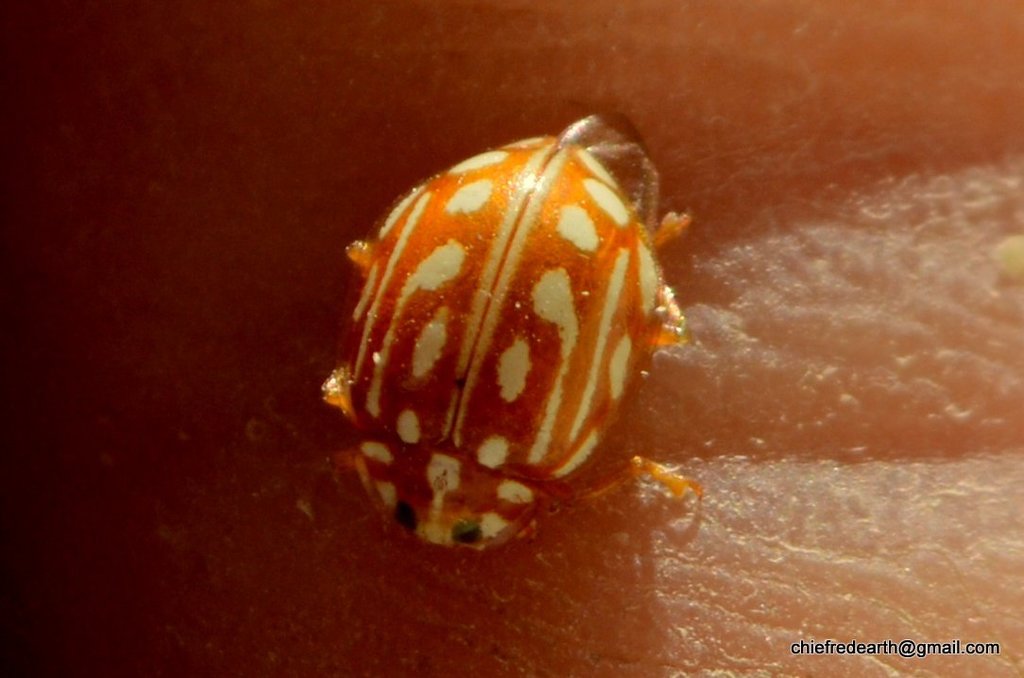
Halyzia sanscrita
Halyzia sanscrita is a species of beetle in the family Coccinellidae. It is found in China, Taiwan, Tibet, India, and Yemen.
Del artículo Halyzia sanscrita de Wikipedia (CC BY-SA), citado sección por sección
Descripción
Adults are approximately 0.52-0.61 cm in length. They are oval in shape. The head is yellowish-white, the pronotum yellowish-brown, and the elytra orange-brown. The pronotum has five white spots, with one in the center and two on either side. Each elytron has ten creamy white markings and a suture of the same color. The pronotum and outer edges of the elytra are transparent.
Wikipedia: «Description»
Lo que hace
The species if fungivorous, with adults feeding primarily on mildew. During the day, they are often found on the undersides of mildew-infested leaves.
Wikipedia: «Ecology»
En la cultura humana
The species name sanscrita is derived from the Sanskrit-like markings on the beetle's elytra.
== References ==
Wikipedia: «Etymology»
Escuchar
Buscando grabaciones de campo…
Dónde vive
Avistamientos registrados
—
registros georreferenciados en GBIF, de museos, herbarios y observadores de campo.
Arrastra el globo para girarlo. Los puntos marcan dónde hay registros, no un mapa de distribución; más oscuro significa más registros.
En los depósitos
Buscando en los depósitos…
Todas las páginas que nombran Halyzia sanscrita en la Biodiversity Heritage Library →
Esta página se compone en directo a partir de iNaturalist, GBIF, Wikipedia, la Source Library y el Internet Archive. Aún no forma parte del códice editado a mano. Taxón 52883 de iNaturalist.