- Animales
- ›Insectos, arácnidos y crustáceos
- ›Camarones, cangrejos y parientes
- ›Crustáceos comunes
- ›Cangrejos, langostas, camarones y cochinillas
- ›Eumalacostraca
- ›Cangrejos, langostinos, camarones y parientes
- ›Cangrejos, langostas y camarones
- ›Langostas, cangrejos de río y de mar
- ›Cangrejos verdaderos
- ›Eubrachyura
- ›Heterotremata
- ›Portunoidea
- ›Geryonidae
- ›Geryoninae
- ›Chaceon
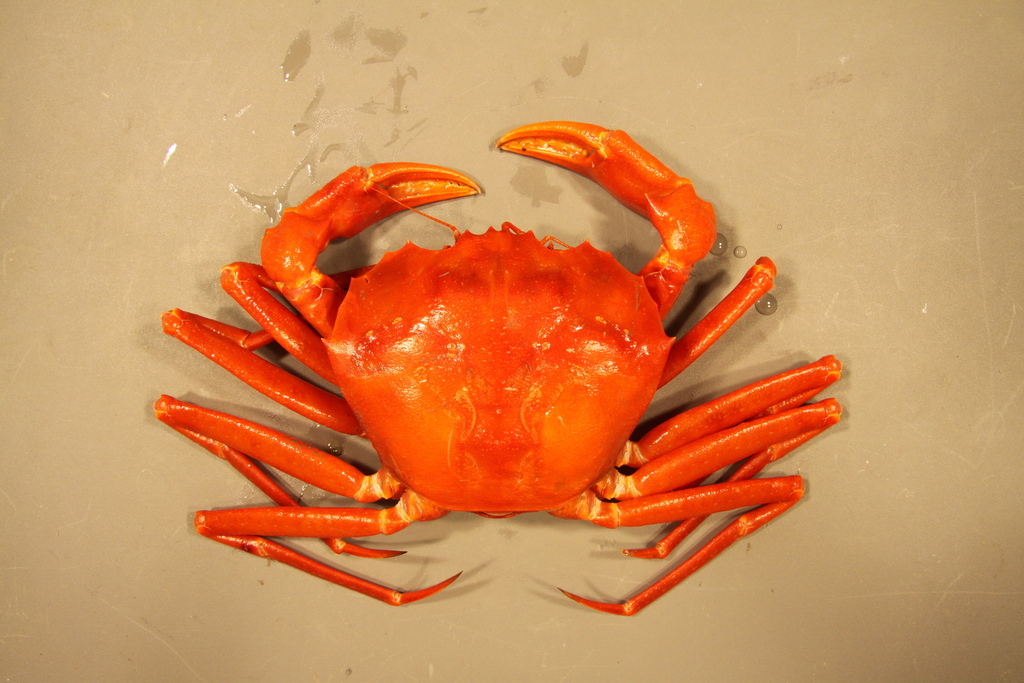
Chaceon quinquedens
Chaceon quinquedens, commonly known as the red deep-sea crab, but sold as Atlantic deep sea red crab, or simply Atlantic red crab or red crab, is a crab that lives in the Atlantic Ocean off the East Coast of the United States and Canada, from North Carolina to Nova Scotia, and in the Gulf of Mexico.
Del artículo Chaceon quinquedens de Wikipedia (CC BY-SA), citado sección por sección
Distribución y hábitat
Red deep sea crabs (DSRC) mostly inhabit the deep continental shelf and slope along a wide range, all the way from the Northwest Atlantic waters and from the Gulf of Maine to the Gulf of Mexico. They can be found at depths of 200 to 1,800 metres (660 to 5,910 ft). DSRC on the U.S. East Coast show distinct sex segregation by depth along the continental slope. Females predominate at depths of 450–700 metres (1,480–2,300 ft), and those in shallow water are predominantly reproductive adults. Females are smaller in size with a maximum carapace width of about 120 millimetres (4.7 in). whereas males predominate at greater depths, and are much larger in carapace width of 180 millimetres (7.1 in). Males can also live up to 15 years and will continue to grow with age. Furthermore, crabs in deeper water tend to be smaller than those in shallow water. This distribution suggests that red deep sea crabs undergo ontogenetic (life-cycle) migration. In a tag experiment that lasted for seven years, it was found that between the depths of 275 to 1,100 metres (902 to 3,609 ft) the red deep sea crabs moved distances of greater than 20 metres (66 ft). In this scenario, females on the upper slope (above 600 m) release larvae that migrate to surface waters, then settle in water deeper than 1000 m. As they grow, they move upslope and eventually become mature in shallower water. …
Wikipedia: «Distribution and ecology»
Lo que hace
Mature deep sea red crabs (DSRC) adults will usually migrate towards the upper slopes of the continental shelf for reproduction, there is also other favorable factors such as warmer temperatures, better abundance in prey, etc., that influence the adult crabs to migrate upwards that help with reproduction and dispersal. Females will also generally retain her eggs clutches up until the larvae are ready to hatch. The greatest seasonal dispersal range for the Deep sea red-crabs is during the winter months. The main stimulus for larvae to swim towards the surface is temperature, and as development proceeds the sinking rates of the crabs within their range increases. Like most crabs, the DSRC go through Brachyuran cold-water life cycle, have longer incubation times, longer total larval period, which result in larger adults. when the larvae hatch, they become planktonic for most of their early stages. the larvae typically hatch in the spring/summer months in shallow waters. DSRC larva develop in six stages: a pre-zoea stage, four zoeae stages, and a megalopa stage. The early stages of development (stages within the pre-zoea to the megalopa) happen within 26 days in cold water temperatures ranging from 18 to 21 °C, this also al occurs in shallower waters. …
Wikipedia: «Reproduction and development»
Dónde vive
Avistamientos registrados
—
registros georreferenciados en GBIF, de museos, herbarios y observadores de campo.
Arrastra el globo para girarlo. Los puntos marcan dónde hay registros, no un mapa de distribución; más oscuro significa más registros.
En los depósitos
Buscando en los depósitos…
Todas las páginas que nombran Chaceon quinquedens en la Biodiversity Heritage Library →
Esta página se compone en directo a partir de iNaturalist, GBIF, Wikipedia, la Source Library y el Internet Archive. Aún no forma parte del códice editado a mano. Taxón 459554 de iNaturalist.