- Animales
- ›Insectos, arácnidos y crustáceos
- ›Hexápodos
- ›Insectos
- ›Insectos alados
- ›Moscas y mosquitos
- ›Brachycera
- ›Cyclorrhapha
- ›Schizophora
- ›Moscas caliptradas
- ›Moscardas, moscas parasitoides y parientes
- ›Moscardones
- ›Chrysomyinae
- ›Phormia
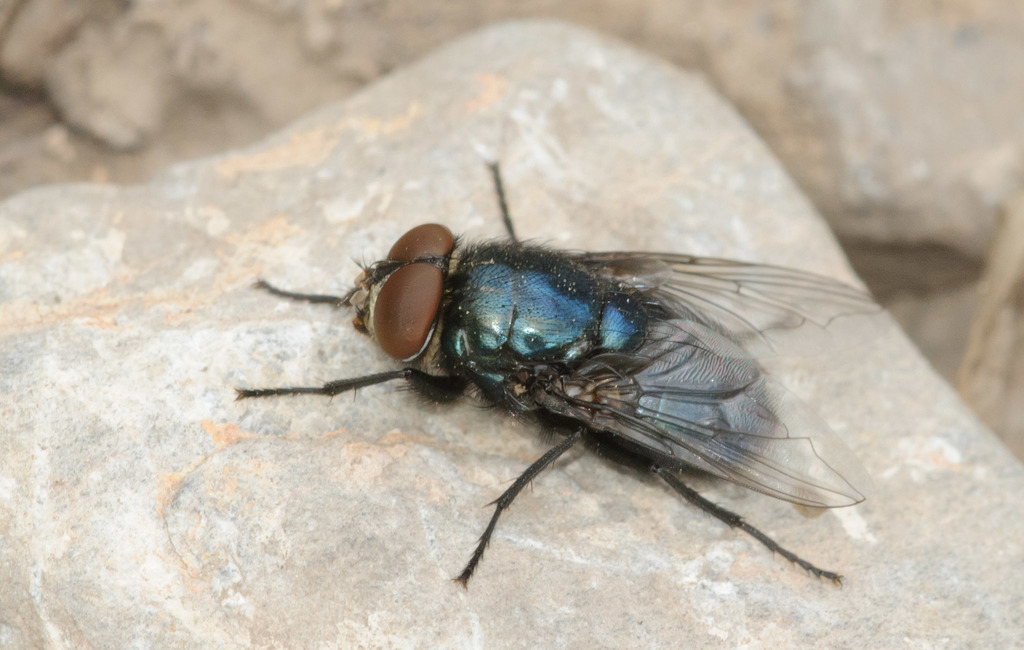
Phormia regina
Phormia regina, the black blow fly, belongs to the blow fly family Calliphoridae and was first described by Johann Wilhelm Meigen. It is the only species in the genus Phormia.
The black blow fly's wings are specialized with a sharp bend. These flies also have well-developed calypters. Blow flies generally are about the size of a house fly or a little larger, and many are metallic blue or green in color. Key characteristics of this species include black gena, mostly white calypters, and anterior thoracic spiracles that appear to be orange yellow due to being surrounded by bright orange setae.
Del artículo Phormia de Wikipedia (CC BY-SA), citado sección por sección
Descripción
Phormia regina adults are metallic blue or green in color and have a distinctive set of orange setae near the anterior thoracic spiracle. They are also recognizable by their black gena (the side of the head below eye level), mostly white calypteres, and the distinctive bend in their wings.
Wikipedia: «Description»
Distribución y hábitat
Phormia regina is commonly found across the entirety of the United States as well as across other regions in North America
Wikipedia: «Distribution»
En la mesa
Feeding habits vary greatly throughout the life cycle of P. regina. The feeding habits of adult flies depend both on sex and reproduction status of the fly. This is particularly important with respect to their protein intake, which literature suggests has an important role in sexual maturation and copulation ability in adult P. regina. Like most other flies, the black blow fly feeds via sponging. Though adults require various types of nutrients, in the wild they are typically able to procure all their nutrition from feces.
Larvae. Adult females oviposit eggs on carrion. These eggs hatch into larvae that feed on the decaying tissue.
Adult females. Virgin adult females, when given access to protein and carbohydrate sources, utilize both for food. However, after their emergence as adults, they will gradually increase their protein intake until they are approximately 8 to 10 days old. From here they will continue to intake protein at a relatively constant rate that is lower than their required carbohydrate intake. Once a female has mated, either for the first time or all subsequent times, a spike in protein intake occurs following oviposition of her eggs.
Adult males. Protein intake in adult male black blow flies follows similar trends to that of virgin adult females; however, they require less total protein than females. …
Wikipedia: «Food sources»
En medicina
Phormia regina is a flesh-eating fly not usually used for medical gain. However, the maggots from the black blow fly are used in maggot therapy, a type of biotherapy involving the intentional introduction of live, disinfected maggots into the skin and soft tissue wound of a human or animal for the purpose of selectively cleaning out only the necrotic tissue to promote healing.
Wikipedia: «Medical importance»
En la cultura humana
The life cycle and development of Phormia regina is similar to that of most other Dipteran species, in which females oviposit their eggs onto a nutrient substrate. Then, after hatching, the larvae feed throughout three instar stages until they have stored up enough calories to commence pupation and finally emerge as adult blow flies. Each transition from first, second, and third instar is marked by a molt, and eventually the third-instar larvae develop sclerotized (hardened) casings which envelop and protect them throughout metamorphosis.
Larval development. Relatively few studies have been conducted on the adults of this species in comparison to those on larval development, mostly due to the importance of blow fly larvae in determining the post mortem interval (PMI) of corpses during investigations by forensic entomologists. For this reason, many researchers have conducted experiments to investigate the effect of various environmental factors on the duration time of larval development in this species (as well as many others). Because the larval life cycle of this species is dependent on a climate with temperatures ranging from 12.7°C (55°F) to 35 °C (95 °F), it tends to inhabit the northern regions of the United States during summer months and southern regions in the winter. …
Wikipedia: «Life history»
Escuchar
Buscando grabaciones de campo…
Dónde vive
Avistamientos registrados
—
registros georreferenciados en GBIF, de museos, herbarios y observadores de campo.
Arrastra el globo para girarlo. Los puntos marcan dónde hay registros, no un mapa de distribución; más oscuro significa más registros.
En los depósitos
Buscando en los depósitos…
Todas las páginas que nombran Phormia regina en la Biodiversity Heritage Library →
Esta página se compone en directo a partir de iNaturalist, GBIF, Wikipedia, la Source Library y el Internet Archive. Aún no forma parte del códice editado a mano. Taxón 449683 de iNaturalist.