- Animales
- ›Cordados
- ›Vertebrados
- ›Mamíferos
- ›Marsupiales y placentarios
- ›Placentarios
- ›Venados, felinos y parientes
- ›Murciélagos
- ›Yinpterochiroptera
- ›Zorros Voladores y Parientes
- ›Zorras voladoras
- ›Rousettinae
- ›Eonycterini
- ›Eonycteris
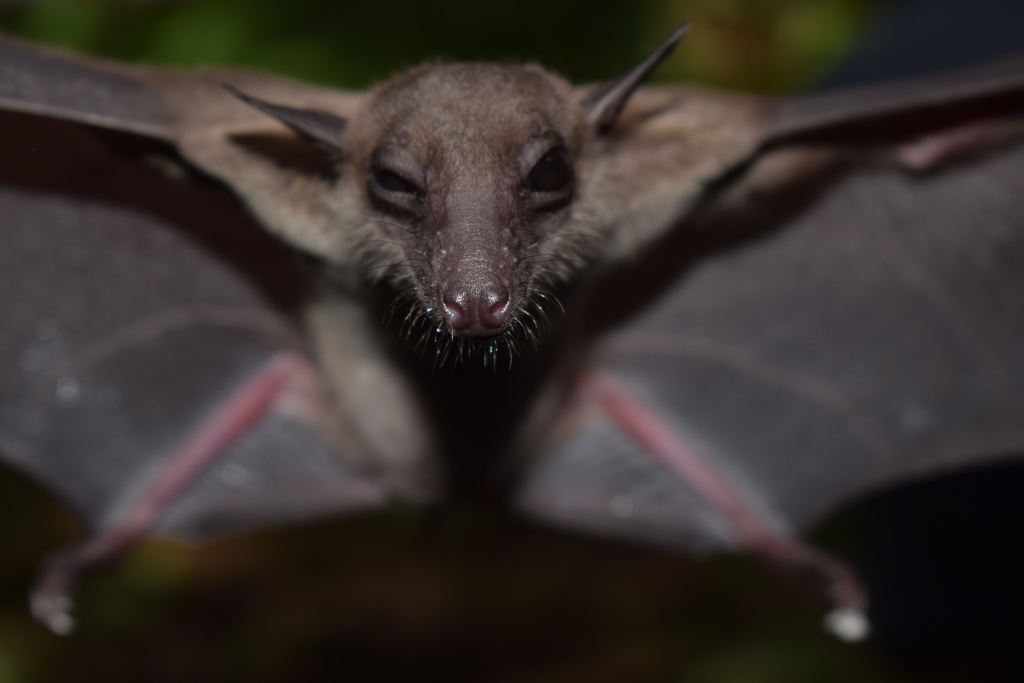
Eoníctérido Pequeño
Eonycteris spelaea
The cave nectar bat, dawn bat, common dawn bat, common nectar bat or lesser dawn bat (Eonycteris spelaea) is a species of megabat within the genus Eonycteris. The scientific name of the species was first published by Dobson in 1871.
Del artículo Cave nectar bat de Wikipedia (CC BY-SA), citado sección por sección
Descripción
The upper parts of the cave nectar bat are grey-brown to dark brown to black. The underparts are paler and the neck is sometimes yellowish brown. The muzzle of this bat is elongated, and particularly adapted for drinking nectar. The species has as well an external tail. The head and body length measures 8.5–11 cm (3.3–4.3 in), the tail length is about 1.5–1.8 cm (0.59–0.71 in) and the forearm length measures 6–7 cm (2.4–2.8 in).
Wikipedia: «Description»
Distribución y hábitat
The cave nectar bat is found in primary forests and in disturbed and agricultural areas. It roosts in caves, in larger groups, with some roosts exceeding 50,000 individuals, and it sometimes roosts with other bat species. In some places, this species seems to have adapted well to leafy, semi-urban habitats. Due to its large roosting size it has an IUCN status of "least concerned" however, only limited data is available on population size and trends. E. spelaea travels many kilometres each night in search of the nectar of flowering trees and shrubs. Because of that, this bat species is a very important pollinator of fruit trees, such as durians, notably Durio zibethinus and Durio graveolens. It also feeds on and pollinates other commercially important crops such as banana (Musa spp.) and jackfruit (Artocarpus heterophyllus). In addition to pollinating these plants, the cave nectar bat is an important pollinator for major crops, including up to 55 species of plants. Their tendencies to pollinate certain plants is determined by the proximity of their living quarters. There are at least thirteen plant taxa that the cave nectar bat feeds upon. The dependence on the proximity of the plants explain the variation of which plants that the cave nectar bats pollinate and feed upon. For this reason, E. …
Wikipedia: «Habits and habitat»
Escuchar
Buscando grabaciones de campo…
Dónde vive
Avistamientos registrados
—
registros georreferenciados en GBIF, de museos, herbarios y observadores de campo.
Arrastra el globo para girarlo. Los puntos marcan dónde hay registros, no un mapa de distribución; más oscuro significa más registros.
En los depósitos
Buscando en los depósitos…
Todas las páginas que nombran Eonycteris spelaea en la Biodiversity Heritage Library →
Esta página se compone en directo a partir de iNaturalist, GBIF, Wikipedia, la Source Library y el Internet Archive. Aún no forma parte del códice editado a mano. Taxón 40949 de iNaturalist.