- Animales
- ›Cordados
- ›Vertebrados
- ›Mamíferos
- ›Marsupiales y placentarios
- ›Placentarios
- ›Venados, felinos y parientes
- ›Murciélagos
- ›Yangochiroptera
- ›Vespertilionoidea
- ›Murciélagos insectívoros
- ›Myotinae
- ›Myotis
- ›Pizonyx
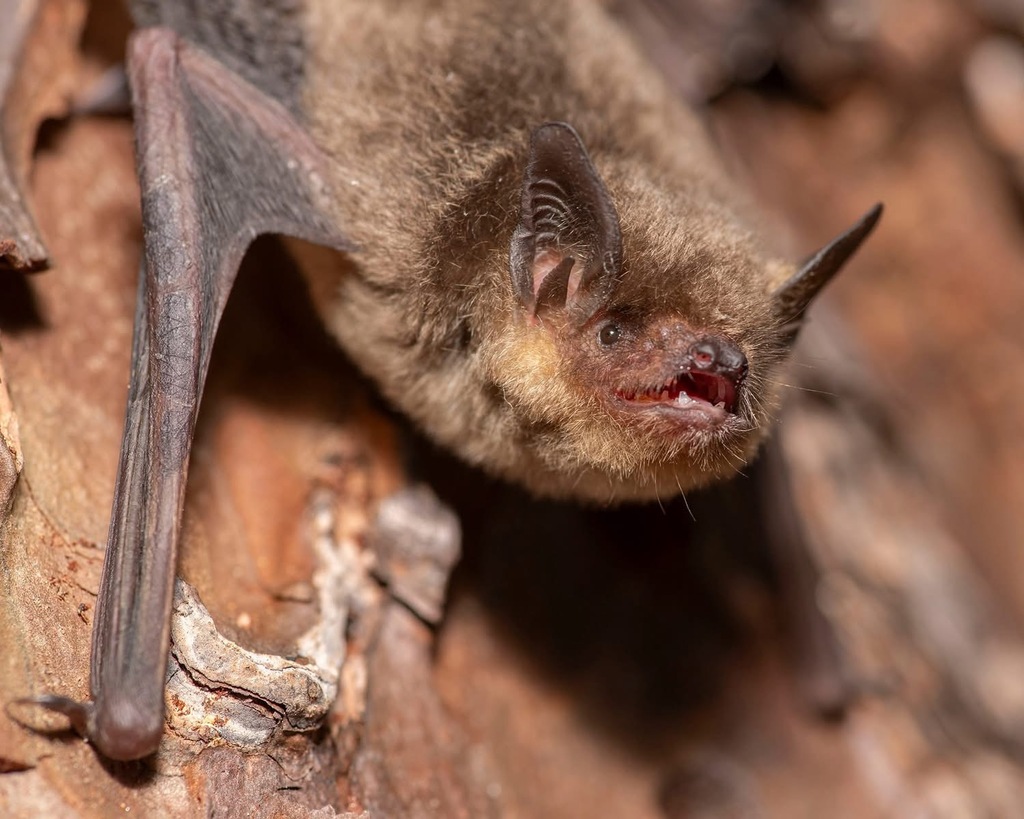
Myotis grisescens
The gray bat (Myotis grisescens) is a species of microbat endemic to North America. It once flourished in caves all over the southeastern United States, but due to human disturbance, gray bat populations declined severely during the early and mid portion of the 20th century. Today, only fifteen caves support 95% of hibernating gray bats. M. grisescens has been listed as federally endangered by the U.S. Fish and Wildlife Service since 1976, and is protected under the Endangered Species Act. Gray bat populations were estimated at approximately 2 million bats around the time they were placed on the Endangered Species list. By the early 1980s populations of gray bats dropped to 1.6 million. With conservation efforts in place, in 2004, gray bat populations were estimated to have reached 3.4 million.
Del artículo Gray bat de Wikipedia (CC BY-SA), citado sección por sección
Descripción
M. grisescens are the largest members of their genus in the eastern United States. Of all U.S. mammals, gray bats are, perhaps, the most cave-dependent. Gray bats have uni-colored dark gray fur on their backs that may bleach to a russet or chestnut brown after the molting season (July or August). Unlike in other species of Myotis, where the wing membrane connects to the toe, in M. grisescens, the wing membrane connects to the ankle. Gray bats typically weigh between 7 and 16 grams. Gray bats can live up to 17 years, but only about 50% of gray bats survive to maturity. Sexual maturity occurs at about age two. Although an adult gray bat's forearm measures only about 40–46 mm, Gray bats with forearm lengths of 39.5 mm (approx. 1.55 in) or less cannot fly. The flight speed of the gray bat, M. grisescens, has been calculated at 20.3 km/h (12.61 mph) during migration. While foraging, gray bats have been clocked at a flying rate of anywhere between 17 km/h and 39 km/h. Annual molting occurs between early June and early August, during which gray bats eat larger amounts of hair than at other times during the activity season. During grooming, gray bats also ingest ectoparasites such as chiggers that live in their fur. Gray bats are believed to groom extensively before beginning their nightly hunt. …
Wikipedia: «Description»
Distribución y hábitat
Gray bats live in limestone karst areas in the southeastern United States. Summer and winter (hibernation) ranges overlap but are not identical. Hibernation occurs in caves in northern Alabama, northern Arkansas, Kentucky, Missouri, and Tennessee. During summer, the species ranges further and can be found in eastern Oklahoma and Kansas, southern Illinois and Indiana, southwestern Virginia, western North Carolina, northwestern South Carolina, and northern Georgia. A very small number of records from West Virginia and Mississippi are considered to represent vagrants. Historically attested populations in Florida appear to be absent as of 2020. Gray bats are cave obligate (or cave dependent) bats, meaning that with very few exceptions (in which cave-like conditions are created in man-made structures like sewers and culverts) gray bats only live in caves, not in abandoned barns or other structures as other species of bats are known to do. Less than 5% of all available caves are inhabited by gray bats. Thus, any disturbance to these cave habitats can be extremely detrimental to gray bat populations.
Cave characteristics. Although the habitat range of the gray bat incorporates much of the southeastern United States, the largest summer colonies of gray bats are located within the Guntersville Reservoir. …
Wikipedia: «Distribution»
Lo que hace
Gray bats consume a variety of insects including Coleoptera (beetles), Diptera (flies), Ephemeroptera (mayflies, of which gray bats consume at least six species), Lepidoptera (moths), Neuroptera (net-winged insects), Trichoptera (caddis flies), and Plecoptera (stoneflies). Juveniles have a tendency to forage more in woodlands and eat more beetles than adults, perhaps they provide a greater energy reward per unit of capture effort. For example, beetles provide 1900–2800 calories/g wet weight versus 800–1400 calories/g wet weight for mayflies. M. grisescens juveniles also eat a less diverse diet than adults, possibly because juveniles are more dependent on high concentrations of prey or swarming prey. Gray bats are believed to be part opportunists, and part selective eaters. (Outside of captivity, gray bats are limited by the sporadic emergences of potential prey. When prey emerges, there is only an abundance of a few taxa at any given time. The available taxa change based on the time of night, the month, and the time during the activity season.) In their natural habitats, gray bats appear to attack any moving target that is of appropriate size, consistent with optimal foraging theory that predicts palatable insects of an appropriate size should be eaten when encountered. …
Wikipedia: «Diet»
Escuchar
Buscando grabaciones de campo…
Dónde vive
Avistamientos registrados
—
registros georreferenciados en GBIF, de museos, herbarios y observadores de campo.
Arrastra el globo para girarlo. Los puntos marcan dónde hay registros, no un mapa de distribución; más oscuro significa más registros.
En los depósitos
Buscando en los depósitos…
Todas las páginas que nombran Myotis grisescens en la Biodiversity Heritage Library →
Esta página se compone en directo a partir de iNaturalist, GBIF, Wikipedia, la Source Library y el Internet Archive. Aún no forma parte del códice editado a mano. Taxón 40352 de iNaturalist.