- Plantas
- ›Plantas vasculares
- ›Plantas con flores
- ›Magnolias, margaritas y parientes (dicotiledóneas)
- ›Sicómoros, notro, lotos y parientes
- ›Notro, avellano chileno, roble australiano, árbol de plata y parientes
- ›Grevilleoideae
- ›Embothrieae
- ›Hakeinae
- ›Grevillea
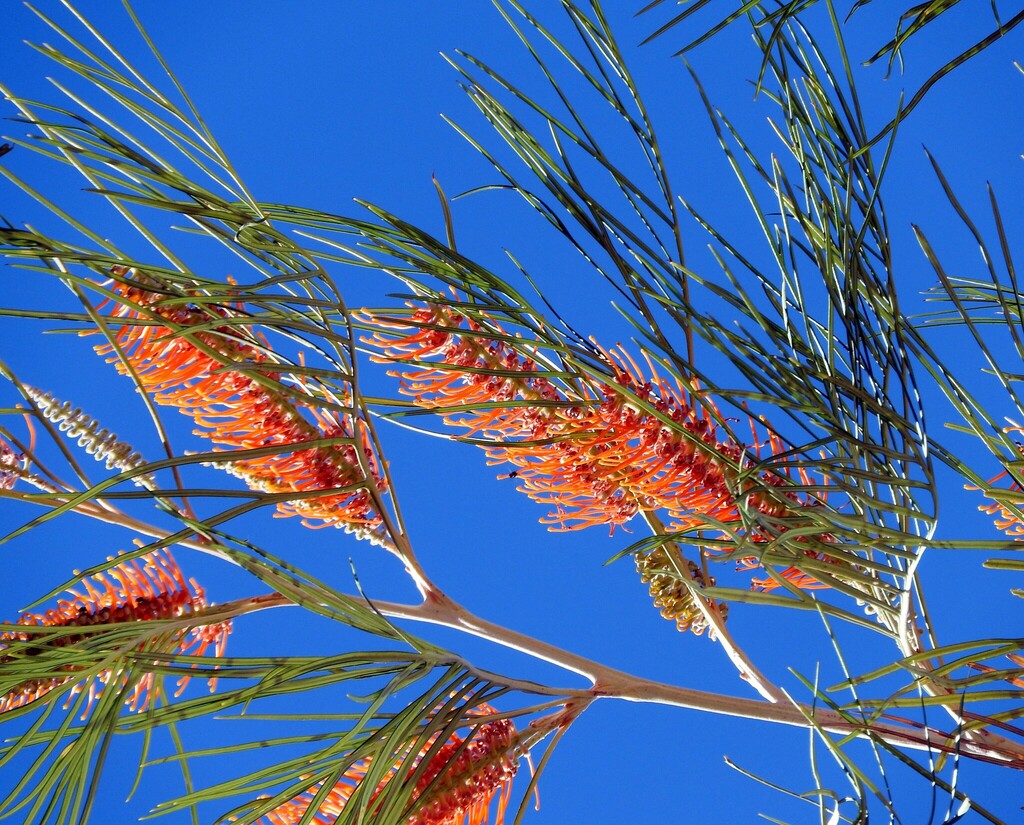
Grevillea pteridifolia
Grevillea pteridifolia is a species of flowering plant in the family Proteaceae and is endemic to northern Australia. It is also known by many common names, including golden grevillea, silky grevillea, fern-leaved grevillea, golden parrot tree, golden tree, manbulu, yawuny and tjummula. It is a shrub or tree usually with pinnatisect leaves, and bright orange-yellow or reddish flowers.
Del artículo Grevillea pteridifolia de Wikipedia (CC BY-SA), citado sección por sección
Descripción
Grevillea pteridifolia is a shrub or tree that typically grows to a height of 2–14 m (6 ft 7 in – 45 ft 11 in), or rarely a prostrate shrub. Its leaves are 100–450 mm (3.9–17.7 in) long and usually pinnatisect with 13 to 29 linear or very narrowly egg-shaped lobes 150–250 mm (5.9–9.8 in) long and 1–4 mm (0.039–0.157 in) wide. The edges of the leaves are rolled under, the exposed parts of the lower surface covered with silky hairs. The flowers are arranged in clusters on one side of a rachis 80–220 mm (3.1–8.7 in) long, the flowers at the base of the cluster opening first. The flowers are greyish-green to silvery on the outside, the inside and the style bright orange-yellow or reddish, the pistil 23–36 mm (0.91–1.42 in) long. Flowering occurs in most months with a peak from May to September and the fruit is a shaggy-hairy follicle 14–21 mm (0.55–0.83 in) long. Plants from Queensland are non-lignotuberous shrubs to small trees with smooth bark and lighter inflorescences than other forms. A prostrate form which spreads up to 5 m (16 ft) across is found on exposed areas near Cooktown in north Queensland. Plants from Western Australia and the Northern Territory grow as a rough-barked lignotuberous shrub to small tree. A population of this last form from Kakadu National Park has all-silvery leaves.
Wikipedia: «Description»
Distribución y hábitat
Grevillea pteridifolia is found from the Kimberley region of Western Australia, across the Northern Territory and into Queensland where it is found along the Great Dividing Range to the vicinity of Barcaldine. It is found in regions with wet summers, dry winters and 500 to 1,500 mm (20 to 59 in) annual rainfall.
Wikipedia: «Distribution and habitat»
En la mesa
Golden grevillea grows readily in warm climates, generally preferring extra water in summer and well-drained soils. The brittle branches can break in strong winds. Several popular garden grevilleas are hybrids between Grevillea pteridifolia and other species. Grevillea 'Sandra Gordon' is the result of crossing with G. sessilis. Grevillea 'Honey Gem' is a cross with a red form of Grevillea banksii. Similar to 'Honey Gem' is G. 'Winter Sparkles', another hybrid of G. pteridifolia and G. banksii. The leaves were used as stuffing and as a herb when cooking emu by the Aborigines on Groote Eylandt, and used by early settlers to stuff pillows. A series of compounds with antibacterial activity, called the kakadumycins, have been isolated from a streptomycete recovered from G. pteridifolia.
== References ==
Wikipedia: «Uses and cultivation»
Dónde vive
Avistamientos registrados
—
registros georreferenciados en GBIF, de museos, herbarios y observadores de campo.
Arrastra el globo para girarlo. Los puntos marcan dónde hay registros, no un mapa de distribución; más oscuro significa más registros.
En los depósitos
Buscando en los depósitos…
Todas las páginas que nombran Grevillea pteridifolia en la Biodiversity Heritage Library →
Esta página se compone en directo a partir de iNaturalist, GBIF, Wikipedia, la Source Library y el Internet Archive. Aún no forma parte del códice editado a mano. Taxón 369442 de iNaturalist.